What PTO Hours and Hydraulic Pump Wear Tell You Before You Bid
Auction listings for hook lift trucks for sale at auction exist to move inventory, not to record mechanical condition. Most give a model year, an odometer reading, and a load rating: how far the truck drove, not how hard it worked. On a hook lift, the load-handling system usually takes more punishment than the road does.
Two numbers close that gap: PTO hours and hydraulic pump wear. PTO hours count the time the power take-off has driven the hydraulic system, through every container lifted, dumped, and set down. Pump wear shows how much service life is left in the part that turns engine power into lifting force.
Neither number shows up in a typical listing, but both can be recovered from ECU data, a photo of the hour meter, and a short walkaround before the sale.
This guide shows commercial buyers how to read both from the data an auction actually provides, then combine them with subframe and lift cylinder checks to size the repair exposure and the real value before bidding.
Reading PTO Hours Like a Fleet Manager
A power take-off (PTO) diverts power from the truck’s powertrain to run an auxiliary device. On a hook lift, that device is the hydraulic pump behind the lift and tilt cylinders that load, dump, and set down roll-off containers. Without a PTO the hook is just metal; with one, the truck works.
Auction trucks use one of two setups. An engine PTO bolts to the front of the engine and runs the pump off the crankshaft pulley. A transmission PTO mounts on a side port of the gearbox and takes power from the transmission’s internal gears. Both do the job, but they wear and fail differently, so it is worth knowing which one you are looking at.

PTO hours are tracked on their own meter and do not move with the odometer. A truck can pile up thousands of PTO hours while the mileage stays low, because the pump runs whenever the hook is working, even when the wheels are not turning.
Picture the cycle: the truck backs into a tight city block, raises and lowers the hook, idles under load, then pulls a few hundred feet to the next bin. The odometer barely moves; the pump, cylinders, and hydraulic oil work the whole time. That on-and-off pattern is the duty cycle, and it predicts hydraulic wear better than mileage does.
A high PTO-to-mileage ratio is therefore a warning. It means constant hydraulic cycling, long idle stretches under load, and more wear on the pump, seals, and lift cylinder. Two trucks with the same odometer can have completely different hydraulic histories, and the PTO hours meter is the one that tells you which is which.
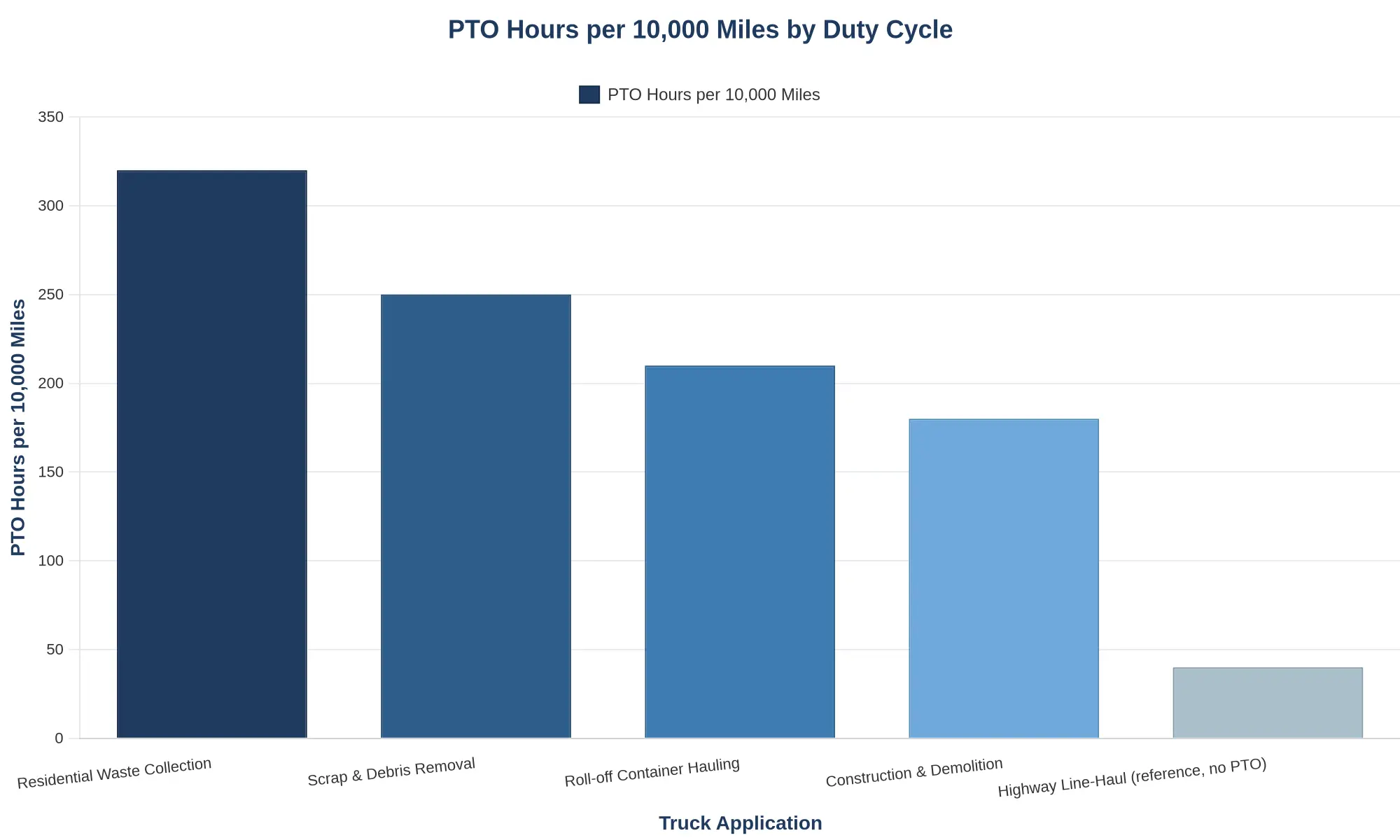
Compare PTO hours with the odometer, then compare both with the duty cycle the truck was built for. The chart above shows the range: a highway line-haul tractor might log 40 PTO hours per 10,000 miles, while a residential waste truck climbs past 320. That gap is the truck’s life story.
Before bidding, pair the hour reading with a hands-on inspection of the subframe and lift cylinder so the numbers and the metal agree.
PTO Hours Interpretation Reference Table
This table turns a PTO hour reading into a quick judgment about how hard the hydraulic system has worked relative to the odometer. Ratios are given in PTO hours per 10,000 odometer miles, the same unit as the chart above; convert quoted figures before comparing. The higher the ratio, the more time the pump, PTO clutch, and lift cylinder have spent under load.
| PTO Hours vs Odometer Ratio | Likely Usage Pattern | Inspection Priority |
|---|---|---|
| Low: under 50 PTO hours per 10,000 mi | Light, intermittent container handling; hydraulic system largely underused | Low – look for age-related seal and fluid degradation rather than cycling wear |
| Moderate: 50-150 PTO hours per 10,000 mi | Balanced fleet duty; regular roll-off service across mixed routes | Standard – confirm the pump shows normal, even wear |
| High: 150-300 PTO hours per 10,000 mi | Heavy daily lifting; stop-and-swap waste or debris operations | High – inspect pump, lift cylinder, and PTO clutch closely |
| Extreme: over 300 PTO hours per 10,000 mi | Near-continuous cycling; demanding C&D, scrap, or demolition work | Very high – budget for a pump rebuild or replacement |
| Discrepancy between listed and reported hours | Rolled-back meter, replaced cluster, or a PTO clock that has been reset | Critical – treat hour data as unverifiable and price in full hydraulic risk |
A high or extreme ratio means digging into the whole hydraulic package, not just the pump. Pair this table with a structured set of subframe and lift cylinder checks to connect hour-based wear estimates to the parts that actually fail and drive repair costs.

Hydraulic Pump Wear: The Silent Cost Driver
On a used hook lift, the hydraulic pump is the most expensive component to ignore. It fails quietly, sets no warning light, and often does not leak until the day a bin will not come up. For anyone walking an auction lot, reading hydraulic pump wear correctly separates a $40,000 workhorse from a $40,000 yard ornament.
Why PTO Hours Are the Wear Clock
The pump turns only when the PTO is engaged, so PTO hours, not odometer miles, measure its wear. A truck that idled between jobs and covered thousands of road miles can show modest engine hours while its pump has cycled through years of lifting. High PTO hours mean more shaft rotations, more clearance between gears or pistons and their bores, and falling volumetric efficiency. Lifting capacity drops gradually, well before the pump fails outright.
What to Check During an Auction Preview
- Slow lift and lower cycles. Time a full raise and lower against the spec sheet. A worn pump bleeds pressure through its internals, so cycles stretch out.
- Whining or cavitation noise. A high-pitched whine under load points to aeration or a starved inlet, often a clogged filter or low fluid. Cavitation pits the pump from the inside.
- Excessive reservoir heat. Feel the tank after a few cycles. A pump bypassing internally turns pressure into heat quickly.
- Foam or discolored fluid. Milky or dark fluid means contamination, water ingress, or oxidized oil, all of which speed wear.
- External seepage around seals. Damp bellies, weeping shaft seals, and residue at fittings suggest a pump that has run hot and stressed.
Pair this walk-around with a full subframe and lift cylinder check so you are judging the whole hydraulic circuit, not just the pump.
Gear vs. Vane vs. Piston: Different Wear, Different Cost
| Pump Type | Typical Failure Pattern | Effect on Lifting Capacity |
|---|---|---|
| Gear | Wear at gear tips and side plates; efficiency falls fast after high PTO hours | Noticeable loss of pressure and lift speed under heavy bins |
| Vane | Vane tip and rotor slot wear; moderate efficiency loss | Gradual capacity drop; sluggish on the heaviest containers |
| Piston | Barrel, bore, and shoe-plate wear; slowest decline | Holds pressure longest; near-full capacity even with high hours |

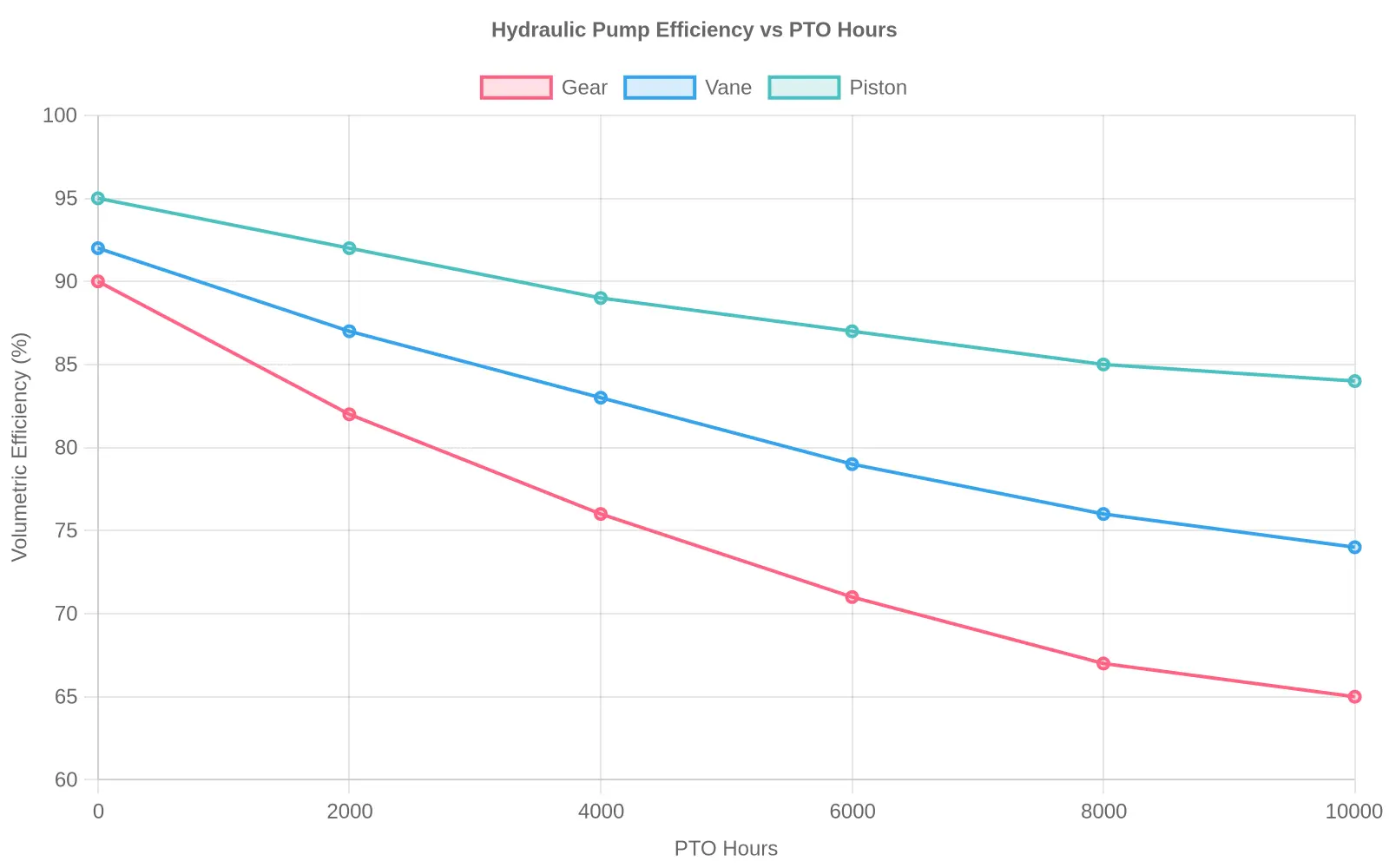
Gear pumps are cheap and durable but lose volumetric efficiency fastest, so a high-hour gear-pump truck may struggle to hoist a fully loaded roll-off. Vane pumps fall in the middle. Piston pumps cost the most up front and hold pressure longest, which matters most when a container is over spec.
Bottom Line Before You Bid
Count PTO hours, listen for cavitation, feel the reservoir, read the fluid, then match the pump type to the loads you actually run. High PTO hours alone are not a reason to pass. Hydraulic pump wear that shows up on the lot is a repair you pay for after the hammer drops.
Reading PTO Hours as a Wear Proxy
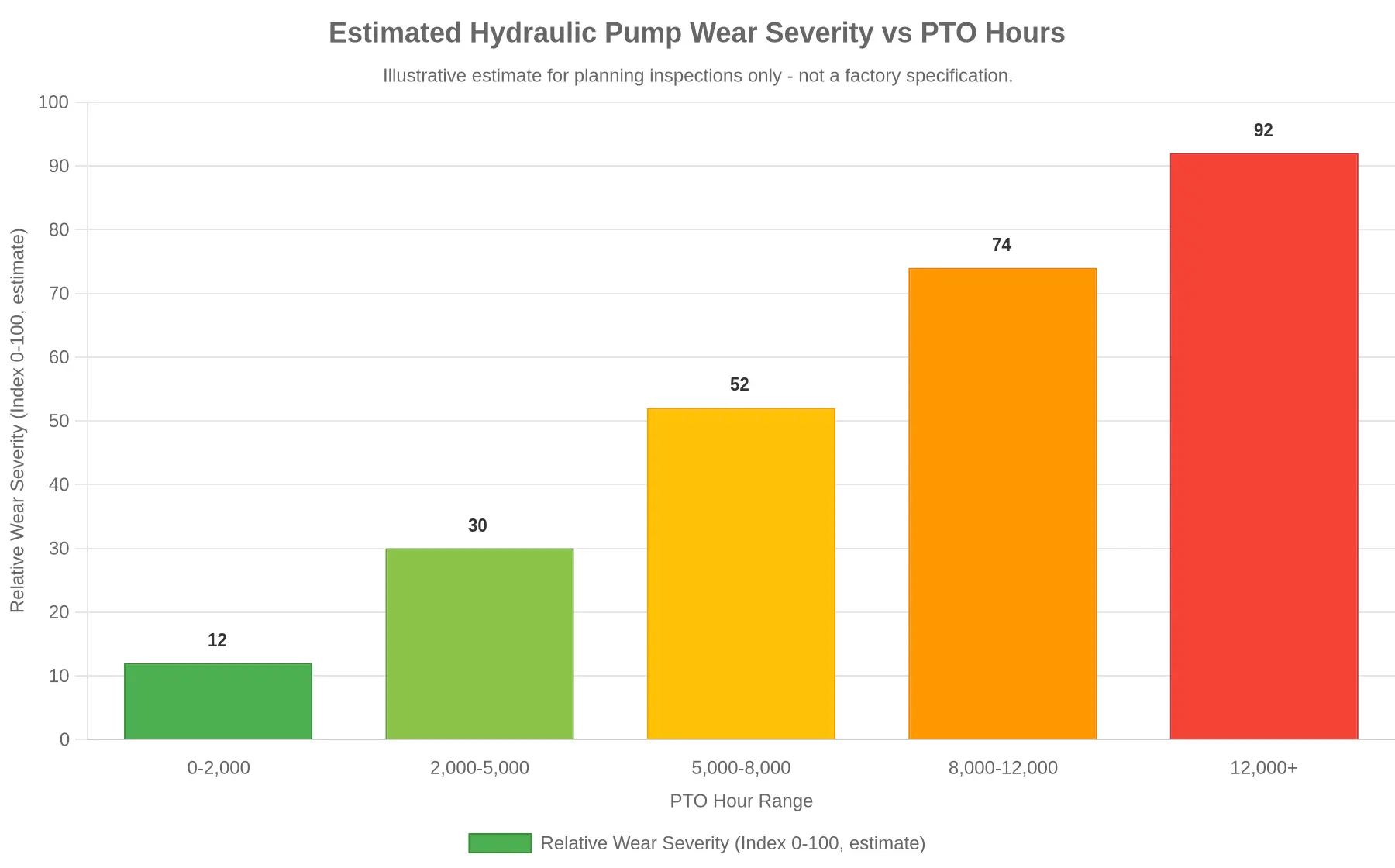
When you compare trucks at auction, lifetime PTO hours give you a rough map of expected pump wear. Treat it as a map, not a verdict: the meter says how much work the pump has done, not how well it was maintained.
The chart below is an illustrative planning estimate, not a factory specification. Use it to decide where to aim your inspection as the hours climb, and which trucks deserve a closer look before you bid.
Turning the Chart Into a Bid Strategy
Higher bars mean a higher probability of internal wear: case clearance opening up, internal leakage, slower cycles, hotter oil. They do not mean the pump is failing. A well-maintained 10,000-hour truck can outperform a neglected 3,000-hour one, so pair the hour reading with a live function test.
| PTO Hour Band | Relative Wear Severity (Estimate) | Inspection Focus Before You Bid |
|---|---|---|
| 0 – 2,000 | Low (around 12) | Baseline function test, check for leaks, verify cycle times |
| 2,000 – 5,000 | Low to moderate (around 30) | Inspect hoses and fittings, review service records |
| 5,000 – 8,000 | Moderate (around 52) | Flow and pressure test, examine pump mount and PTO drive |
| 8,000 – 12,000 | Elevated (around 74) | Oil analysis, pump rebuild history, cylinder seal condition |
| 12,000+ | High (around 92) | Assume rebuild budget, negotiate price accordingly |
Why Cycle Time Beats a Single Number
Read the meter, then time the lift and lower cycle yourself. A pump that takes noticeably longer than it should, whines under load, or runs hot is leaking internally, even if the hours look reasonable. Because the pump shares duty with the rest of the hoist, verify the supporting structure too: subframe and lift cylinder checks keep a healthy pump from being undermined by a cracked subframe or a tired cylinder.
Practical Takeaways
- Below 5,000 PTO hours: wear is usually light; a thorough function test is often enough.
- 5,000 – 8,000 hours: budget for a pressure and flow test as a condition of purchase.
- 8,000+ hours: factor a potential pump rebuild or replacement into your maximum bid.
- Always compare the hour meter against the year of manufacture, service records, and the physical condition of hoses, coolers, and the PTO drive itself.
Used this way, PTO hours are an early-warning signal: they tell you which trucks need a deeper mechanical review and which you can approach with more confidence.
Pre-Bid Inspection Checklist
A hook lift body often outlives two or three chassis, so the PTO and hydraulic story matters more than paint. Work through the list below at the preview and you will bid on evidence rather than guesswork. Pair it with a closer look at the subframe and lift cylinder checks for a complete condition snapshot.
- Cross-check the PTO hour meter against the odometer and model year to estimate average hook lift usage per mile, then flag any reading that looks rolled back, disconnected, or too high for the mileage.
- Listen to the pump at idle and at full throttle from a few feet away. A steady, low hum is healthy; whining, grinding, chattering, or a mechanical rattle points to cavitation, worn gears, or failing bearings.
- After the system has run a few minutes, check the fluid through the sight glass or on the dipstick. Clean amber oil is right; milky, black, or burnt-smelling fluid means moisture, overheating, or clutch-material contamination.
- Feel the reservoir and return lines after cycling the system. Fluid too hot to touch comfortably suggests a struggling pump, a restricted cooler, or a bypassing valve.
- Check every seal, fitting, and hose along the subframe, lift cylinder, and pump lines for weeping, cracking, chafing, or oily residue a seller may have recently wiped down.
- Run the lift cylinder through a full raise and lower. Watch for jerky motion, load drift, slow extension, or a piston rod that is scored, pitted, or slightly bent.
- Cycle each control function – lift, tilt, and any bin lock – and confirm smooth, immediate engagement with no sticking spools, delayed response, or spongy levers.
Photograph what you find and note the time. A small leak is leverage at the block tomorrow; a clean, quiet system is evidence you can bid on.
Turning Raw Indicators Into a Bid Number
PTO hours and pump wear are two halves of one story. The hour meter records how much hydraulic work the truck has banked: every lift, dump, and winch cycle. Pump readings show how efficiently the system still turns that work into pressure and flow. A low-hour truck with a screaming pump is a liability; a high-hour truck running cool, clean, and to spec may be the best value on the block. The job is to merge both into one defensible bid figure.
Baseline first: flow and pressure at operating temperature, plus case-drain leakage. Stack those against the PTO clock and the visible structure. A worn pump rarely travels alone, so check the subframe and lift cylinder for cracks, elongation, and pin wear before trusting the hydraulics. When the readings line up, price the truck against a realistic repair reserve.
A simple matrix turns the raw data into an action:
| PTO Hours | Pump Evidence | Estimated Remaining Service Life | Bid Action |
|---|---|---|---|
| Under ~3,000 | Flow and pressure at spec, low case-drain leakage | Long – 5+ years of normal duty | Bid aggressively; fund only routine service |
| ~3,000-6,000 | Slight flow fade, minor leakage, warm but stable | Moderate – 2-3 years | Bid with a rebuild reserve built into your number |
| Over ~6,000 | Heavy leakage, metal in fluid, pressure won’t hold | Short without intervention | Budget a full pump rebuild before bidding |
| Over ~6,000 | Same as above plus structural cracks or contamination | Uncertain | Walk away – the repair can exceed the truck’s value |
The rule: subtract a realistic rebuild cost from the fair market value of a healthy truck of the same spec, and never bid above the result. If that number is below what the seller will accept, walk. Buyers who price the pump before the auction’s momentum takes over come out ahead.
The Bid Decision at a Glance
Before you raise a paddle or click “confirm bid” on a used hook lift, four checkpoints carry the decision: verify PTO (power take-off) hours, assess hydraulic pump wear, translate the findings into an estimated repair cost, then compare that number against your ceiling to reach the bid or pass call.

PTO hours set the baseline, pump condition confirms or challenges it, and the combined picture decides whether the truck earns a number or a pass. If either check lands in the red, the decision is a pass. If both hold up, you have what you need to price the truck. Treat any step you cannot verify as a reason to slow down.
Matching Indicators to Your Fleet’s Duty Cycle
Raw PTO-hour counts and pump readings mean little on their own. A number that looks healthy in one application can flag a near-worn unit in another. The threshold you accept has to be anchored to the work the truck will actually do: its duty cycle, load profile, and operator model.
How Duty Cycle Resets the Thresholds
Waste hauling. Residential and commercial routes run high-frequency, moderate-load cycles: many short bin swaps per shift with consistent, predictable payloads. The PTO engages often and the oil stays warm, so moderate pump wear is tolerable, but hours pile up fast. Judge these units on hours per operating year rather than a lifetime total, and confirm a sound match between bin size and chassis length, since oversized bins on a light chassis exaggerate pump stress.
Construction and demolition (C&D) debris removal. C&D loads are heavy, abrasive, and awkwardly shaped, and they shock-load the lift cylinder and pump. Peak pressures spike and contamination builds faster, so the PTO-hour ceiling should be lower and the wear tolerance stricter than for clean waste service.
Scrap handling. Dense ferrous scrap is the harshest profile of the three: extreme payloads, hard dump impacts, punishing duty ratios. Even modest pump scoring is a red flag, and you should assume shortened cylinder and seal life.
| Duty Cycle | Load Profile | Practical PTO-Hour Ceiling at Purchase | Pump Wear Tolerance |
|---|---|---|---|
| Waste hauling | Frequent, moderate, predictable | Higher (judge hours per year) | Moderate |
| C&D debris | Heavy, abrasive, shock-loaded | Moderate | Low |
| Scrap handling | Extreme payloads, high impact | Lowest | Very low |
Weighing Replacement Pump Availability
Wear tolerance depends on serviceability. Before accepting a wear level, check whether the pump is still supported by the OEM, whether a quality aftermarket equivalent exists, and what the lead time and price actually are. A fleet running several identical units can justify stocking a spare and tolerate more wear; a one-off or discontinued model makes even minor scoring a gamble, because a single failure can sideline the truck for weeks.
Single-Driver Operations and Hydraulic Responsiveness
When one driver runs the whole truck, no second operator absorbs slow cycles. A responsive hydraulic system becomes a productivity asset: every lagging control action and every extra second waiting on the lift is lost time, and it compounds across dozens of swaps a day. For these operations, a fresh pump, clean valve body, and well-matched cylinders are worth more than they would be in a multi-operator yard. Owners comparing system designs can read hooklift versus cable hoist for single-driver bin swapping to see how hydraulic responsiveness shapes real cycle times before committing at auction.
Final Takeaway for Auction Buyers
Buying a hook lift at auction rewards whoever reads the iron, not just the sticker. Two indicators should anchor every bid: PTO hours and hydraulic pump wear. High PTO hours show how much real duty the hydraulic system has absorbed. Pump wear, found through pressure testing, flow checks, and inspection of the casing and drive coupler, shows whether the lift is still strong or already on borrowed time. Together they turn a listing’s vague promises into a defensible bid ceiling.
On-site inspection confirms what listings leave out. Cold-start behavior, leak trails, cylinder scoring, and frame condition rarely make it into an auction description, yet they decide whether a truck earns its keep. Check the subframe and lift cylinder checks before committing money.
Then connect the data to your own duty cycle. A truck on tight city routes hauling light bins has a very different wear profile from one dragging demolition and scrap debris. Match the numbers to the work and the capital budget holds: fewer surprise failures, less downtime, and a fleet that keeps rolling.
CRRC Trucks builds special vehicles, and every unit leaves the line under a quality system that treats durability as a specification rather than a sales point. For operators who buy carefully and inspect hard, that is what makes the next auction win worth having.