How Container Tare Weight Consumes Rated Lift Capacity
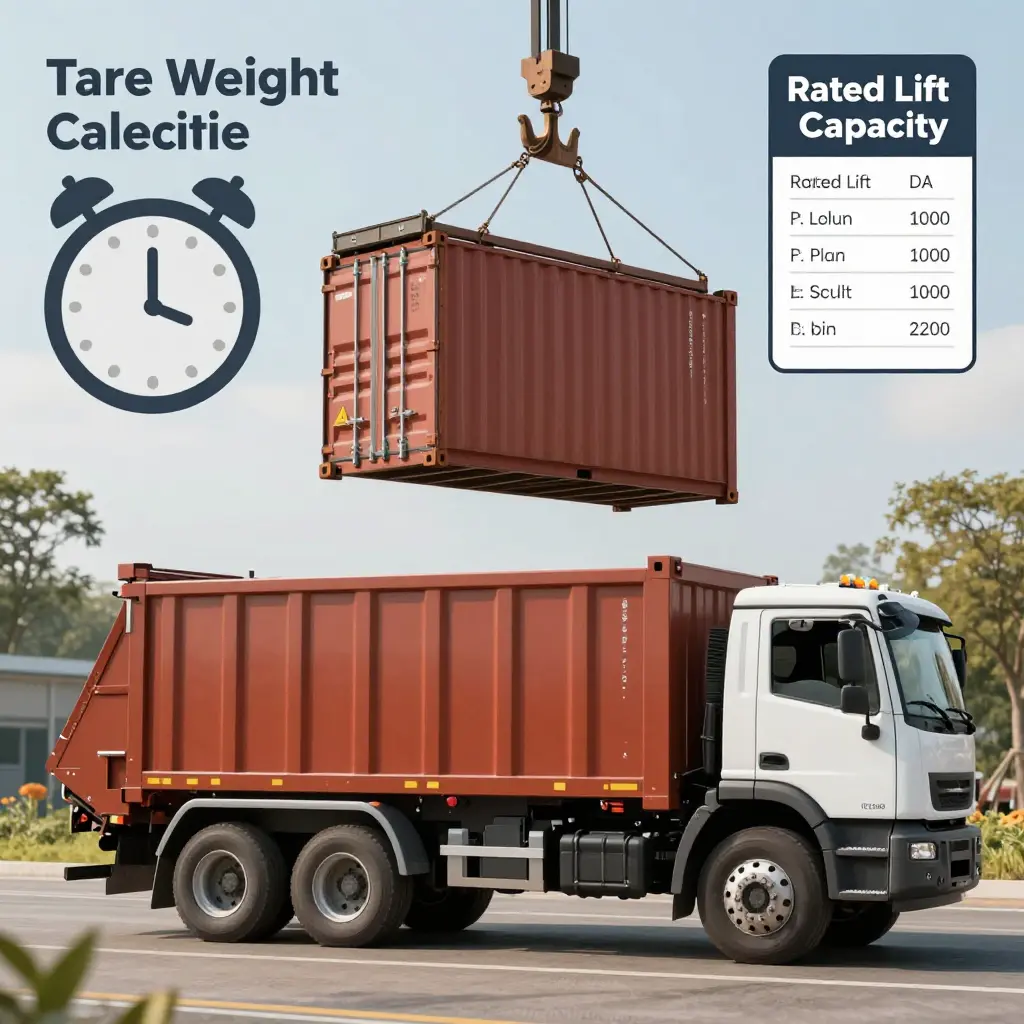
Rated lift capacity is the maximum combined mass a hook lift hoist, subframe, and lift cylinder are built and certified to lift through a full pick-up, dump, and tip-over cycle. The rating covers the whole load: the container tare weight plus everything inside the box. Every pound of container steel comes off usable capacity before the first cubic yard of debris goes in.
Three numbers get confused in load calculations, and they need to stay separate:
- Tare weight – the empty, wet mass of the container as delivered: shell, floor, understructure, hoist bar, rollers or slide pads, lid, and paint.
- Rated lift capacity – the certified maximum total mass the hoist system can lift and dump.
- Payload – the net mass of material the box may carry, mechanically and legally, equal to rated lift capacity minus container tare weight.
The relationship is a straight subtraction:
Payload = Rated lift capacity – Container tare weight
A 20 cu yd box with 7-gauge walls over channel crossmembers might tare at 4,500 lb. On a 26,000 lb rated lift that leaves about 21,500 lb of hook lift truck payload; the empty structure has already used up roughly 17% of the rating. Switch to a 1/4 in abrasion-resistant demolition body at 6,200 lb and payload drops to 19,800 lb, with nothing changed on the hoist.
What Actually Drives Tare Weight
- Construction material: mild A36 steel is the baseline. Abrasion-resistant grades such as 450/500 Brinell plate wear longer at the same thickness, so a builder can go thinner for the same service life.
- Reinforcement: top rails, vertical stiffeners, reinforced bulkheads, hoist frames, and bubble tails add mass that never hauls revenue material.
- Wall thickness: 10-gauge sheet, 3/16 in, and 1/4 in plate can differ by about a third or more in shell mass at identical external dimensions; 1/4 in plate is close to twice the weight of 10 gauge.
- Floor design: 7-gauge sheet over formed channel crossmembers, 3/16 in plate on tight centers, and solid 1/4 in wear plate produce three very different tare figures on the same footprint.
Tare Weight Across Standard Container Sizes
| Container size | Typical tare weight (lb) | Net payload on a 26,000 lb rated lift (lb) |
|---|---|---|
| 10 cu yd | 2,200 – 2,800 | 23,200 – 23,800 |
| 12 cu yd | 2,600 – 3,200 | 22,800 – 23,400 |
| 15 cu yd | 3,000 – 3,800 | 22,200 – 23,000 |
| 20 cu yd | 3,800 – 4,800 | 21,200 – 22,200 |
| 30 cu yd | 5,000 – 6,300 | 19,700 – 21,000 |
| 40 cu yd | 6,500 – 8,000 | 18,000 – 19,500 |
The ranges assume standard sheet-metal construction. Heavy-duty demolition and recycling bodies sit at the top of each band and often exceed it. Matching bin size to chassis length is therefore only half the decision; the other half is the tare penalty each box brings to the fleet.
Bottom line: container tare weight is a fixed deduction from rated lift capacity. Choosing the lightest box that still survives the application recovers the most legal, billable hook lift truck payload.
Container Tare Weight vs. Available Lift: A Side-by-Side Comparison
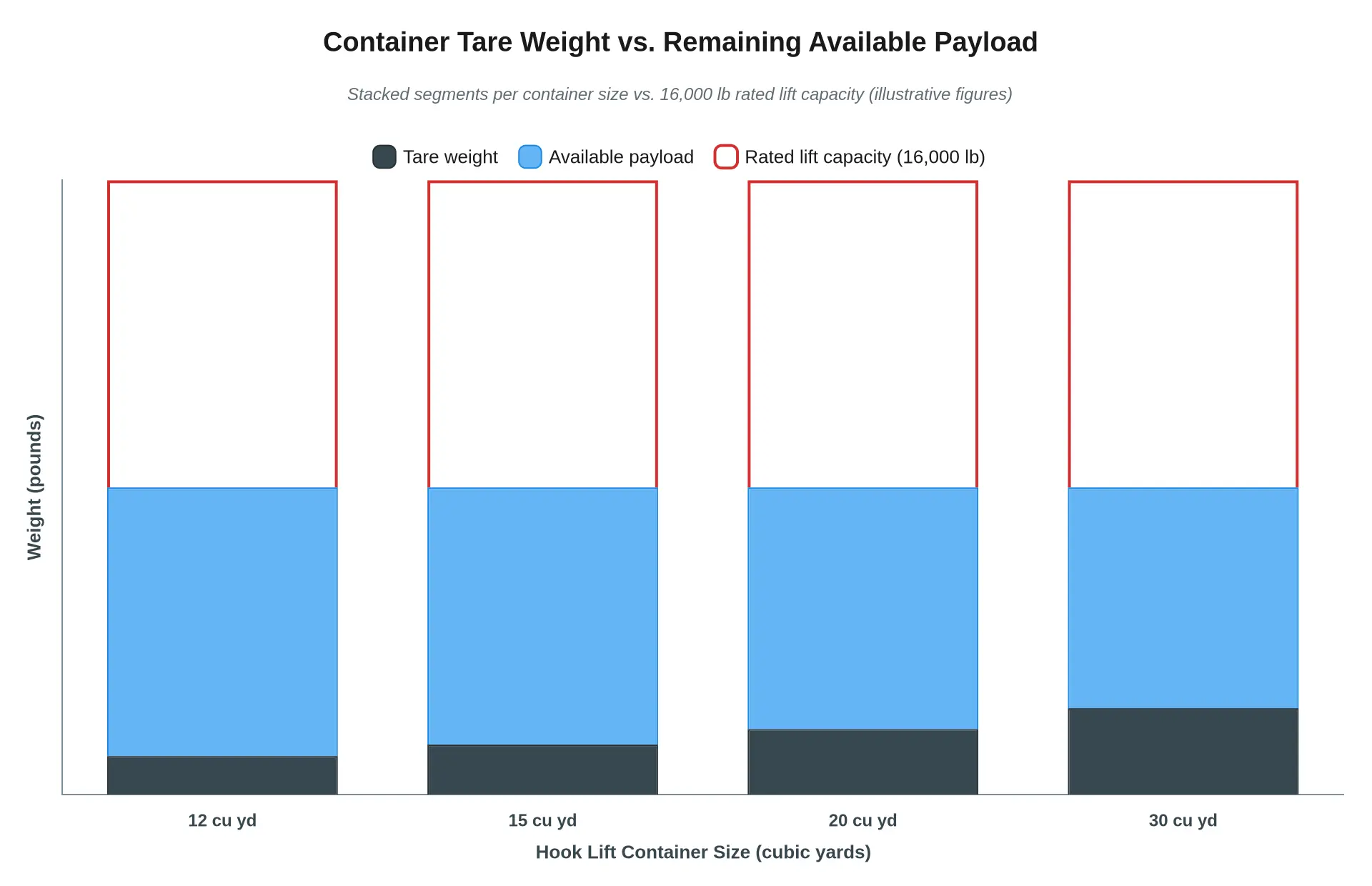
Before committing a container to a chassis, run the delta between what the lift system can safely raise and what the empty steel box weighs on its own. The table below uses a mid-size hook lift truck with a 16,000 lb rated lift capacity to show how tare weight cuts into the payload you actually get to sell. The figures are illustrative and rounded for engineering reference, not a substitute for your specific truck’s data plate.
Comparison Table (Illustrative Figures)
| Container Size | Typical Container Tare Weight | Rated Lift Capacity | Remaining Available Payload |
|---|---|---|---|
| 12 cu yd | 2,000 lb (907 kg) | 16,000 lb (7,257 kg) | 14,000 lb (6,350 kg) |
| 15 cu yd | 2,600 lb (1,179 kg) | 16,000 lb (7,257 kg) | 13,400 lb (6,078 kg) |
| 20 cu yd | 3,400 lb (1,542 kg) | 16,000 lb (7,257 kg) | 12,600 lb (5,715 kg) |
| 30 cu yd | 4,500 lb (2,041 kg) | 16,000 lb (7,257 kg) | 11,500 lb (5,216 kg) |
Caption: In each row, usable payload is the truck’s rated lift capacity minus the container’s tare weight, so heavier containers leave less room for material. The loaded combination still has to stay within the vehicle’s gross vehicle weight (GVW) limits, so the lightest container is not automatically the right match for every chassis.
Reading the Numbers
The pattern repeats at every size: the jump from 12-yard to 30-yard adds roughly 2,500 lb of container and removes about the same amount of sellable capacity. A 30-yard container carrying dense demolition debris can push a nominally “16,000 lb” system toward its limit sooner than operators expect, because dense material reaches the payload ceiling long before the box looks full. Payload planning and load distribution matter as much as the headline lift rating. The same principle applies when matching bin size to chassis length to keep the center of gravity inside the safe envelope.
Where the Load Really Lands
The tare-versus-lift gap decides which component absorbs the stress once the margin is gone. The lift arm and its pivot pin carry the container’s tare weight every cycle, and the hydraulic lift cylinder carries the combined tare-plus-payload load. Overshoot the available payload and the cylinder is working with an overload, not an empty box.

Quick Takeaways
- Tare weight comes off rated lift capacity before any material is added.
- Treat the remaining available payload as the working number; rated lift capacity is a ceiling, not a target.
- GVW and axle limits can be exceeded even with a light container once dense material is aboard.
- Density decides the real limit: heavy spoil, concrete, and scrap reach the payload ceiling long before the box looks full.
How to Calculate Usable Lift
The arithmetic is simple enough to run in your head before a container leaves the ground. Rated lift capacity is the gross working limit for the hydraulic system, subframe, and hook. Container tare weight is the empty mass of the bin. The difference is the mass you may place inside it.
Usable payload = rated lift capacity − container tare weight
Why a Heavier Container Shrinks Your Legal Load
The relationship is linear, which is why it catches operators off guard. A thicker body, reinforced floor, heavier rollers, or a permanently welded lid all raise the container tare weight, and every pound added there is a pound subtracted from usable payload. The rated lift capacity does not grow to compensate. Add 1,500 lb of tare and legal, safe carrying capacity falls by the same 1,500 lb.
Tare works against two limits at once. A hook lift must also respect the chassis gross vehicle weight rating (GVWR) and the individual axle ratings (GAWR), limits that cover the truck, the lifting equipment, the container, and the material together. A heavy container eats into payload twice over: once against the lift rating and again against the weight margin that governs road legality. Overshoot either figure and the truck is both unsafe and out of compliance. Treat container mass and chassis rating as one calculation, which is where matching bin dimensions to the correct chassis platform becomes essential.
A Worked Example
Consider a mid-range hook lift with a 20,000 lb rated lift capacity and a steel container with a 5,000 lb tare weight.
- Rated lift capacity: 20,000 lb.
- Subtract the container tare weight: 20,000 − 5,000 = 15,000 lb.
- That 15,000 lb is the maximum usable payload, provided the chassis GVWR still has that much headroom once the truck itself is accounted for.
- Swap in a heavier 7,000 lb container and usable payload falls to 13,000 lb – one ton less material on the same truck.
Choose the lightest container that meets the structural need, and subtract tare weight before assuming you can load to the full rating.
Factors That Change Effective Lift Capacity
A hook lift dumpster truck rarely works at the single number stamped on its data plate. The rated lift capacity is a designed maximum measured under ideal conditions, and field variables push the effective figure up or down. Engineers and fleet managers should treat the following as active inputs to every load calculation:
-
Container tare weight – The empty weight of the bin consumes part of the available capacity before any material is added, so a heavier container directly reduces the payload a hook lift dumpster truck can legally and safely raise.
-
Load density – Dense debris such as concrete or wet soil concentrates mass into a small volume, so rated lift capacity can be exceeded even when the container is only partially full.
-
Hydraulic system pressure – Pressure below spec produces less force at the cylinder, so a system running under its rated PSI cannot move the same tonnage.
-
Lift cylinder bore and rod size – A larger bore multiplies force for the same pressure, while rod diameter sets buckling resistance and the usable stroke under load.
-
Hook height geometry – The height of the hook above the frame changes the moment arm, which alters the mechanical advantage and the peak force required to tip a container onto the rails.
-
Center of gravity of the load – A load positioned far from the pivot increases the torque the cylinder must overcome, lowering the safe effective capacity below the nominal figure.
-
Subframe condition – Cracks, corrosion, or loose fasteners keep the subframe from distributing lifting loads, which is why subframe and lift cylinder checks matter when inspecting used equipment.
-
Chassis rear axle rating – Even with surplus strength in the lift mechanism, the rear axle and suspension must carry the transferred weight, so the lower of the two ratings governs the true limit.

Usable lift decreases steadily as container tare weight rises.
The First Component to Fail Under Overload
When a hook lift truck is loaded past its rated capacity, the lift cylinder is typically the first part to fail on overload. That comes from load-path geometry rather than chance. During the lift stroke, the cylinder carries the most concentrated hydraulic load in the assembly, converting pump pressure into the linear force that raises and tips the container.
Failure develops in a predictable sequence:
- Excessive pressure. Overloading drives system pressure to the relief setting, so the cylinder barrel and end caps run at the edge of their design margin.
- Rod buckling. The extended piston rod behaves as a slender column. Once the compressive load exceeds its critical buckling value, the rod deflects and bends permanently.
- Seal extrusion. Elevated pressure drives the rod and piston seals into the clearance gaps, tearing them and causing rapid fluid loss and lost lift force.
- Cylinder wall fatigue. Repeated overload cycles build hoop stress and start fatigue cracks in the barrel wall.
Why the Cylinder Reaches Its Limit First
The hook, subframe, and chassis are sized as structural members with broad safety factors and distributed load paths. The lift cylinder is different: it concentrates the entire lift force into a small cross-section of rod and bore and multiplies pressure directly through the piston area. It reaches its mechanical and hydraulic limit well before the heavier fabricated structures that merely react to the load. On a used unit, thorough pre-purchase subframe and lift cylinder checks help confirm that this component has not already been overstressed.

As the hook engages the container’s lift bar, the container’s tare weight resolves into a downward load that pivots the tilting frame and concentrates its full force on the hydraulic lift cylinder, making that rod and its mounting points the primary stress path during any lift.
Even a modest increase in container tare weight raises the cylinder’s working load more than operators expect, because the lever geometry between the hook, the pivot, and the cylinder multiplies the force. On a used unit, subframe and lift cylinder checks are the fastest way to confirm that this load path is still sound.
The Overload Failure Sequence: Warning Signs and Progressive Degradation
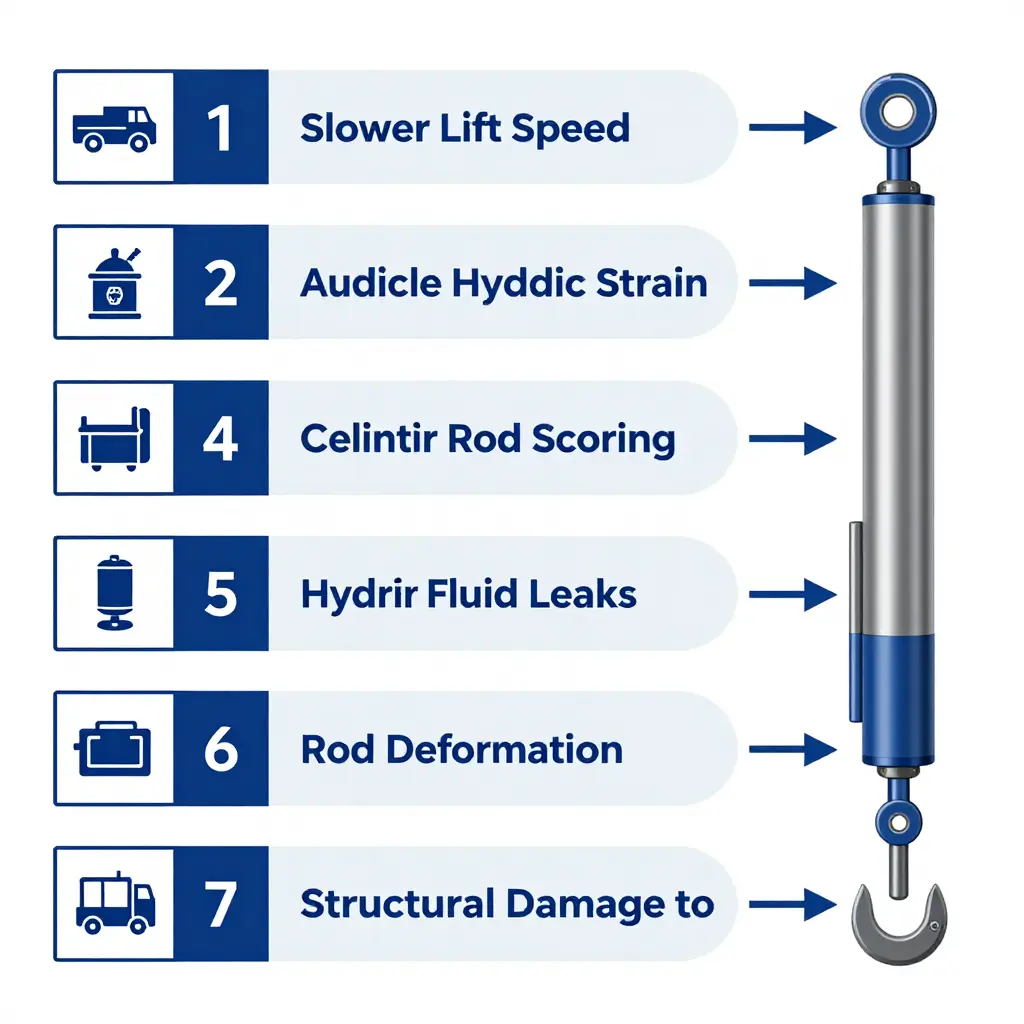
Under sustained overload, a hook lift truck does not fail all at once. Damage moves through a fixed sequence that starts with small performance losses and ends in structural failure. Catching a stage early keeps a minor symptom from becoming an expensive repair. Because the hydraulic lift cylinder absorbs most of the imposed load, it is almost always the first part to fail on overload.
-
Slower lift speed. The overloaded cylinder can no longer raise the container at its rated rate.
-
Audible hydraulic strain. The pump groans, whines, or labors under the higher pressure demand, which signals that the system is running past its intended design envelope.
-
Cylinder rod scoring. Abrasive contaminants and elevated side loads scratch the hard-chrome surface of the piston rod, speeding wear at the sealing interface.
-
Seal failure. The scored rod tears the rod seal and wiper, allowing internal bypass and letting the cylinder lose its hold on the load.
-
Hydraulic fluid leaks. Fluid escapes past the damaged seals, weeping or dripping at the cylinder gland and bleeding off system pressure.
-
Rod deformation. Once the cylinder can no longer carry the load, bending forces permanently deflect the piston rod and misalign the lift geometry.
-
Structural damage to the hook or subframe. With the cylinder compromised, the residual overload transfers to the hook and subframe, cracking or bending them until the truck is unsafe to operate.
Each stage feeds the next, so the earliest symptoms are the cheapest to act on. Before buying used equipment, review these subframe and lift cylinder checks to confirm the assembly has not already moved down this chain.
Matching Containers to Rated Lift and Protecting the Lift Cylinder
A hook lift truck is only as capable as the container it lifts. Rated lift capacity is an engineering limit, and container tare weight eats into it before any payload is loaded.
Verify Container Tare Weight Before You Buy
Tare weight is the empty weight of the container. Confirm it from the manufacturer’s spec plate or a certified scale; two bins of the same nominal size do not necessarily weigh the same.
Steel thickness, floor gauge, and reinforcement vary from one fabricator to the next. A heavier-than-expected bin erodes usable payload and pushes the lift system closer to overload. Start with matching bin size to chassis length, since hook geometry and container footprint have to line up with the frame before weight enters the calculation.
Confirm Rated Lift Exceeds Tare Plus Intended Payload
Rated lift capacity must exceed container tare weight plus the intended payload, with a safety margin left intact.
Do the subtraction up front and confirm the remainder covers the heaviest load you actually intend to haul. If it does not, the honest options are a lighter container or a higher-rated truck. System type matters here too, so a clear comparison of hooklift vs. cable hoist for a single driver swapping bins helps you pick the setup that fits your loads and your streets.
Inspect the Cylinder, Seals, and Hydraulic System Regularly
Under sustained overload, the lift cylinder is typically the first component to fail. Watch for rod scoring, seal weeping, and pressure loss, and check the hydraulic fluid for contamination or excess heat.
A torn seal lets fluid bypass internally and bleeds off lift force exactly when you need it most. Keep inspection and torque records current, and review the subframe and lift cylinder checks before any purchase or rebuild.
Protecting the cylinder costs less than replacing it. Weigh the bin, respect the rating, and inspect often.
Frequently Asked Questions
How does container tare weight affect rated lift capacity?
A hook lift truck’s rated lift capacity is the maximum gross weight the hoist and lift cylinder are engineered to raise, and it covers the empty container plus its payload together. Tare weight takes part of that envelope directly, so a heavier bin lowers the payload you can safely lift without exceeding the rating. Across different bin designs, tare weight can swing usable payload by several thousand pounds.
Does a heavier container reduce the legal payload?
Yes. Legal payload is governed by the chassis gross vehicle weight rating (GVWR) and axle limits, and container tare weight occupies part of that allowance whether the bin is loaded or empty. A heavier container therefore lowers the maximum payload you can carry while staying compliant, even when the truck’s structural rating is higher. Calculate payload against the regulatory limits, not just the hoist’s rated lift capacity.
Which component fails first on overload?
Usually the lift cylinder, specifically its rod or seal assembly, because it carries the highest concentrated load during the lift cycle. When the moment load exceeds the design limit, rod buckling, seal extrusion, or hydraulic surge damage tends to appear before distress in the subframe or hook assembly. Repeated overload can eventually crack the subframe mountings, but the cylinder normally shows the earliest sign of strain. Reviewing subframe and lift cylinder inspection points can catch this damage before it spreads.
Can the lift cylinder be repaired after overload damage?
It depends on the type and extent of the damage. Minor seal failures and scored rods can be rebuilt with new seals and wipers and a re-chromed or replacement rod, which restores full function. If overload has bent the cylinder tube or rod beyond tolerance, or cracked the barrel, the cylinder must be replaced rather than rebuilt to preserve safety margins. Always pressure-test a rebuilt cylinder before returning the truck to service.
How do you calculate the maximum safe payload for a hook lift dumpster truck?
Subtract the container tare weight from the truck’s rated lift capacity to get the maximum gross load the hoist can raise, then verify that figure against GVWR and axle limits. The lower of the two values, the hoist limit or the legal chassis limit, becomes your maximum safe payload. That dual check covers both structural safety and road-legal compliance.
The Bottom Line: Tare Weight and the First Part to Fail
Two engineering facts should stay with every operator. First, container tare weight is payload you pay for before any material is loaded. That empty steel frame comes straight out of a truck’s usable rated lift capacity, so a heavier empty container lowers the maximum load you can legally and safely lift.
Second, when a hook lift dumpster truck is pushed past its limit, the lift cylinder is typically the first component to fail. It carries the greatest concentrated load during the initial pull, and it tends to reveal weakness before the subframe, hook, or chassis do. The signs show up as a bent rod, a blown seal, or a hydraulic system that suddenly will not hold pressure.
What This Means for Your Fleet
- Verify tare weight and rated lift capacity before matching a container to a chassis.
- Use the actual empty weight, not the nominal spec sheet figure.
- Inspect the hydraulic lift system on a regular schedule, and treat cylinder condition as a leading safety indicator.
Match the right container to the right chassis and keep the hydraulics in good condition. For a closer look at how the subframe and cylinder behave under load, this breakdown of subframe and lift cylinder checks is worth reading.
Matching a container to a truck is an engineering decision: verified numbers and components built to take real punishment.