Payload Versus Axle Weight on a Rear Load Compactor: Why It Matters
A rear load compactor answers to two separate limits: the rated rear load compactor payload and the truck’s axle weight limits. They are related, but they are not the same number, and on a heavy residential route they seldom run out at the same moment.
Every chassis carries a Gross Vehicle Weight Rating (GVWR), the ceiling for total loaded weight, plus a Gross Axle Weight Rating (GAWR) for the front axle and another for the rear. How fast hauling weight builds on those axles depends on the body’s compaction ratio – how tightly loose residential waste is packed inside the hopper.
On most residential rear load routes the rear axle fills first. The body, hopper, and packing mechanism sit behind the rear axle, and densely compacted material puts its mass there. A truck can hit its rear GAWR with the payload rating still reading low. Lighter, bulkier waste flips the order: the volumetric payload rating fills while both axles stay legal.
Plan for both. Route density, compaction ratio, and the container mix move the payload-to-axle balance from one day to the next, so specifiers need to read GVWR and GAWR together instead of trusting a single headline capacity figure.
Payload Capacity vs. Axle Weight: The Fundamentals
Payload capacity and axle weight limits come from separate ratings. Treating them as one number is how trucks end up with overweight citations and worn components: a vehicle can be legal on total weight and still over on a single axle.
The Ratings That Define the Limits
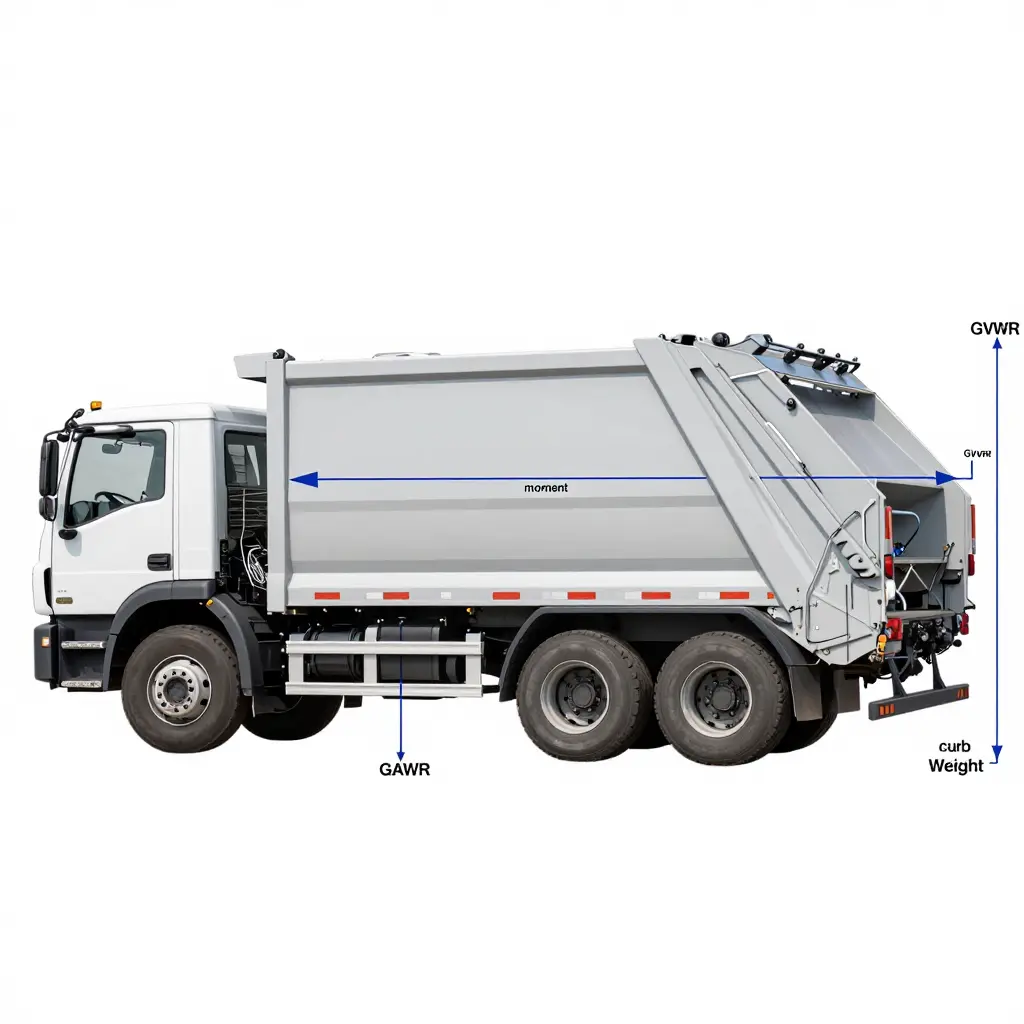
GVWR (Gross Vehicle Weight Rating) is the most weight the chassis is built to carry: the truck itself, fuel, operators, and payload combined.
Curb weight is the completed truck with no payload: chassis, mounted body, hydraulic system, and full fluids.
Rated payload is GVWR minus curb weight. On a rear load compactor, that leftover figure is what remains for refuse once the body and packer are on the truck.
Each axle has its own ceiling: the front axle GAWR and the rear axle GAWR (Gross Axle Weight Rating). The two ratings are independent, and capacity cannot be moved from one axle to the other.
How a Rear Load Compactor Loads the Rear Axle
A rear load compactor puts its mass behind the rear axle. The body, packer blade, and hopper sit aft of the rear axle centerline, so the rear axle carries them instead of sharing that weight with the steer axle.
As refuse builds up, the hopper and packer add more rear-biased load, pushing the center of gravity back and lengthening the moment arm over the rear axle. On a heavy residential route, that is why the rear GAWR usually fills before the front.
The Numbers at a Glance
| Rating | Definition |
|---|---|
| GVWR | Maximum total vehicle weight |
| Front GAWR | Maximum weight allowed on the front axle |
| Rear GAWR | Maximum weight allowed on the rear axle |
| Curb weight | Completed truck weight, no payload |
| Rated payload | GVWR minus curb weight |
With these five figures in hand, an operator can predict which threshold a route will reach first.
Weight Constraints That Govern Whether Payload or Axle Weight Fills First
On a heavy residential route, these are the figures that decide the outcome.
- GVWR (Gross Vehicle Weight Rating): The chassis builder’s hard ceiling for loaded weight. Once fuel, body, crew, and refuse reach it, the truck is full no matter how much room is left in the hopper.
- Front axle GAWR: The steer axle rarely binds on a rear loader, because the load sits behind the rear axle and tends to keep weight off the front. It still deserves a check, since a body mounted too far forward or a light chassis can push the front axle past its rating.
- Rear axle GAWR: Usually the limit that stops a rear loader. The compacted mass sits over the rear bogie and can exceed the rating while the bin still looks half empty.
- Tire load ratings: A correctly rated axle means nothing if its tires cannot carry the load, so compare per-tire capacity against real corner weights rather than a single gross figure.
- Legal bridge and weight limits: Public roads add their own axle and gross limits. A compactor that is legal at the yard can still be over on a posted bridge or a restricted residential street.
- Compaction ratio and refuse density: A higher ratio squeezes more mass into the same volume, so dense routes such as food waste or flattened cardboard can reach a weight limit long before the body fills.
- Body tare weight: The empty compactor body’s heft eats into available payload first, so a heavier body leaves less room for refuse before GVWR or an axle limit is reached – a factor to weigh when matching a body to its chassis.
Whichever of these limits is reached first is the one that defines your route’s usable capacity.
Axle Weight Distribution on a Rear Load Compactor
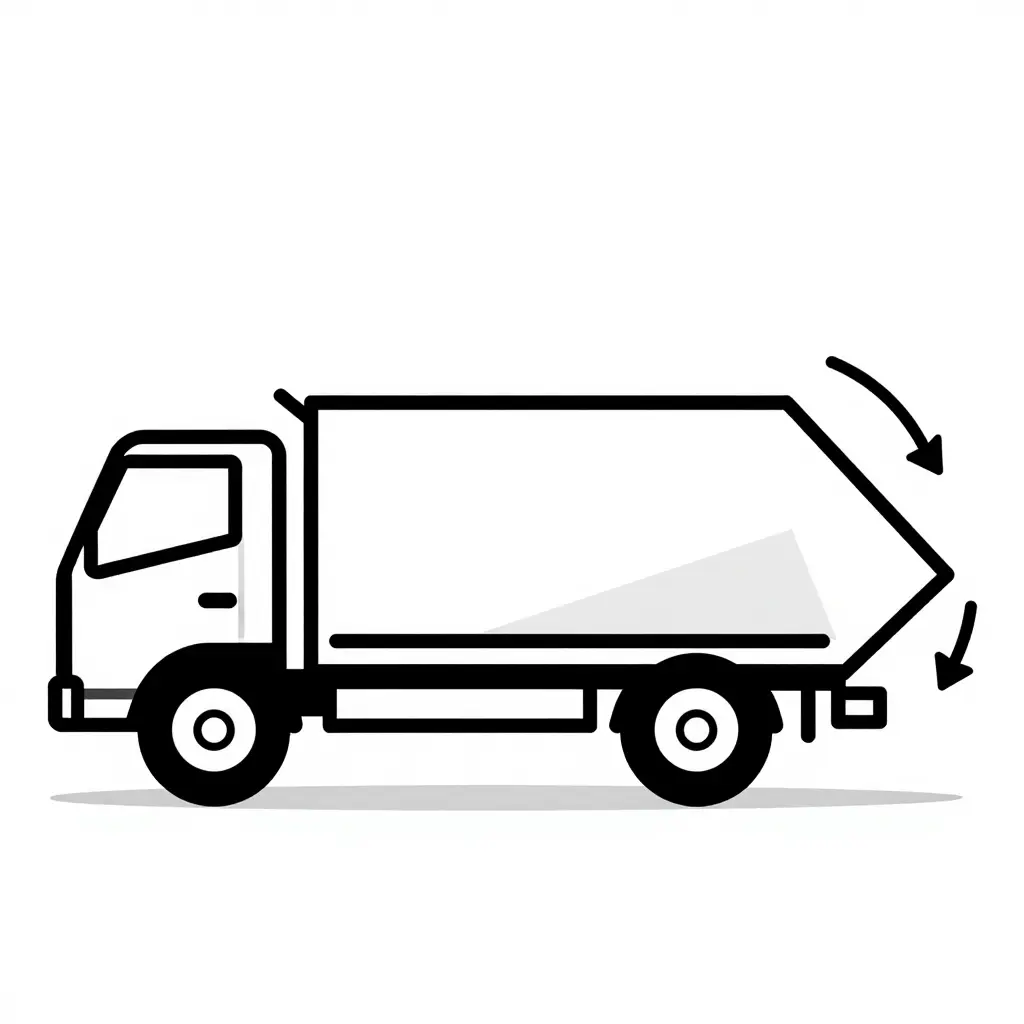
The schematic maps where a rear load compactor carries its weight. The front axle takes the cab and chassis plus part of the body; the rear axle takes the packer, the hopper, and most of the refuse. As the body fills from the rear forward, the center of gravity moves toward the tail, adding load to the rear axle and taking it off the front. That rearward shift is what decides whether a heavy residential route stays inside both axle ratings – and there the packer fills long before the truck reaches gross vehicle weight.
Compaction Mechanics and Their Effect on Payload
A rear load compactor’s payload is not one fixed number. It is the lower of two limits: the volumetric payload rating of the body and the legal gross axle weight rating (GAWR). Compaction mechanics decide which of those two a given route reaches first.
Compaction ratio is the volume reduction the packer achieves, stated as uncompacted volume to compacted volume. At 3:1, three cubic yards of loose refuse fit into one cubic yard inside the body. A higher sustained ratio puts more mass into each unit of body volume, so payload density rises with the ratio the packer can hold.
Packer blade force is the hydraulic force the blade applies to the load, given in pounds or kilonewtons at a stated system pressure. Blade force, cylinder bore, and pump pressure set how densely and evenly the refuse packs. More force means more mass in the body before the cycle ends.
Hopper capacity is the volume accepted per loading cycle. A larger hopper means fewer cycles, but it does not change the density the packer achieves; it only governs how much material enters the body per sweep.
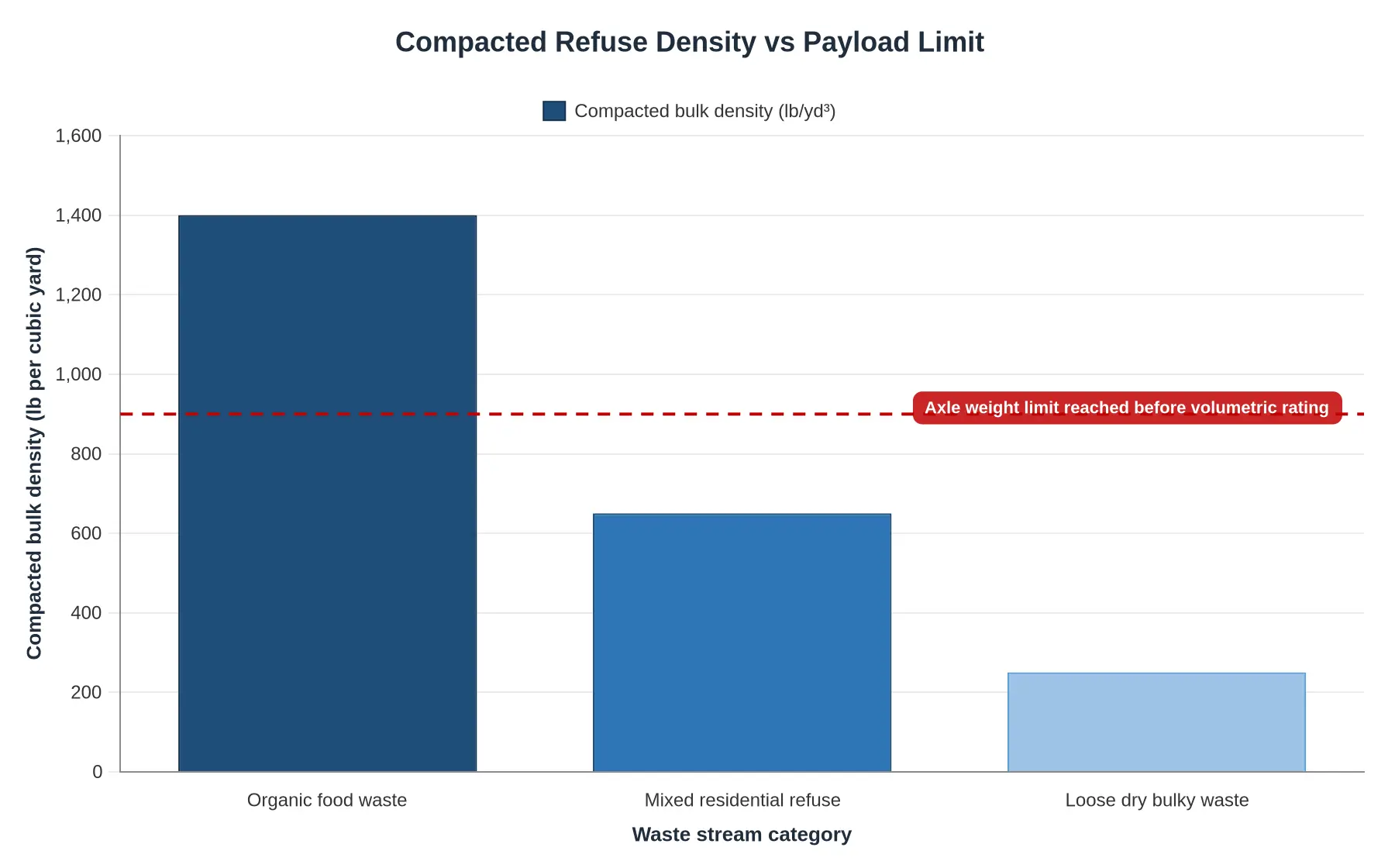
Density then sets the payload-versus-axle-weight balance:
| Waste stream | Compacted bulk density | Limit reached first |
|---|---|---|
| Organic food waste | 1,000-1,500 lb/yd3 | Axle weight (GAWR) |
| Mixed residential refuse | 550-750 lb/yd3 | Axle weight, near volume |
| Loose dry bulky waste | 150-300 lb/yd3 | Volumetric payload |
Organic food waste compacts to roughly 1,000 to 1,500 lb/yd3. A truck hauling it reaches its GAWR well before the volumetric rating is filled, so the body is often only part full when the axle is at its limit. Loose dry cardboard sits near 150 to 300 lb/yd3; there the body fills to its volumetric rating while axle weight stays under the legal maximum. Mixed residential refuse falls between the two, where both limits arrive close together.
The practical point: on a heavy residential route, compaction ratio and refuse density, not body volume alone, determine usable payload.
Payload Capacity Versus Axle Weight Ratings by Rear Load Compactor Configuration
The payload-versus-axle-weight tradeoff is where well-run residential routes quietly go overweight. Gross vehicle weight rating (GVWR) sets the legal ceiling, but the individual front and rear axle ratings – the GAWRs – decide how that weight can actually be spread across the chassis. A body can advertise a headline payload it can never legally carry once the packer, hopper, and rear-axle geometry are counted, so specifiers have to read the numbers together.
| Configuration | Rated Payload Capacity (lb) | Front Axle GAWR (lb) | Rear Axle GAWR (lb) | Curb / Tare Weight (lb) | Limit That Typically Fills First on a Heavy Residential Route |
|---|---|---|---|---|---|
| 16 yd3 body (single rear axle) | 8,000 | 14,600 | 23,000 | 29,500 | Rear axle GAWR |
| 20 yd3 body (single rear axle) | 11,000 | 18,000 | 26,000 | 33,000 | Rear axle GAWR / GVWR |
| 20 yd3 body (tandem rear axle) | 14,000 | 18,000 | 40,000 | 35,500 | GVWR |
| 25 yd3 body (tandem rear axle) | 16,500 | 18,000 | 40,000 | 38,000 | Rear axle GAWR on heavy routes |
| 25 yd3 body (tandem, heavy-duty spec) | 19,000 | 20,000 | 46,000 | 41,000 | GVWR |
How to read this table: Each row is a complete loading envelope, not a single number. Rated payload is the body’s nominal capacity; the front and rear GAWR columns give the most weight each axle may legally carry; curb/tare weight is what the truck already weighs empty. Subtract curb weight from GVWR to get the nominal payload, then check that payload against the axle ratings – the lower figure is what the truck can actually haul. On most heavy residential routes the rear axle GAWR, or the GVWR, is hit long before the body volume fills, which is why planners should weigh fresh routes instead of trusting cubic-yard ratings alone. Values shown are illustrative for comparison and will vary with chassis, body builder, and options selected.
What Fills First on a Heavy Residential Route
On a heavy residential route, the rear axle gross axle weight rating (GAWR) usually reaches its limit before the truck ever hits its rated payload. On dense trash, payload capacity is not the binding constraint. Rear axle loading is.
The reason is geometry. The packer, the compaction mechanism, and the growing load all sit behind the rear axle, so nearly every ton added to the body lands there instead of spreading across the chassis. The front axle offers little relief as the body fills, and rear axle weight climbs far faster than total vehicle weight. A route can therefore be “under weight” on paper and still be overloaded on the rearmost axle.
Density makes it worse. Refuse carrying mixed organics, food waste, and other compactable material can get dense enough that a 25-cubic-yard body nears its maximum mass long before the hopper looks full. At a compaction ratio of roughly 3:1 to 4:1, each cubic yard of loose material becomes a heavier, denser block sitting behind the axle.
Lighter, bulky-waste routes run the other way. Cardboard, packaging film, and dry bulky waste are low-density, so volume usually fills first: the body runs out of space while the axles still have margin. The packing cycle matters less because there is not enough mass to load the axle.
On heavy residential routes, spec and plan around rear axle GAWR, not rated payload. The rear axle is the real ceiling; operators should weigh routes, track axle loading, and treat rear GAWR as the practical limit for safe, repeatable collection.
Payload Fill vs Rear Axle Weight Fill: What the Curve Tells You
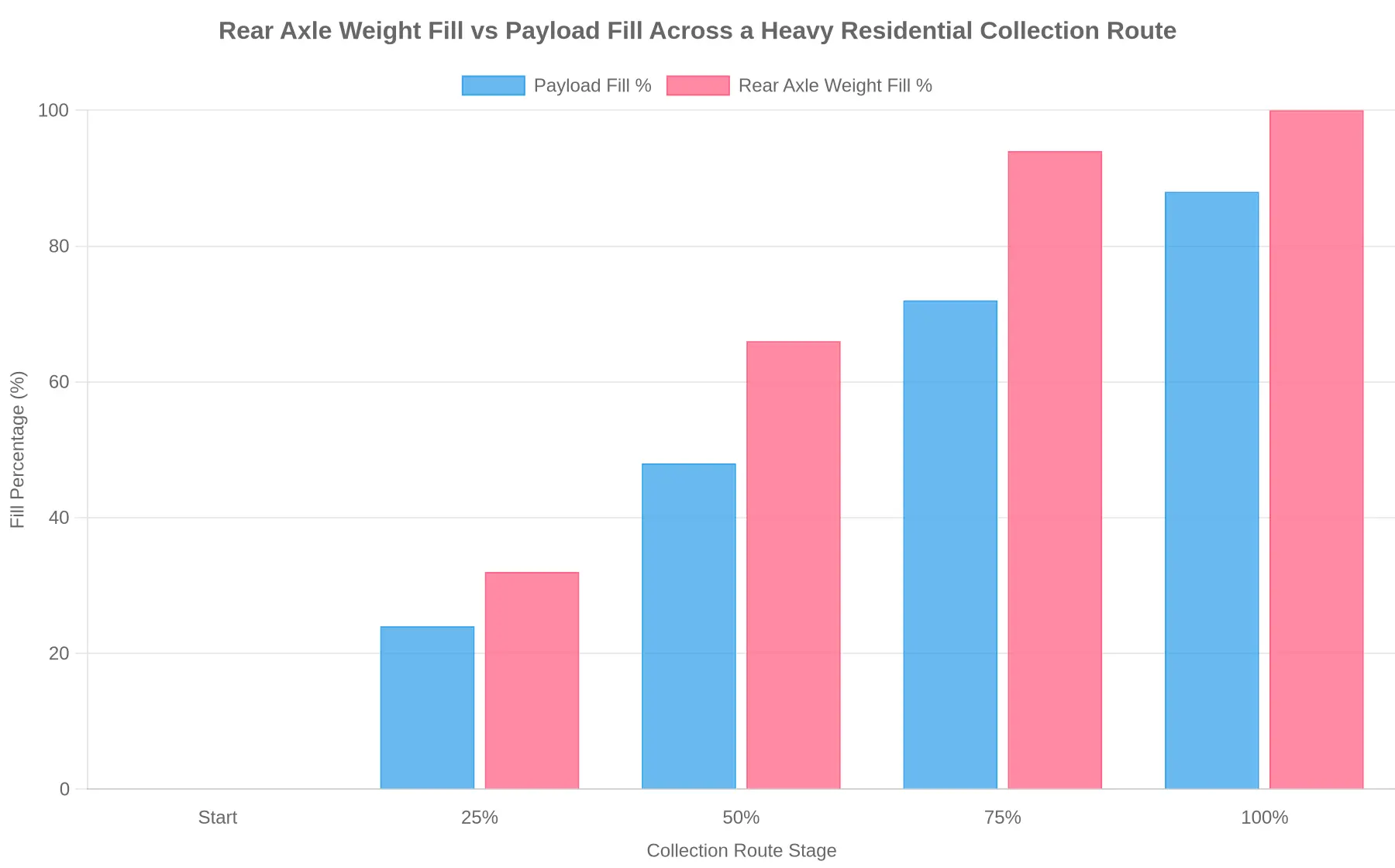
The grouped bar chart below puts two fill metrics side by side across the five stages of a heavy residential collection route. The blue bars show the payload fill percentage against the compactor’s rated Payload capacity; the red bars show the rear axle weight fill percentage against the vehicle’s legal rear axle weight limit.
Reading the Chart
The chart makes one point clearly: the rear axle weight limit is reached well before the payload rating. At the 75% route stage the rear axle is already at 94% of its legal limit while the compactor’s payload box sits at just 72%. Finish the route and the axle is pinned at 100% of its allowance, with the payload rating only 88% consumed.
In practice that leaves “empty space” in the payload box that can never legally be filled, because filling it would push the steer and rear axle loadings past their legal maximums. It is the difference between a volumetric limit and a mass distribution limit.
Underlying Chart Data
The table below holds the exact figures behind the chart, so you can reproduce it or change the staging percentages to match your own routes.
| Collection Route Stage | Payload Fill % | Rear Axle Weight Fill % |
|---|---|---|
| Start | 0 | 0 |
| 25% | 24 | 32 |
| 50% | 48 | 66 |
| 75% | 72 | 94 |
| 100% | 88 | 100 |
Why the Axle Runs Ahead of the Payload
Three things drive the gap in the chart:
- Rear-biased load placement. Carts and bags go to the curb, and the hopper and body cavity carry material toward the rear of the compactor where the ram panel and tailgate sit. That mass lands almost directly over the rear bogie, so the rear axle gains load faster than the box fills.
- Compaction density. As refuse is compacted, the denser, heavier material settles into the lower and rearward parts of the body, concentrating mass over the drive axles instead of spreading it along the chassis.
- Fixed axle ratings. The OEM rated payload assumes an idealized weight distribution that real collection routes rarely reach. The practical payload ceiling therefore usually comes from the rear axle, not the gross payload number on the spec sheet.
For fleet operators and specifiers, the rear axle weight limit should be the primary constraint when planning routes and specifying equipment. It is also why scale integration and on-board load sensing matter on dense residential routes.
Practical Implications for Route Planning
- Stop the route when the axle hits its limit, not when the box looks full. Full to the eye is not the same as legal on the scale.
- Weigh the truck, do not eyeball it. Axle fill climbs faster than payload fill, so a look in the box tells you little about compliance.
- Front-load heavy stops earlier. Taking the densest stops while the body is light lets material compact more evenly and can stretch usable payload a little before the rear axle caps out.
- Re-examine spec assumptions. If your routes are consistently axle-limited, a chassis with a higher rear axle rating, or a weight redistribution strategy, may give you more usable capacity than a larger body.
Route Planning and Loading Steps: Managing Payload vs Axle Weight
On a heavy residential route, a rear load compactor rarely fills by volume first. The rear axle more often reaches its gross axle weight rating (GAWR) before the body is full, so operators need a fixed process to keep every truck legal and productive. Work through these steps to determine whether a route fills by payload or by axle weight.
-
Confirm GVWR and GAWR ratings. Read the vehicle’s gross vehicle weight rating (GVWR) and each axle’s GAWR from the door placard and OEM spec sheet. These hard limits, not the body’s cubic-yard capacity, set the legal ceiling.
-
Weigh the empty truck on a certified scale. Record tare weight on the front and rear axles separately, since the compaction body and packer already put much of that mass over the rear tandem. The baseline shows how much of your rear GAWR is consumed before the first tote is tipped.
-
Estimate the refuse density for the route. Residential waste typically runs about 500 to 750 lb per cubic yard once compacted, depending on material mix, so sample or use local data rather than assuming volume equals weight. Dense loads fill by weight far sooner than light ones fill by volume.
-
Calculate the allowable payload from the rear axle GAWR. Subtract empty rear axle weight from its GAWR to get the usable rear-axle payload, then divide that figure by your density estimate to get the practical cubic yards the truck can carry. That turns a legal weight limit into a fill target the crew can use.
-
Monitor rear axle load during the route. Onboard scales or check-weighs at fixed stops show how the packing cycle shifts weight rearward as the body fills. Once the rear axle approaches 90 to 95 percent of GAWR, the truck has effectively filled by weight even if space remains.
-
Adjust route length or body size as needed. If the rear axle saturates early, shorten the route, add a mid-route dump, or specify a lighter body or a tag axle on the next purchase. Matching body size and route length to the binding constraint keeps you compliant without wasting capacity.
Frequently Asked Questions: Payload vs Axle Weight on Rear Load Compactors
Does payload capacity or axle weight limit fill first on a rear load compactor?
The rear axle GAWR almost always fills first. Compacted refuse typically runs about 550 to 750 lb/yd³, and the packer concentrates that mass at the rear. The body may still show volumetric room while the rear axle reaches its rating. Payload capacity and GVWR are rarely the binding constraint; legal axle loading governs the usable load.
How does compaction ratio affect axle weight?
Higher compaction ratios pack more mass into the same volume. Going from 3:1 to 6:1 roughly doubles the refuse weight for an identical load, and that weight lands on the rear axle. Better compaction raises payload potential but speeds up GAWR saturation, so the ratio and the rear axle rating have to be balanced.
Can I increase payload by reducing body tare weight?
Yes, within limits. Lighter bodies, aluminum packer panels, or reduced hopper steel cut tare and free up GVW for payload. But the rear axle is the usual bottleneck, so trimming mass ahead of the rear axle may buy little legal payload. Aim the reduction at the mass the rear axle carries.
Why does the rear axle GAWR fill first?
The packer, hopper, and compacted refuse all sit behind the rear axle, and the rear axle carries the greatest share of body and payload weight. That concentrated overhang pushes the rear GAWR to its limit long before the front axle or the gross weight rating.
What data do I need to spec a rear load compactor correctly?
You need route refuse density in lb/yd³, daily tonnage, cycle time, body volume, target compaction ratio, front and rear GAWR, GVWR, wheelbase, and desired payload. Accurate per-axle tare weights and weight distribution let you model which limit binds and size the body to match.