Rear Loader Compaction Ratio: What It Actually Means for Residential Routes
Rear loader compaction ratio compares the loose refuse that goes into the hopper with the volume that same material takes up once the packer has forced it into the body. It is the figure that ties hauling capacity to body volume and to what a truck actually gets through on a residential route. Spec it wrong and the truck heads back to the transfer station with the route half finished.
Take a 3:1 ratio. Three cubic yards of loose refuse go in, roughly one cubic yard of packed volume comes out. Body volume alone tells you none of that; it only measures the space inside the box.
A 25-cubic-yard body running at 3:1 absorbs about 75 cubic yards of loose refuse before it fills, so the higher the ratio, the more stops you serve before the next trip to the tipping facility.
- Rated ratio: the manufacturer’s published figure, measured under uniform test conditions.
- Achievable ratio: what the truck delivers on a real route, shaped by material mix, moisture, and how consistently the hopper gets packed.
How a Rear Loader Achieves Its Compaction Ratio
A bigger body does not by itself pack more refuse. Compaction comes from the packer panel and the hydraulics driving it. Working together, they squeeze loose refuse into a denser mass, and that density is what lets a given body volume hold more stops.
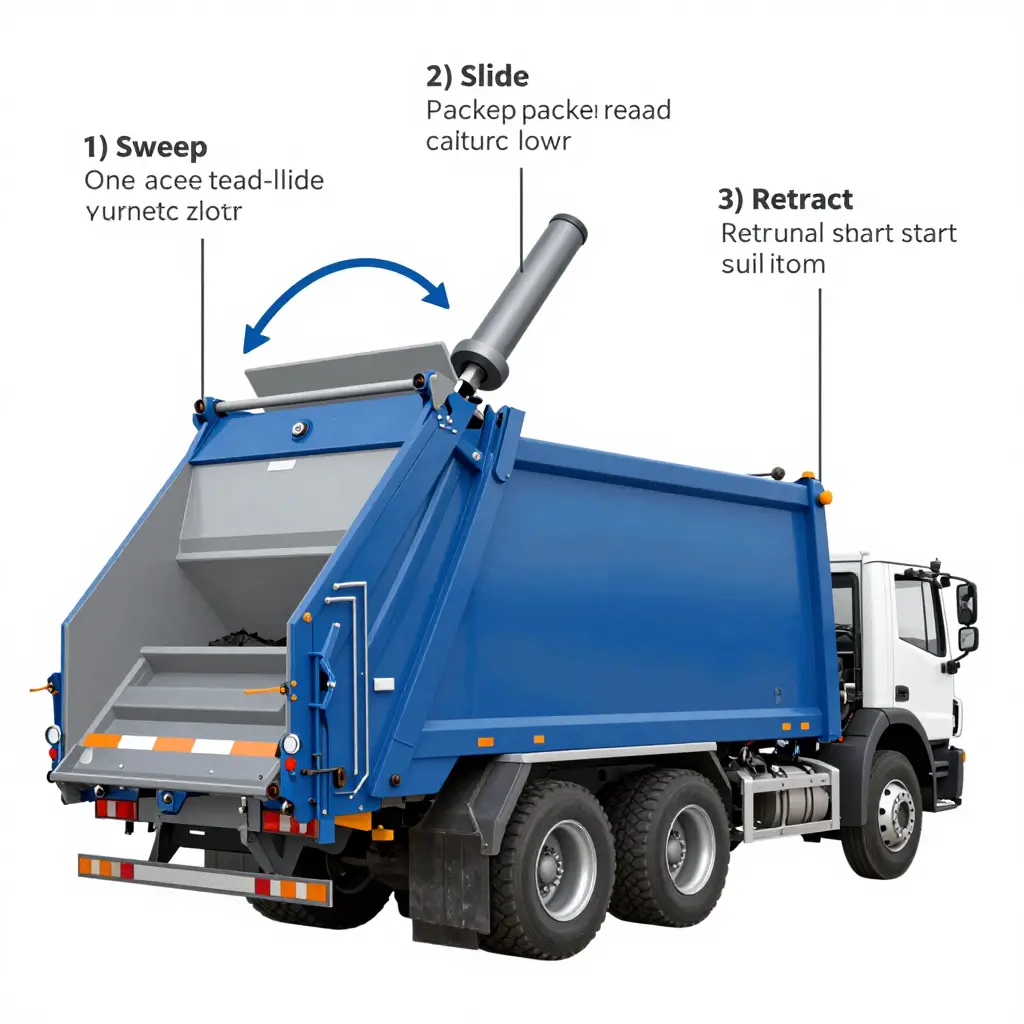
The packer panel is the moving wall inside the hopper. Operators throw refuse in, the panel sweeps and slides, and the material is forced into the body. One full motion is one packing cycle.
The Three Stages of a Single Packing Cycle
- Sweep – the packer panel rotates down through the hopper, breaking up the load and gathering loose material toward the body opening.
- Slide – the hydraulic cylinder extends its full stroke, pushing the gathered refuse into the body and compressing it against the material already packed inside.
- Retract – the cylinder retracts and the panel returns to its start position, ready for the next load.
Cycle time, the seconds needed for sweep, slide, and retract, sets how fast a route moves. A short cycle keeps the truck rolling between stops, though speed on its own does not build density.
Hydraulic force does. Cylinder pressure drives the packer panel back against the hopper and body walls, and the harder the panel pushes, the more the refuse compresses. That is why hydraulic and cycle design, not body size, decide real compaction: a well-engineered system packs tighter, so a modest body carries a dense residential load and the route runs longer before the landfill trip.
The packer panel, cylinder stroke, and hydraulic pressure against the hopper and body set how much a rear loader packs. Body volume is the ceiling; the hydraulic sequence determines how close you get to it.
The rated figure on a spec sheet only gets you partway. The table below maps rated against achievable ratios for the most common rear loader configurations, so you can match a body to the density your routes actually produce.
Table: Compaction Ratio Range by Rear Loader Configuration
| Configuration | Rated Compaction Ratio | Typical Achievable Ratio in Residential Service | Best-Fit Route Type |
|---|---|---|---|
| Small rear loader (6-10 yd³) | 2:1 – 3:1 | 1.8:1 – 2.5:1 | Tight alleys, scattered stops |
| Standard rear loader (16-20 yd³) | 3:1 – 4:1 | 2.5:1 – 3.5:1 | Mixed suburban residential |
| High-compaction rear loader (25-32 yd³) | 5:1 – 6:1 | 3.5:1 – 4.5:1 | Dense curbside, high-volume routes |
| Automated high-compaction unit (28-34 yd³) | 5:1 – 6.5:1 | 4:1 – 5:1 | Heavy recyclables and bulky residential |
A higher ratio pays off only when route density and material mix can feed it. Match body volume to the gains you can realistically achieve, not to the rated ceiling.
Turning Compaction Ratio Into Payload and Fewer Trips
Compaction ratio is the multiplier that turns loose refuse into dense, shippable mass, and it only means something once you apply it to a real body: usable body volume x compaction ratio = effective payload capacity. A garbage truck with a 20-cubic-yard body and a 3.5:1 ratio packs roughly 70 cubic yards of loose material into that space before it is full.
That payload capacity is what the route carries. Each stop produces a fairly predictable volume of loose waste, so how tightly the body squeezes it down sets how much you collect per load.
Payload then sets stop count. Divide the effective payload by the average cubic yards collected per home and you get the number of residential stops a single load can serve. This is where route density matters: dense neighborhoods with small, frequent set-outs put out less per stop, so a high-compaction body stretches one load across more addresses.
A Plain-Numbers Example
Take a route where each home contributes about 0.5 cubic yards of loose waste, and the truck carries the same 20-yard body in both cases.
| Scenario | Compaction Ratio | Usable Body Volume (cu yd) | Effective Loose Capacity (cu yd) | Avg. Waste per Stop (cu yd) | Stops per Load |
|---|---|---|---|---|---|
| Low compaction | 4.0:1 | 20 | 80 | 0.5 | 160 |
| High compaction | 5.5:1 | 20 | 110 | 0.5 | 220 |
Same body, same truck, and the high-compaction setup collects 60 more stops per load. Those extra stops accumulate across a shift, which means fewer trips to unload and more homes serviced before the body fills.
Every point of compaction ratio you gain turns into fewer trips and a lower cost per stop.
Why Real Compaction Falls Short of the Rated Ratio
Rated ratios come from controlled test conditions. On the street, several things pull the real number down.
-
Material mix – A rated ratio assumes a steady, uniform diet of compressible waste, and no residential route delivers that. Cardboard, film plastic, and yard waste pack very differently from rigid containers and dense food scraps, so the blend on any given street reshapes compaction performance.
-
Moisture content – Wet waste is heavy. Food scraps, soaked paperboard, and saturated yard waste add water weight that can push a truck to its axle limit before the body fills by volume, and fibrous material that has been compressed can spring back once the packer retracts. Either way, the volume you were counting on is not all available.
-
Bulky items – Sofas, mattresses, and rolled carpet create large voids that a standard blade cannot crush efficiently. A single bulky item near the top of the load can block the sweep and leave usable capacity empty on an otherwise full route.
-
Cycle interruptions – Every pause to clear a jam, reposition the truck, or wait for a straggling can stalls the pack cycle. Frequent stop-and-go packing in dense neighborhoods keeps waste from reaching the density the rated ratio implies.
-
Operator technique – Experienced drivers know when to let the packer finish a full stroke and when to top off before rolling to the next stop. Rushing cycles or short-stroking the blade leaves air pockets that erode compaction performance over a shift.
-
Body fill pattern – Even, front-to-back loading lets the packer work against consistent resistance and complete each stroke. Uneven charging, or dumping everything against the hopper lip, creates build-up zones where the blade never reaches full compression.
Add those up and the gap between rated and real is easy to see. Achievable ratio, not the rated figure, is what should drive body volume and spec decisions. Size on the lab number and a fleet ends up with trucks that run out of room two hours into a route.
Seeing the Real Payoff: Compaction Ratio Beats Raw Body Size
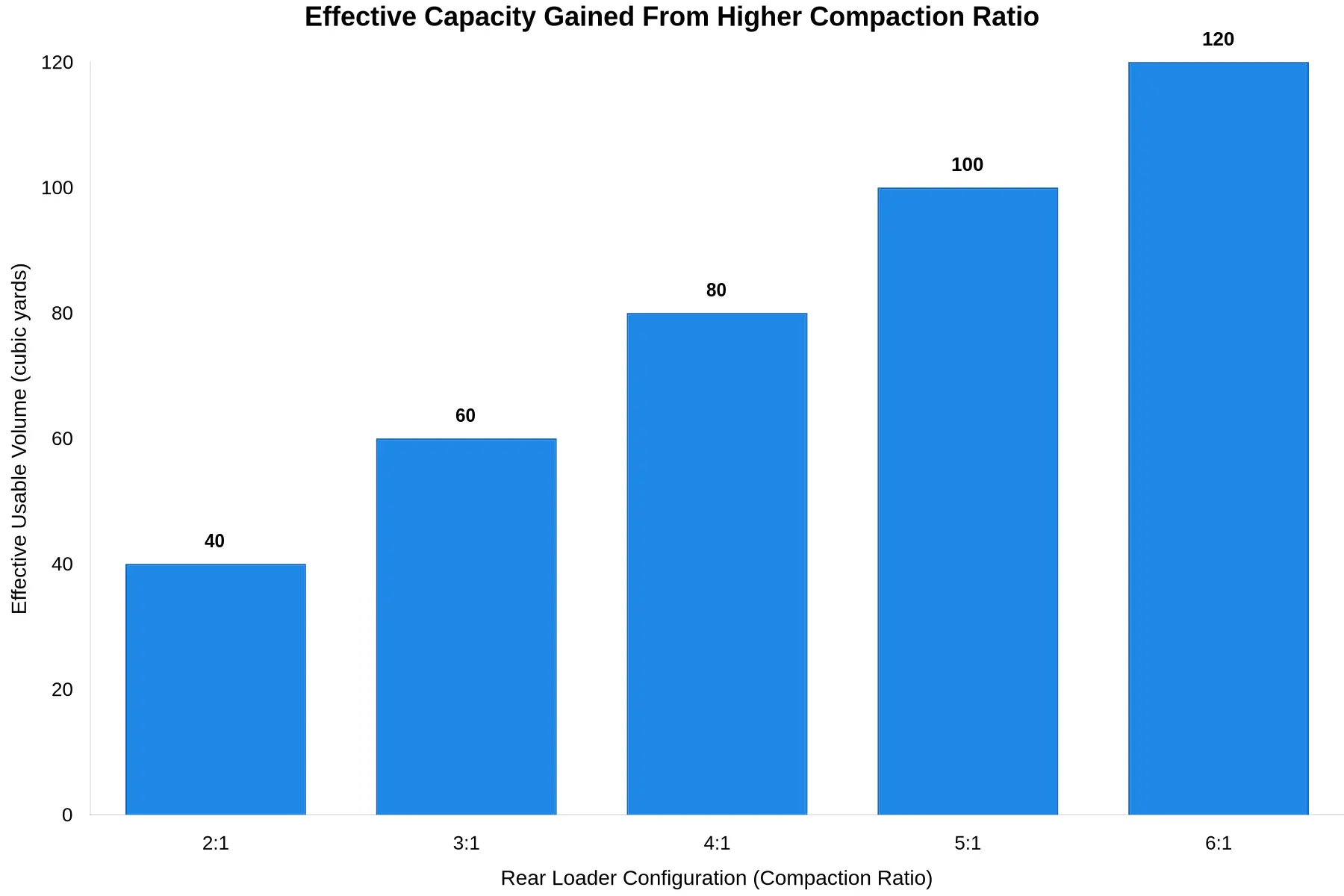
Hold the body size constant at a 20 cubic yard rear loader and change only the compaction ratio. The chart shows what happens to effective usable volume, the amount of loose residential refuse the truck can actually pack and haul before it needs to tip.
What the Numbers Tell You
| Rear Loader Configuration | Compaction Ratio | Effective Usable Volume (cu yd) |
|---|---|---|
| Light-duty packer | 2:1 | 40 |
| Standard residential | 3:1 | 60 |
| Mid-tier residential | 4:1 | 80 |
| High-performance packer | 5:1 | 100 |
| Premium heavy-duty packer | 6:1 | 120 |
Same body, same footprint, same driver, and the highest-ratio packer moves three times the loose material per load as the entry-level unit. For anyone sizing equipment, that means a slightly larger body with a weak packer is often a worse buy than a slightly smaller body with an aggressive compaction ratio.
Why This Matters on the Route
- Fewer trips to the disposal site. Tripling effective capacity can be the difference between three loads a day and one, which frees up labor hours.
- Better density handling. Dense, heavy residential waste such as kitchen organics and yard debris responds well to higher ratios, so the gains compound in real neighborhoods.
- Smarter spec decisions. Compare effective capacity at your expected ratio against your route density, not just the advertised body volume.
Match the packer’s compaction ratio to the material you actually collect, and let effective capacity, not the number on the body, set fleet sizing.
Frequently Asked Questions About Rear Loader Compaction and Body Volume
These are the questions fleet managers, hauling company owners, and route supervisors ask most often when they spec a rear loader and plan residential collection.
-
What is the difference between rated and achievable rear loader compaction ratio?
The rated ratio is what the manufacturer publishes after controlled testing, usually based on specific material densities under ideal conditions. Achievable is what the truck delivers on a real route, where bulky items, soft bags, and mixed waste limit how many packing cycles do useful work. A machine rated at 4:1 often settles somewhere around 2.5:1 to 3:1 once route reality sets in. -
Does a higher rear loader compaction ratio always mean a smaller body volume?
No, and this is one of the most common spec mistakes in garbage truck buying. A higher ratio lets a given body volume hold more waste; it does not shrink the body, so you still need enough physical space for bulky and oversized loads. A better ratio means fewer trips, not a smaller hopper or packing chamber. -
How does moisture affect the rear loader compaction ratio?
Wet, heavy waste such as food scraps and soaked paperboard compresses differently from dry material, so moisture shifts the ratio you see on the route. Saturated trash adds water weight that can use up payload before the body is full by volume, while bulky dry items resist packing altogether. Knowing your route’s moisture profile keeps body volume planning realistic. -
What body volume suits a typical residential route?
Most residential routes work well with a body volume between 20 and 25 cubic yards paired with a rear loader compaction ratio in the 3:1 to 4:1 range. Lower-density suburban stops with a lot of recyclables may favor the larger end, while dense urban pickups can manage with less capacity. The right number depends on stop count, waste density, and how often you want the truck to tip. -
How does compaction ratio influence tipping frequency?
A higher rear loader compaction ratio packs more waste into each cubic yard, so the body fills more slowly and you can serve more stops before tipping. That reduces trips to the landfill or transfer station and trims fuel and labor costs across the day. A low ratio fills the same body volume faster, forcing more tipping runs and cutting route productivity.
Getting Compaction and Body Volume Right on Purpose
The compaction ratio on a brochure is a ceiling, not a promise. What should anchor body volume and residential route planning is the real, achievable rear loader compaction ratio your trucks deliver shift after shift, through wet weeks, dense stops, and the mixed waste streams a genuine collection cycle produces. Spec to that figure and refuse hauling stops being a guessing game of overfilled hoppers and premature trips to the tipping floor.
A sequence a fleet manager or equipment buyer can follow when speccing a rear loader for residential collection:
- Log real pack weights and volumes for two to four weeks of live service instead of trusting the rated maximum on the datasheet.
- Recalculate usable body volume from that achievable ratio, then check it against your actual route density and stop count per trip.
- Match the body and compaction configuration to the waste stream you really haul, not a generic municipal average.
- Confirm axle ratings, subframe, and hopper geometry can support the target payload at full load before the order is locked.
- Pilot a single unit on one representative residential route, then roll the winning spec across the fleet.
As a manufacturer of durable, reliable, and cost-effective special vehicles, we build rear loaders to earn their keep on the street, not just on the spec sheet.