Why Container Lug Spacing Varies Between Builds
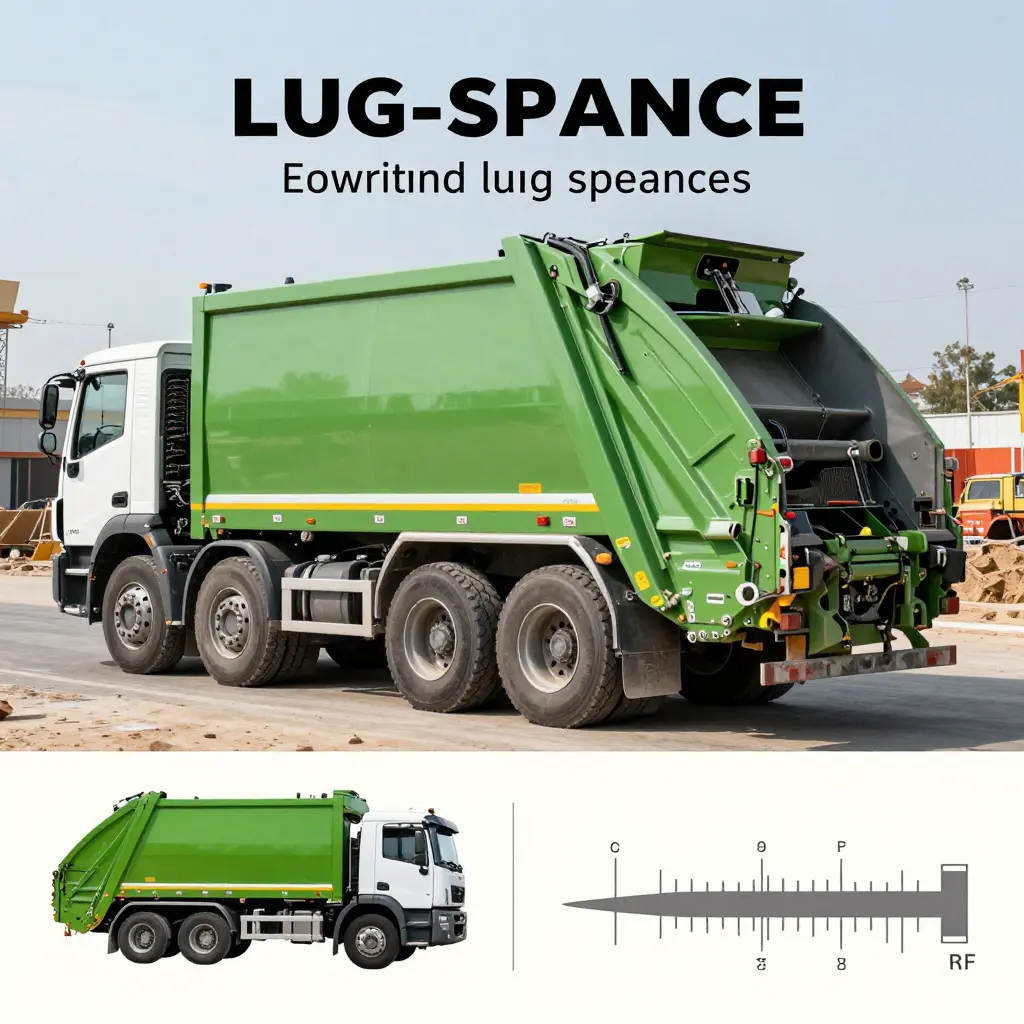
Among skip loader garbage truck suppliers, there is no single universal container lug spacing. Two reputable manufacturers can each deliver what they call a standard build, and the containers that fit one will not seat on the other. Each factory has sized its lift hook, subframe and lug pattern around the containers its home market uses, so two trucks with the same tonnage, the same hook rating and the same body length can still have incompatible interfaces. For an owner buying several units, that gap is not a technical footnote: it decides whether a new container order can be shared across the fleet or has to be split by truck.
Four dimensions define the interface, and all four belong in writing on the purchase order. Lug center-to-center spacing is the horizontal distance between the two lug centers, and it decides whether a container frame lines up with the hook at all. Lug plate thickness is the steel that carries the loaded weight through a small contact patch. Throat or opening depth is how far the hook or pin can drop into the lug: too shallow and the lift point rides high, too deep and the bin hangs loose. Lug height above the container base sets the lift angle and how the container settles back onto the truck bed. All four are measured from a datum on the truck, which is why matching container size to chassis length belongs in the same conversation.
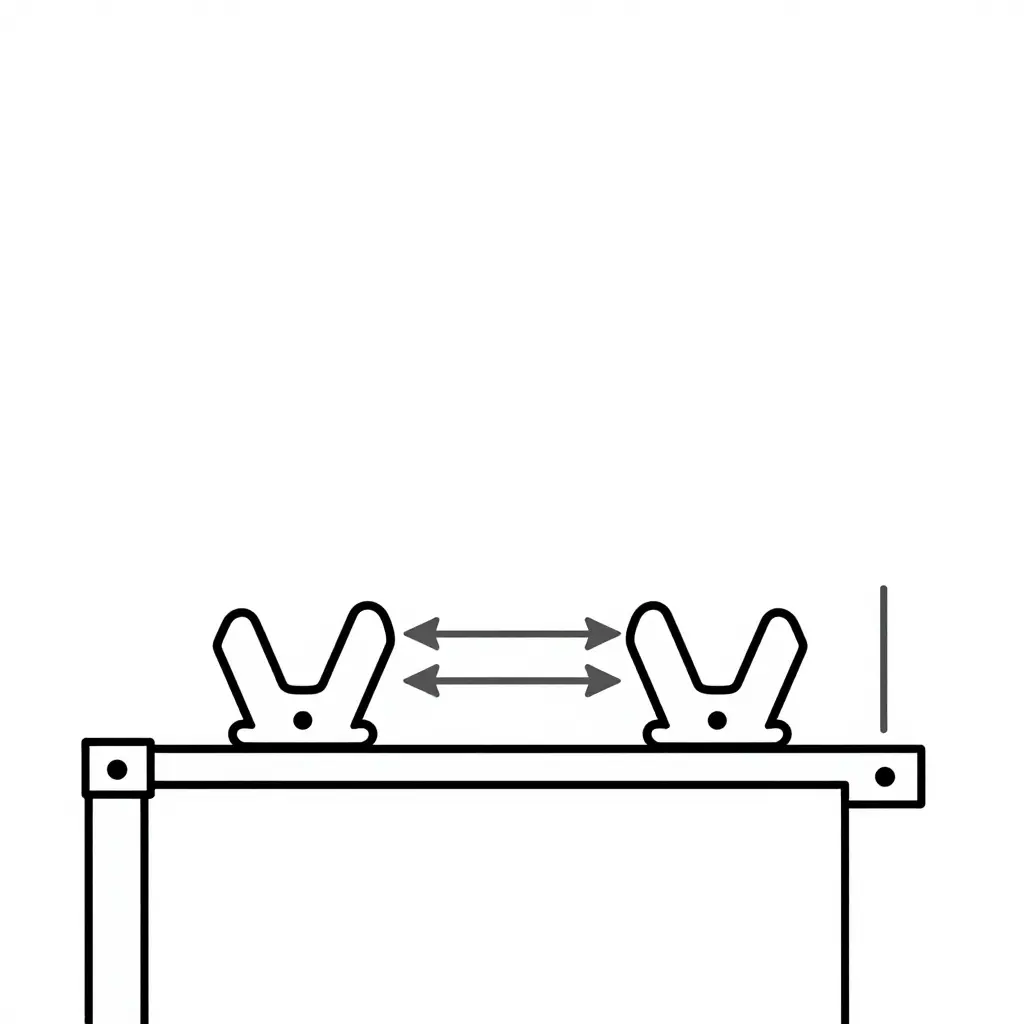
What each arrow is telling you
- Center-to-center spacing – the distance between the two lug centers. Suppliers get this one wrong most often, because it has to match the lifting frame rather than follow the container’s own dimensions.
- Lug plate thickness – the steel that carries the whole loaded weight through a very small contact patch. A thin plate wears fast, the lug pocket goes oval and the bin starts to sit crooked.
- Throat or opening depth – how deep the hook or pin can drop into the lug. Too shallow and the lift point rides high; too deep and the bin hangs loose.
- Lug height above the base line – sets the lift angle and how the container settles back onto the truck bed.
Measure all four on your existing bins before you send an enquiry, and measure them on the truck side too.
Lug spacing variants across common skip loader build families
| Build family | Typical lug center spacing range | Lug plate thickness | Lug height above container base | Container chain/sling size it suits | What a buyer must confirm in writing |
|---|---|---|---|---|---|
| Mini / light hooklift (3-6 t) | 620-700 mm | 10-15 mm | 80-120 mm | 6-8 mm chain, single-leg 1 t sling | Center-to-center tolerance and lug bore diameter |
| Euro hooklift, medium (8-12 t) | 900-1,000 mm | 20-25 mm | 120-150 mm | 8-10 mm chain, two-leg sling | Whether spacing is measured at plate face or bore center |
| Euro hooklift, heavy (14-20 t) | 1,000-1,100 mm | 25-30 mm | 150-180 mm | 10-13 mm chain, two to four-leg sling | Size of the reinforcement pad welded behind each lug |
| US-style hooklift (25,000-40,000 lb) | 42-50 in (1,070-1,270 mm) | 1-1.25 in (25-32 mm) | 5-6 in (125-150 mm) | 3/8-1/2 in chain, two-leg bridle | Imperial or metric drawing, plus jib hook reach at full extension |
| Cable hoist / roll-off frame | No lugs; sill eye spacing 1,200-1,500 mm | 16-20 mm sill plate | Not applicable (rollers and sill carry load) | 5/8 in cable, no sling used | That the container is hoist-rated for your cable unit, not just hooklift-rated |
| Mixed / non-standard containers | 650-1,300 mm, varies per unit | 12-32 mm | 90-190 mm | Mixed; rating taken per unit | A per-container drawing and one trial lift before a batch order |
Read this table against a supplier’s datasheet one column at a time: start with the build family and lug center spacing, then check that both documents use the same unit and the same measuring point, because a spacing quoted at the plate face differs from the same lug measured at bore center by roughly the plate thickness – between 10 and 32 mm on the families above. If the lug height or plate thickness sits below the range for your truck’s rated capacity, treat the container as a different build family rather than a small deviation. Get the confirmations in writing, and check the spacing against your chassis and body layout before you commit to a fleet order.
Where the Lug Numbers Come From
Frame rails and lift hardware set the datum
Container lug spacing starts at the frame. Chassis frame rails differ in width from market to market and class to class, commonly landing somewhere between 860 mm and 1,000 mm, and the subframe that carries the lift sits directly on top of them. Onto that subframe the body builder mounts the lift hook and jib arm, and the length of the jib arm, the hook height and the pivot position together decide where the hook actually reaches the container. The lugs then have to be located so the container lifts level and seats squarely against that geometry. Chassis and body are therefore matched as a set, which is why bin-to-chassis matching is best treated as the first check in a specification, not the last.
Reinforcement and regional conventions shift the figure again
Body builders rarely leave lugs as bare plate. Doubling plates, gussets and wear pads are welded in to take the point load of a loaded container, and that reinforcement moves the effective pick-up point by a few millimeters depending on how the builder designs it. On top of that, regional container fleets were built to different conventions, and local body builders tend to copy the convention their domestic market uses rather than work to a single international figure. Two factories can both quote a nominal spacing and still produce containers that do not match.
The operational consequence
A fleet bought from two different suppliers will not swap containers freely. Bins built to the first supplier’s lug pattern hang off-center or refuse to seat on the second supplier’s trucks, drivers learn which container goes with which chassis, and the spare-bin pool splits into two non-interchangeable sets. The cost shows up as extra containers, longer swap times and a dispatch board that has to track compatibility instead of just availability.
Tolerance matters more than the nominal figure
The nominal lug spacing is only a starting reference. What actually governs interchangeability is the permitted tolerance on lug position: the drift allowed in center-to-center spacing, and in the height of the lugs relative to the frame rail, decides whether a container drops onto the hook cleanly or fights it every lift. When comparing suppliers, ask for the drawing and the stated tolerance band on lug position, not just the headline dimension.
Container Lug Spacing Measurement Checklist
Before you put a fleet order on paper, walk around your yard with a tape measure and a clipboard. Every number below either protects a lift or settles a warranty argument later.
- Lug center-to-center spacing, measured on your own containers – the figure suppliers most often assume instead of asking for.
- Lug thickness and throat clearance – a loose throat lets the bin slop around against the hook and wears the pin flat within months.
- Lug height above the container base – decides how the bin sits on the deck and whether the hook can reach it cleanly.
- Lift hook engagement height on your chassis – a low hook fouls the top rail on tall bins and stalls the first pull.
- Container tare weight, taken from an actual weighbridge ticket – guessing here is how axle limits get breached; start with understanding tare weight before you commit to a bin size.
- Chassis frame rail width and the usable rail length – the subframe and the longest bin you plan to carry both have to fit that footprint.
- Hooklift or cable hoist identification per truck – the two systems need different lug geometry, so never let one spec sheet cover both.
- Written tolerance window from the supplier – a stated ±10 mm per lug gives you something to point at if the first delivery arrives crooked.
- A sample container test requirement – insist on witnessing one live lift of your own bin before the balance of the fleet is built.
- Planned bin mix and lengths for the next two to three years – stops you buying lugs that only suit today’s containers.
Send the completed list to your suppliers as part of the enquiry pack, so every quote is priced against the same numbers.
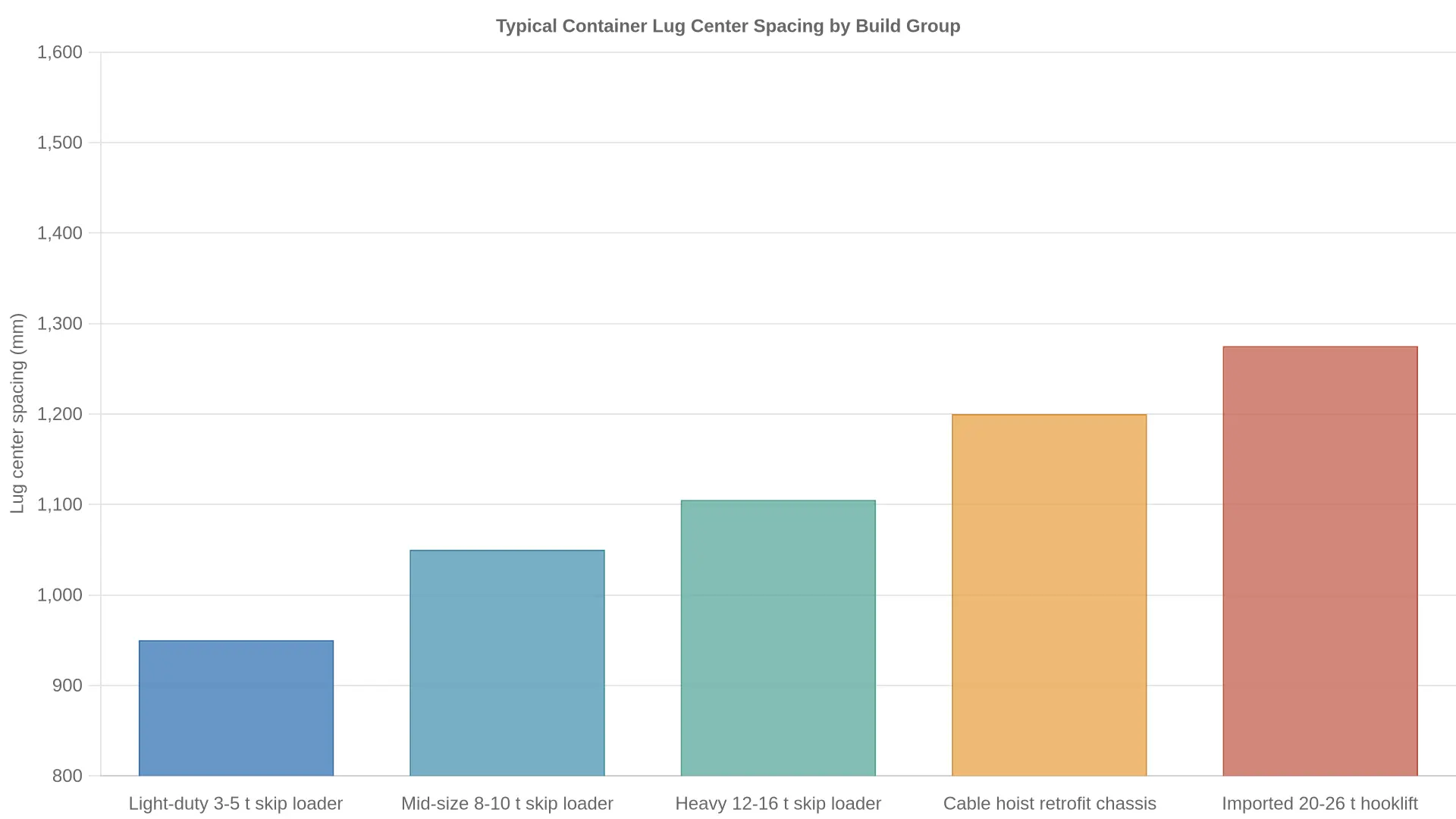
Indicative supplier datasheet ranges. Values vary by manufacturer, bin supplier and chassis year – use them to plan, not to cut steel.
Read the spread, not the average. Mini and light 3-6 t units sit at 620-700 mm, Euro-style medium builds at 900-1,000 mm, Euro heavy units at 1,000-1,100 mm, US-style hooklifts at 1,070-1,270 mm, and mixed or non-standard containers anywhere from 650 to 1,300 mm. Notice how the heavy and mid-size bands overlap: a truck can look correct on paper and still miss your bins by 50 mm.
That is why spacing belongs in the ordering conversation before you commit. Ask every supplier for the measured lug center distance on the actual unit, plus the tolerance, and confirm it against the bins you already own.
Tolerance Windows and Mixed-Supplier Risk
Before you place a multi-unit order, fix the numbers in writing. The truck is the fixed side: the hoist, hook height and jib geometry are welded in place, so every bin has to be built to the chassis, and the fleet standard you set is whatever that geometry can accept. On a skip loader garbage truck, the number that decides whether a bin seats cleanly is container lug spacing – the center-to-center distance between the lifting lugs, checked against the pin-to-pin span on your lift arms. Specify lug centers within ±10 mm of your truck’s figure, and hold the center-to-center span within a batch to about 5 mm, stated on the purchase order rather than left to a phone call. Settle the hoist type first, since the way a cable hoist and a hooklift present the hook to the bin changes the pin height and approach angle you are measuring to, and let tare weight govern the steel gauge, because a batch that gains 60 kg a bin quietly eats payload on every run.
When a container will not seat, the lift stops. The driver climbs out, repositions, tries again, sometimes drags the bin, and a 40-second lift can turn into five to fifteen minutes on a tight city block with traffic stacking behind. That is the real cost of a mixed fleet: spare containers that fit only one truck, drivers memorizing which bin belongs to which chassis, and a loader standing idle while a bin is persuaded onto the wrong bed. To keep the second batch identical, freeze one drawing revision, nominate a reference container from batch one, record its measured lug centers and tare, and require the next purchase order to quote the same revision. Then check the first unit of batch two against that reference before the rest are unloaded.
FAQ: Container Lug Spacing and Skip Loader Sourcing
Can container lug spacing be changed after a truck is built?
Yes, but it is a fabrication job rather than a parts swap. The lugs are welded to the lift frame and tie into the subframe, so re-spacing means cutting, repositioning and re-welding lug pockets, then re-checking alignment across the full hook travel. Budget for frame inspection and paint repair, and confirm the new spacing still matches every bin in your existing fleet before committing.
Does container lug spacing affect legal payload or axle load?
Only indirectly. Lug spacing itself adds or removes a few kilograms of steel, but it shifts where the bin sits relative to the rear axle, which changes the load distribution once a full container is lifted. Spacing that pushes bins further back can move weight onto the rear axle and reduce the payload you can legally carry, so check the tare weight and axle rating against the actual bin position.
How do I verify container lug spacing on a used skip loader before buying?
Measure center-to-center between the lug pairs at several points along the frame, then compare those figures with the bins you intend to run. Look for weld repairs, elongation in the lug pockets and any sign the frame has been re-drilled or re-welded, since mismatched repairs usually mean a non-standard build. Pair the measurement with a proper subframe and lift cylinder inspection before you agree on price.
What should a purchase order include so a second fleet batch matches the first?
Specify lug spacing as a center-to-center dimension with a tolerance, plus lug thickness, pocket width, hook height and the frame datum point the measurement is taken from. Add the bin model, designed lift capacity and the requirement that spacing be verified against a sample container before shipment. Written dimensional sign-off on the first unit, carried into the repeat order, is what keeps batch two interchangeable with batch one.
Closing the Sheet: One Page, Every Enquiry
Before you send another enquiry, reduce everything to a single page. A written lug specification sheet – spacing, thickness, throat, height and tolerance, each with the value you will accept – turns a vague conversation into a document every bidder can be measured against. Attach that sheet to every enquiry, so no quote drifts into guesswork on container lug spacing, and require a sample-container fit check before any batch is signed off: one container lifted and lowered on the actual truck, measured against your sheet, photographed and filed.
This is where the manufacturer’s role earns its keep. A factory that builds to a documented specification under a strict quality system reads your sheet the same way on every unit, instead of adjusting dimensions to whatever steel happens to be on the floor that week. Pair the sheet with the pre-delivery checks on the subframe and lift cylinder you already run, and the closing routine stays short: spec, sample, sign off. Do that, and a fleet order stops being a gamble on interpretation and becomes a repeatable purchase you can hand to any reliable yard.