Route tonnage is one of the most consequential specifications on a rear loader garbage compactor truck, yet fleets often treat it as a line item rather than a planning decision. The gross vehicle weight rating (GVWR) caps payload, body capacity, and the compaction ratio a unit can hold across a full collection route. Those limits decide how productively the truck works its stops, what it brings on the used market, and how long a rebuild stays worth paying for.
Choosing on acquisition cost alone is the common error. Price-first specs leave fuel burn, maintenance intervals, route productivity, and residual value out of the model, and they distort resale: over-spec’d and under-spec’d trucks land in different buyer pools, neither of them deep. A 25-cubic-yard rear loader on a heavier GVWR chassis depreciates on a different curve, and hits rebuild on a different horizon, than a lighter unit built for dense residential routes.
Defining Route Tonnage and Its Market Relevance
Route tonnage is the payload a rear loader compactor truck is engineered to collect, compact, and carry over one collection route before legal or mechanical limits stop it. No nameplate states it. It falls out of how a specific chassis, compactor body, and packer mechanism are matched to a duty profile: the number of stops, the density of the material, the container mix, and the distance between the route and the disposal site.
Route Tonnage vs. Nameplate GVWR
Nameplate Gross Vehicle Weight Rating (GVWR) states the maximum total mass a chassis is certified to support, counting truck, body, fuel, crew, and payload together. Route tonnage always sits below that ceiling, and it depends on how the truck is used rather than on the data plate. It reflects how much MSW or recyclables the hopper and packer can actually densify, how evenly the load spreads across the axle group, and how many lift-and-dump cycles fit into the route’s cycle-time budget before the truck is full. A chassis rated at a high GVWR can still be route-limited when body volume, compaction ratio, or axle loading fills the legal payload window early. GVWR is the envelope; route tonnage is what the operator actually monetizes each shift.
How Tonnage Classes Map to Duty
Tonnage classes follow route density, container type, and daily lift volume, not marketing tiers:
| Tonnage Class | Typical Route Density | Common Container Type | Daily Lift Volume Profile |
|---|---|---|---|
| Light-duty (6-8 t) | Low-density urban cores, bin-servicing | Wheeled bins, 120-240 L containers | Moderate stop count, low payload per lift |
| Medium-duty (10-14 t) | Mixed municipal curbside | Curbside carts, small rear-load bins | High stop count, balanced payload |
| Heavy-duty (16-26 t and above) | High-density commercial, transfer haul | Large rear-load containers, dumpsters | Lower stop count, high payload per lift |
A body sized for one class rarely works well in another. Too much tonnage on a light route burns fuel and wears parts early; too little on a dense route means extra trips and a packer and hoist that wear out ahead of schedule.
What Route Tonnage Physically Drives
Route tonnage is a load case, and that load runs through the whole machine:
- Axle loading: it governs how payload distributes across the front and rear axles, which decides legal bridge compliance and the stress tires and springs carry.
- Body wear: higher accumulated tonnage and compaction pressure accelerate floor, side-sheet, and packer-blade fatigue.
- Drivetrain strain: repeated heavy-lift cycles load the PTO, hydraulic system, transmission, and differential in proportion to the duty class.
Fleets that size tonnage to the route rather than the nameplate ceiling keep payload, wear rates, and residual value in step.
How Route Tonnage Drives Resale Value
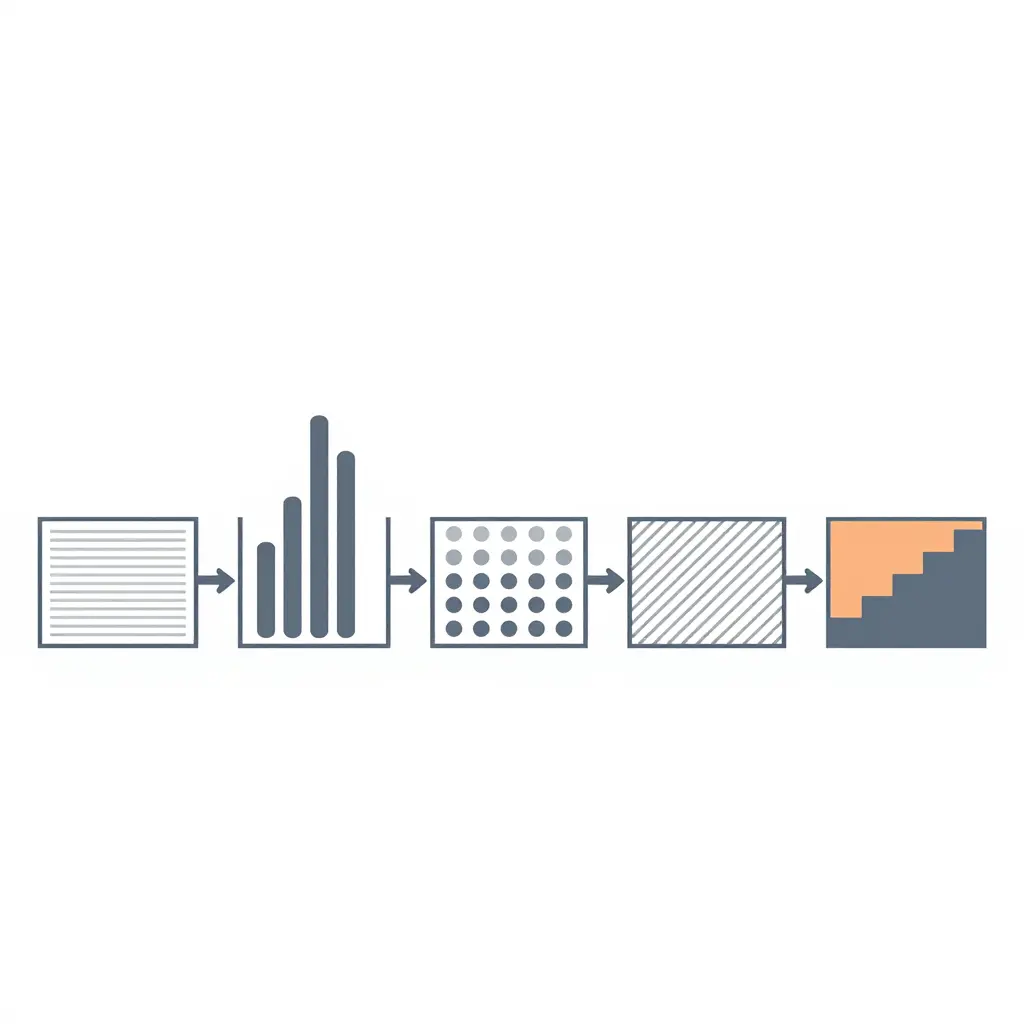
Route tonnage does more to set the resale value of a rear loader than any other specification. Two units can leave the factory with near-identical bodies, hydraulics, and sticker prices and, five years on, sell for very different money. The spread almost always traces to how much weight the chassis was built to carry and how many buyers that weight class draws.
Demand-Side: The Breadth of the Buying Pool
Medium-tonnage rear loaders, typically 25,000 to 33,000 lb GVWR with 20 to 25 cubic yard bodies, sit in the market’s sweet spot. Light enough for tight residential streets and heavy enough for commercial curbside volume, they draw municipal sanitation departments, private haulers, contractors, and startups into the same bid. That breadth keeps bid depth healthy and residuals firm.
Very heavy units are a different story. A 40,000 lb-plus chassis with a 30 to 36 cubic yard body is built for high-density commercial and industrial collection, and it does that work well. But few buyers need it, so when one comes to market, the leverage sits with the purchaser, not the seller.
Supply-Side: Scarcity versus Oversupply
Supply widens the same gap. Medium-tonnage chassis are built in high volume and retired in steady waves, so dealers get a predictable, financeable supply. Very heavy units come in small batches; when several land at one regional auction at once, prices fall harder than they would in the deeper medium-tonnage market.
The Specs That Move the Number
Tonnage alone does not set value. Three more variables interact with it:
- Tonnage-appropriate service history. A very heavy chassis with maintenance records matched to its duty cycle builds confidence; mismatched records signal abuse.
- Mileage-to-tonnage ratio. Low miles on a heavy chassis can imply underutilization and idle corrosion, while high miles on a medium chassis that track route intensity often read as healthy, productive wear.
- Body condition. Compaction panels, hoppers, and packer cylinders degrade faster under heavy-duty cycling, so body integrity carries disproportionate weight at the top of the tonnage range.
Depreciation Curves Differ by Tonnage Class
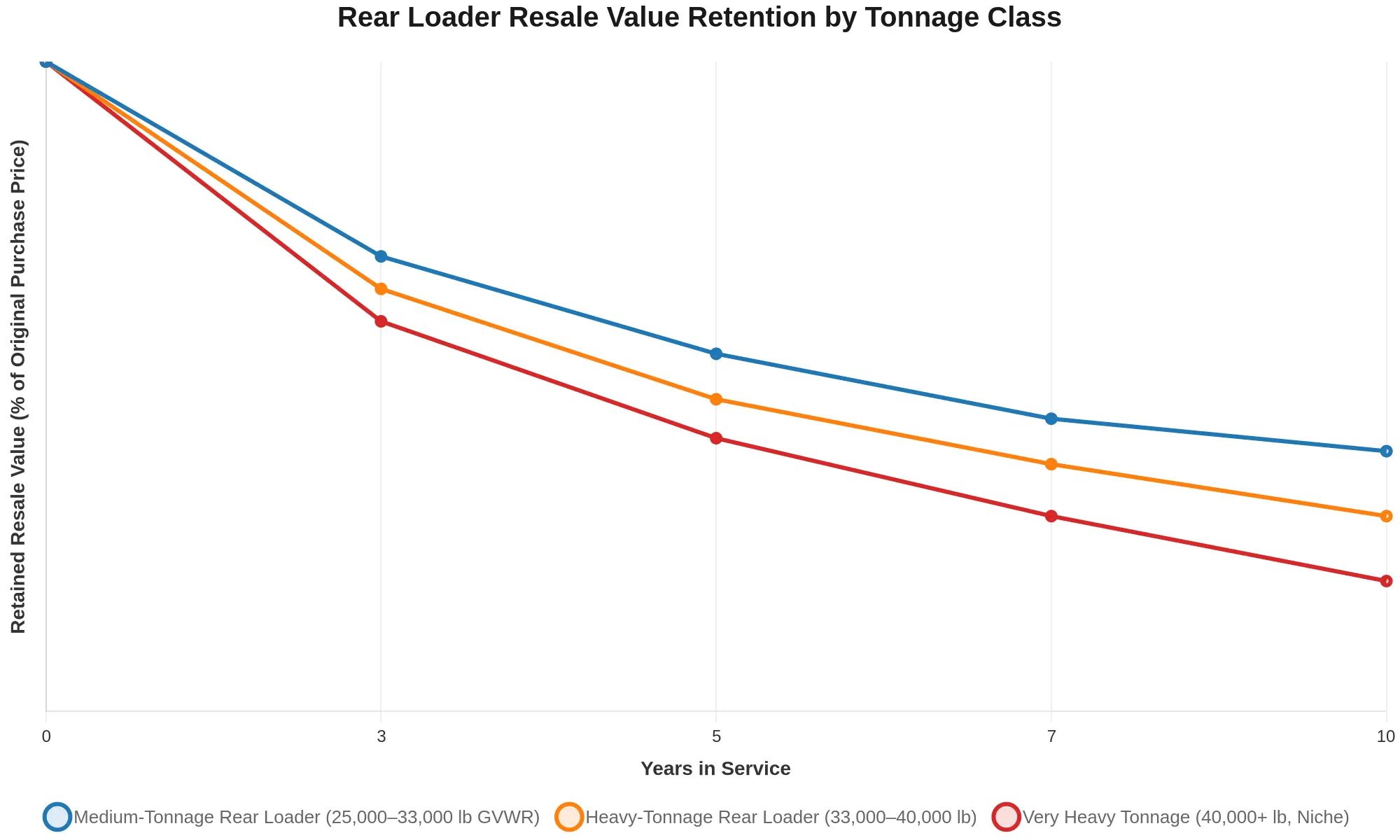
Depreciation is not one curve but a family. Medium-tonnage rear loaders stay relevant to more buyers for longer, so they hold the flattest line. Very heavy units fall faster, particularly after year five, when rebuild economics and thin demand arrive together. The chart below models retained value across three tonnage classes.
Cross-Shopping in Adjacent Categories
Few buyers weigh one class in isolation. A fleet pricing a heavy rear loader may also look at a roll-off or a hook lift truck, where matching bin size to chassis length sets payload and route fit. That substitutability caps what a narrow-tonnage rear loader can bring, because adjacent categories pull buyers out of thin niches.
Medium-tonnage rear loaders hold value best: broad demand flattens their depreciation curve. Very heavy units trade that residual strength for capability in a niche.
Route Tonnage Class vs Resale Value and Rebuild Cycle Economics
| Tonnage Class | Typical Route Profile | Average First Rebuild Interval | Estimated Residual Value Retention at 5 Years | Secondary-Market Liquidity |
|---|---|---|---|---|
| Light-duty | Low-density suburban curbside; low stop count | 120,000-180,000 mi / 2,000-3,000 hrs | 40-50% | High |
| Medium-duty | Mixed residential + light commercial | 150,000-220,000 mi / 2,500-3,500 hrs | 42-52% | Very high |
| Heavy-duty | Dense urban commercial + multifamily | 220,000-300,000 mi / 3,000-4,500 hrs | 45-55% | Moderate |
| Severe-duty | High-compaction transfer; landfill shuttle; steep grades | 260,000-350,000 mi / 4,000-5,500 hrs | 38-48% | Low-moderate |
Figures are reasoned industry estimates; rebuild intervals combine chassis mileage and compactor body hours, and residual retention reflects 5-year, mid-configuration rear loader units under normal fleet maintenance. Actuals vary with spec, route duty, and regional demand.
Rebuild Cycles and How Route Tonnage Shapes Them
What Constitutes a Rebuild Cycle
A rebuild cycle is the point at which a rear loader compactor truck moves out of “repair as needed” and into a scheduled, capital-level restoration. It is a bundle of work, not a single repair, meant to return the unit to near-original duty capacity. A formal cycle usually covers:
- Packer panel and blade replacement – the highest-wear contact surfaces in the loading hopper, where abrasive, wet, and compacted refuse grinds against steel thousands of times per shift.
- Hydraulic cylinder refurbishment – resealing, rod inspection, and bore honing on the pack, eject, and lift cylinders that drive the compaction stroke.
- Body panel repair – patching or sectioning of the collection body where corrosion, fatigue cracking, and impact damage accumulate.
- Subframe reinforcement – welding, plate reinforcement, or outright replacement of the rail structure that carries the body and absorbs road and loading shock.
- Drivetrain overhaul – engine, transmission, and rear-axle service once accumulated mileage and stop-start duty catch up with the power pack.
Each item wears on its own clock. They come together as one cycle because on a hard-working truck they tend to converge on the same window, and route tonnage largely sets it.
How Tonnage Drives the Interval
Tonnage is the master variable. Every ton collected turns into a predictable count of compactor strokes, hydraulic pressure cycles, and structural load reversals. A dense residential or commercial route at 14-20 tons per day cycles the packer far more often than a light 4-6 ton route, and each stroke loads the panel, blade, cylinders, body, and subframe together.
The effect does not scale linearly, even where the numbers look gradual. As tonnage rises:
- Hydraulic pressure cycles per shift increase sharply, accelerating seal degradation, rod scoring, and pump duty.
- Compactor wear concentrates on the packer panel face, blade edge, and hopper floor, driving earlier steel replacement.
- Chassis fatigue compounds through more frequent full-load braking, curb drops, and packed-body weight on the subframe rails.
The chart shows the mechanism: a light route can run about 72 months to rebuild; a heavy 20-ton route compresses that to roughly 22 months. Higher tonnage does more than add wear. It shortens time-to-rebuild by raising the rate at which load stress accumulates.
Why the Break-Even Point Moves
High-tonnage routes pull the first rebuild forward, and that pulls the second forward with it. The second rebuild is usually where the decision flips from rebuild to replace.
A rebuild pays when the capitalized cost of the restoration, spread across the remaining service life, stays below the replacement unit’s cost per mile or cost per ton. On a high-tonnage route:
| Variable | Light Route (4-8 T/day) | Heavy Route (16-20 T/day) |
|---|---|---|
| First rebuild interval | ~54-72 months | ~22-30 months |
| Structural (subframe/body) load | Moderate | High, cumulative |
| Cylinder service frequency | Low | High |
| Break-even vs. replacement | Favors rebuild | Shifts toward replacement |
| Residual value at rebuild | Higher | Lower |
By the second rebuild on a heavy route, the operator is paying to restore a chassis that has already absorbed millions of load reversals. Replacement often wins on total cost of ownership at that point, and the math feeds straight back into what trucks retiring from dense, high-tonnage duty fetch on the used market.
Duty Cycles and Hours-of-Service
Rebuild timing follows the working day, not just the odometer. Multi-shift or extended routes pile up service hours faster, so engine and drivetrain overhauls come due sooner regardless of tonnage. Two shifts a day on a dense route can pack a full year of wear into six months of calendar time. Managers who read hours as well as miles catch those triggers earlier and book downtime before a failure, not after.
Subframe and Cylinder Condition as Early Triggers
Two components earn attention as early triggers because they fail quietly. Subframe rails crack at stress risers long before a driver feels a change in handling. Hydraulic cylinders lose seal integrity a little at a time, hiding falling compaction force behind seemingly “normal” operation. Inspecting both on purpose, instead of waiting for a visible failure, is what turns a rebuild from a reaction into a plan. The same structural and hydraulic checkpoints govern other refuse platforms; this breakdown covers the subframe and lift cylinder checks that flag a worn unit before it reaches the market.
For fleet operators the point is simple: route tonnage does more than wear a truck out. By compressing the interval between cycles, it re-prices the rebuild-versus-replace decision. Match tonnage to realistic lifecycle assumptions and the rebuild can pay for itself; miss them and the same rebuild sinks capital into a chassis already past its stress budget.
Residual Value Retention by Route Tonnage Class Over Holding Period
The chart below plots residual value retention across four rear loader tonnage classes over an eight-year holding period, indexed to 100% at the point of acquisition.
Figure 1. Residual Value Retention by Route Tonnage Class Over Holding Period
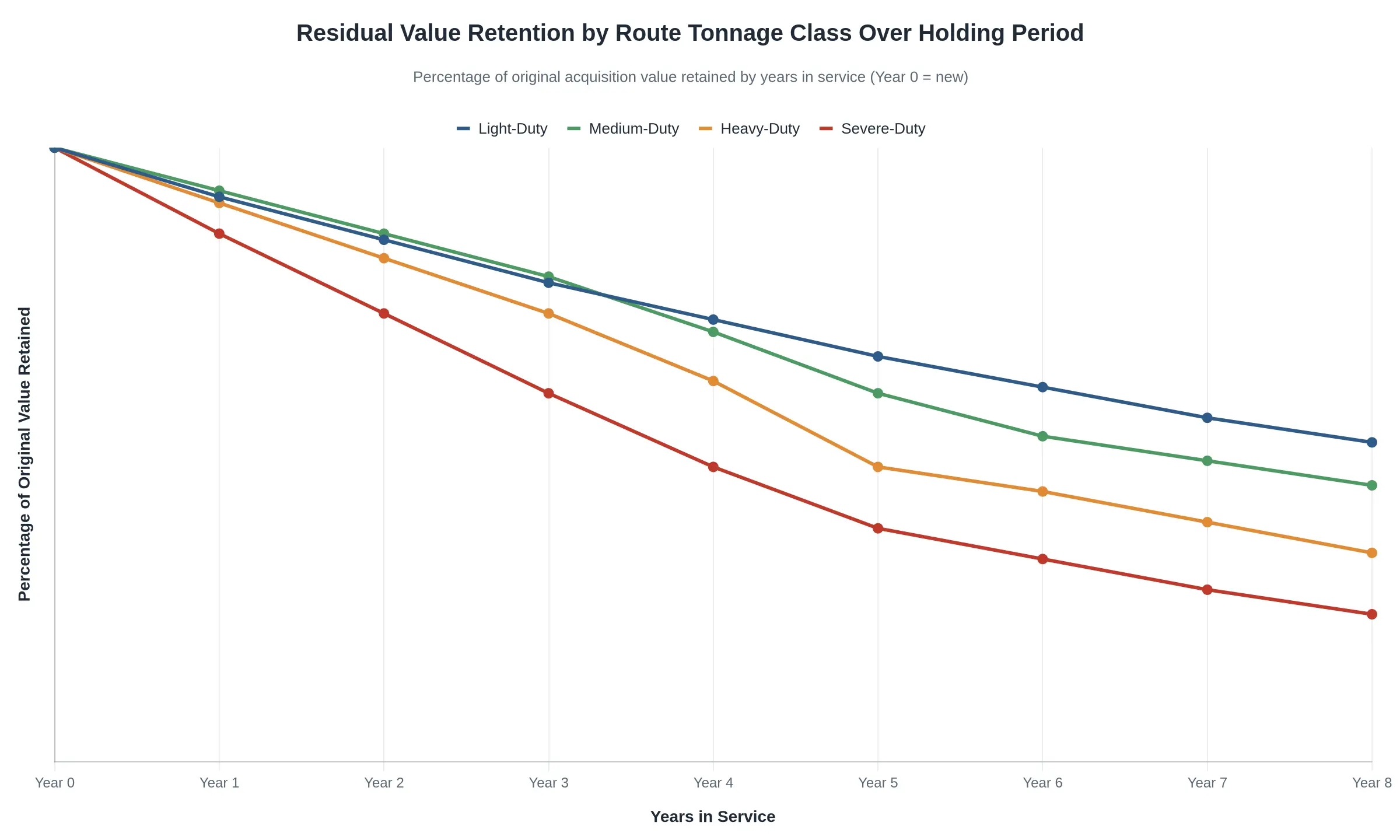
Tonnage class changes the depreciation slope, and the four curves diverge rather than tracking in parallel. Medium-duty rear loaders hold the shallowest early curve, retaining roughly 60% of original value at year 5 and about 45% by year 8. Heavy-duty units decline at a moderate pace, holding approximately 48% at year 5 and settling near 34% by year 8. Light-duty trucks decline gently at first and flatten late, ending near 52%. Severe-duty rear loaders depreciate fastest, giving up the steepest share of their value in the first three years and retaining only about 38% at year 5 and roughly 24% by year 8, a reflection of the punishing duty cycles and accelerated wear these units absorb.
By year 8, roughly 21 percentage points separate the best- and worst-retaining classes. Severe-duty assets lose value quickly enough that they reach economic rebuild thresholds earlier, which shortens the replacement window and pushes total cost of ownership toward more frequent turnover. Fleets weighing route assignments against resale exposure should treat tonnage class as a primary variable in lifecycle planning, not a downstream detail.
For teams benchmarking subframe and chassis retention against lift-equipment configurations, reviewing comparable subframe and lift cylinder checks on used units can help validate whether a discounted severe-duty asset is genuinely worth the earlier rebuild cycle.
Key Factors When Matching Route Tonnage to Service Profile
- Route stop density – High-density, short-throw routes reward lighter, more maneuverable bodies with faster cycle times, while dispersed stops justify heavier-rated packers that can absorb longer travel distances without consistent payload penalties.
- Average container weight and volume – Benchmark the true mean and upper-range container loads on the route; a stream dominated by dense, wet waste demands a higher GVWR and greater compaction force than one handling bulky, low-weight material.
- Compaction ratio requirements – Match the packer’s rated compaction ratio to the actual material stream, since higher ratios reduce trips but increase structural and hydraulic stress that accelerates wear and shortens component life.
- Axle configuration and legal payload limits – Balance front and rear axle ratings against bridge-law payload caps; over-specifying tonnage without matching axles simply adds tare weight and erodes usable legal payload. For a parallel sizing exercise, see how to match bin size to chassis length.
- Terrain and grade – Rolling or steep collection areas demand more torque and braking capacity, so grade profile should push the required tonnage upward even when average stop weight stays moderate.
- Daily lift counts – Track lifts per shift to estimate cycle-driven fatigue; very high lift counts shorten rebuild intervals regardless of the nominal tonnage rating.
- Expected holding period – A longer intended service life justifies over-specifying tonnage for durability, whereas short-hold fleets should size closer to actual duty to protect resale liquidity.
Matching Tonnage to Route Profile for Optimal Lifecycle Economics
Route tonnage is not just a line on a spec sheet. It shapes acquisition cost, fuel burn, depreciation, and rebuild interval on a rear loader garbage compactor truck. When tonnage matches the actual service profile, the truck approaches its rated gross vehicle weight rating (GVWR) on most shifts, depreciates predictably, and commands strong resale value. When it is mismatched in either direction, the economics erode long before the first rebuild.
The Hidden Cost of Over-Speccing
A 25-ton GVWR chassis dispatched on a route that consistently tops out at 14 tons of payload never reaches its design load. The operator finances steel, axles, tires, and brakes they never fully use.
- Acquisition cost rises roughly 15-25% over the adjacent lighter class.
- The asset is perceived as underworked, so absolute resale dollars fall from a higher original price base even when the retained percentage looks comparable.
- Low annual mileage stretches the rebuild interval on paper, yet heavy-idle, low-cycle collection duty still wears the packer, hydraulics, and brakes.
The Cost of Under-Speccing
Running a lighter rear loader on a route that demands more route tonnage invites chronic overloading, and the consequences compound:
- Accelerated packer panel fatigue, chassis frame stress, and brake wear.
- Rebuild cycles compressed well below the expected interval, pulling major capital outlays forward.
- Compliance exposure: axle-weight violations, tire overloads, and failed safety inspections that can trigger an out-of-service order.
- A documented hard-life history that suppresses resale value for the remainder of the asset’s service life.
Reasoned Thresholds Between Adjacent Classes
The decision should be driven by worst-case payload, not average payload. A workable rule: if a route’s peak payload sits within roughly 80-85% of the lighter class’s legal payload, stay light; if it routinely exceeds about 90%, step up to the next class.
| Route profile | Typical peak payload | Recommended GVWR class | Primary risk to manage |
|---|---|---|---|
| Light commercial / inner-city | 8-12 t | 16-18 t | Cubing out before weighing out; prioritize body volume |
| Standard residential | 12-16 t | 20-23 t | Peak-day overload; match packer cycle to stop count |
| High-density multi-family / heavy commercial | 16-20 t | 25-28 t | Axle-load compliance; brake and chassis duty cycle |
Bin-to-Chassis and Alternative Equipment Strategies
Tonnage matching does not exist in isolation; it intersects with how bins and bodies are configured. Operators weighing alternative equipment strategies should apply the same discipline, matching bin and body capacity to the chassis rather than defaulting to a heavier class “just in case.” When a single driver must choose between hooklift and cable hoist setups for swapping bins on tight city blocks, gearing, body geometry, and GVWR matter as much as raw lifting capacity. Get route tonnage right, and the truck works exactly as its spec intends, earning a longer rebuild interval, a cleaner service record, and a firmer resale number.
Frequently Asked Questions: Route Tonnage, Resale Value and Rebuild Cycles
How does route tonnage affect the resale value of a rear loader garbage compactor truck?
Route tonnage decides how many compaction and packer cycles the body, hopper, and hydraulics absorb in a service year, which is why it predicts resale value better than any other specification. A 20-yard rear loader garbage compactor truck on a light residential route at 8-10 tons per day wears far more slowly than an identical unit pulling 16-18 tons on dense commercial collection. The high-tonnage truck reaches rebuild thresholds sooner and takes a steeper discount. Buyers therefore price used units on documented lifetime tonnage, not odometer mileage alone, because a 300,000-mile highway truck and a 300,000-mile urban route truck have very different life left. Lower cumulative route tonnage means stronger resale value and fewer mid-life capital outlays.
What is the typical rebuild interval for different tonnage classes?
Rebuild cycles track the structural and hydraulic loads a body endures, so the route’s tonnage class largely sets the interval. Light-duty rear loaders under 25,000 lb GVWR on residential routes commonly stay serviceable for 6-8 years before a major rebuild. Mid-weight 25,000-33,000 lb units on mixed routes typically follow a 4-6 year cycle. Heavy 33,000-40,000+ lb bodies on high-density commercial work often need packer, floor, and cylinder work every 3-5 years. Fleets that log route tonnage can forecast these cycles as planned line items instead of surprise failures. The pattern holds across makers because steel, cylinder bores, and hopper seams respond to cycles and pressure the same way no matter whose chassis carries them.
Does higher route tonnage always mean a longer service life?
No. Higher tonnage capacity widens the operating envelope, but it does not extend the life of a body that consistently runs at its outer limits, because packing pressure, floor abrasion, and cylinder cycling add wear faster than the extra capacity offsets it. A heavy-spec rear loader garbage compactor truck used at moderate route tonnage will outlast a lighter spec unit pushed to its ceiling, since the marginal ton is far more damaging than the first. Service life depends on the ratio of actual route tonnage to rated capacity, not the nameplate number.
How do you assess remaining rebuild life during a used-truck inspection?
Look for the wear signatures route tonnage leaves behind instead of trusting the hour meter. Measure floor plate thickness, check hopper and body seams for fatigue cracking, examine cylinder rod condition and barrel scoring, and verify tailgate and packer panel alignment against factory tolerances. Service records that show route tonnage and prior rebuild cycles let you estimate how much of the body’s design life is left before the next overhaul.
How does route tonnage influence financing and resale liquidity?
Lenders and dealers read documented route tonnage as a proxy for useful remaining life, which shapes advance rates and how quickly a unit sells. Low-tonnage municipal-style rear loaders with clean rebuild histories turn over faster and bring more money. Heavy high-tonnage units sell to a narrower pool of commercial haulers willing to absorb near-term rebuild costs. Accurate tonnage documentation removes risk from the transaction and widens the buyer base.
How do municipal versus private hauling routes change tonnage economics?
Municipal routes tend to be steady, lower-density collection with predictable tonnage, which produces gentler rebuild cycles and more durable resale value. Private hauling often concentrates high-density commercial tonnage that shortens service intervals but earns more revenue per stop. The operator has to weigh faster depreciation against higher route productivity. Matching the rear loader garbage compactor truck’s spec to the realistic tonnage profile is what protects both operating margin and long-term asset value.
Key Takeaways
| Factor | Light Tonnage | High Tonnage |
|---|---|---|
| Typical rebuild interval | 6-8 years | 3-5 years |
| Resale value trend | Stronger, broader buyer pool | Discounted, narrow buyer pool |
| Life driver | Tonnage-to-capacity ratio | Tonnage-to-capacity ratio |
Assessing a used rear loader means reading its route tonnage history, not just its hours.
Tonnage Is a Lifecycle Decision, Not a Purchase Decision
Route tonnage is a primary determinant of both resale value and rebuild cycles. When chassis and compactor specifications are mismatched to the duty cycle a route actually imposes, the damage is not isolated: wear accelerates across the body, the packer mechanism, and the driveline, which compresses the interval between rebuilds and erodes the residual value a fleet can recover at the end of first service. Operators who select tonnage purely against acquisition price, without modeling realistic route payloads and daily stop density, absorb those costs later as premature overhauls and weaker trade-in positions.
Practical Takeaways
- Model tonnage against real route duty, not nominal capacity. Match rear loader sizing to measured payloads, stop density, and daily cycles so the compactor operates within its engineered envelope rather than at its limits.
- Treat over-specification and under-specification as distinct financial risks. Oversized units carry excess capital and lower utilization efficiency; undersized units drive rebuild frequency. Both distort total cost of ownership.
- Underwrite residual value at acquisition. Build resale assumptions into the purchase decision by tracking how tonnage class performs in secondary markets and how rebuild intervals map to depreciation curves.
- Standardize tonnage classes across the fleet where routes allow. Consistent specification simplifies maintenance, parts planning, and driver training, and it strengthens negotiating leverage in both procurement and disposal.
About CRRC
CRRC, the manufacturer behind CRRCTrucks, supplies special vehicles, including garbage trucks and sanitation vehicles, to clients worldwide. A strict, disciplined quality system governs materials, assembly, and final inspection on every platform, so fleets receive equipment engineered for demanding municipal and private collection work. Buyers weighing lifecycle economics rather than sticker price can review the range and specifications at CRRC Trucks.