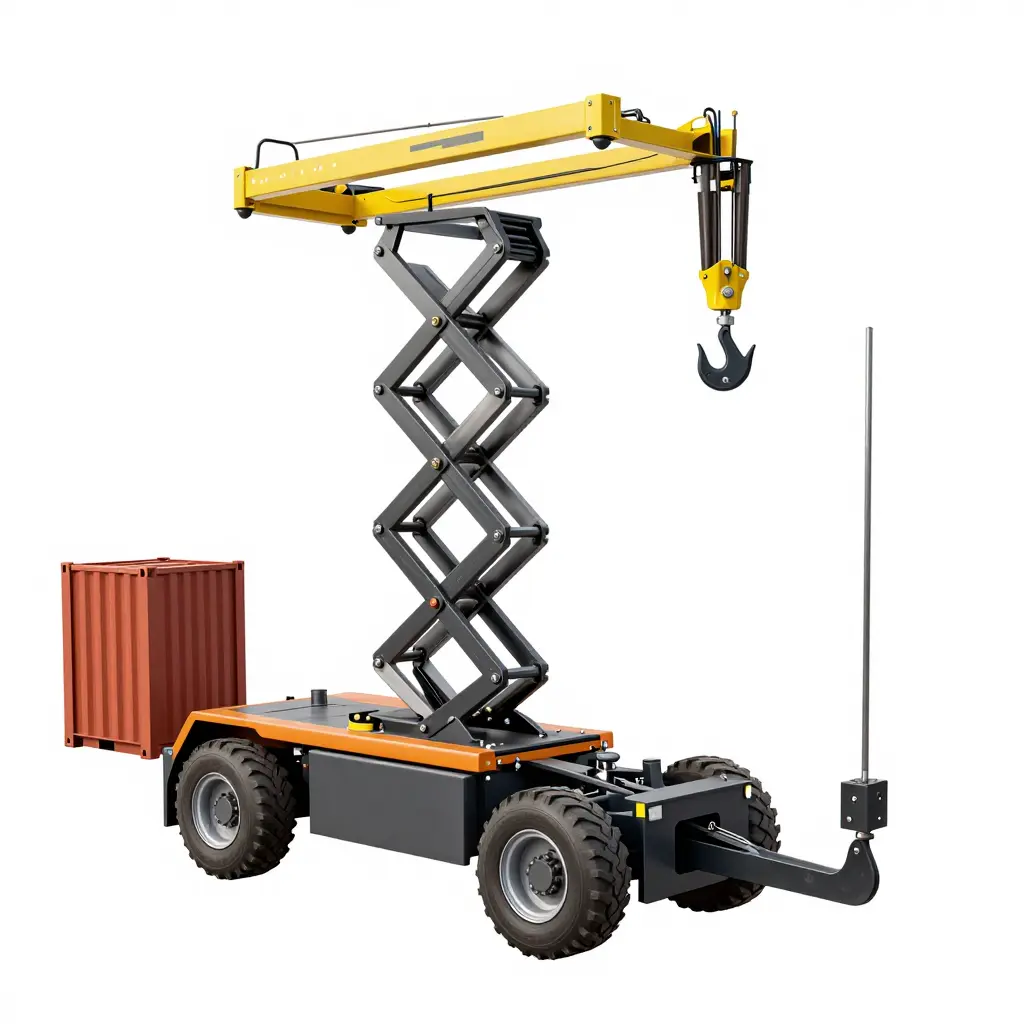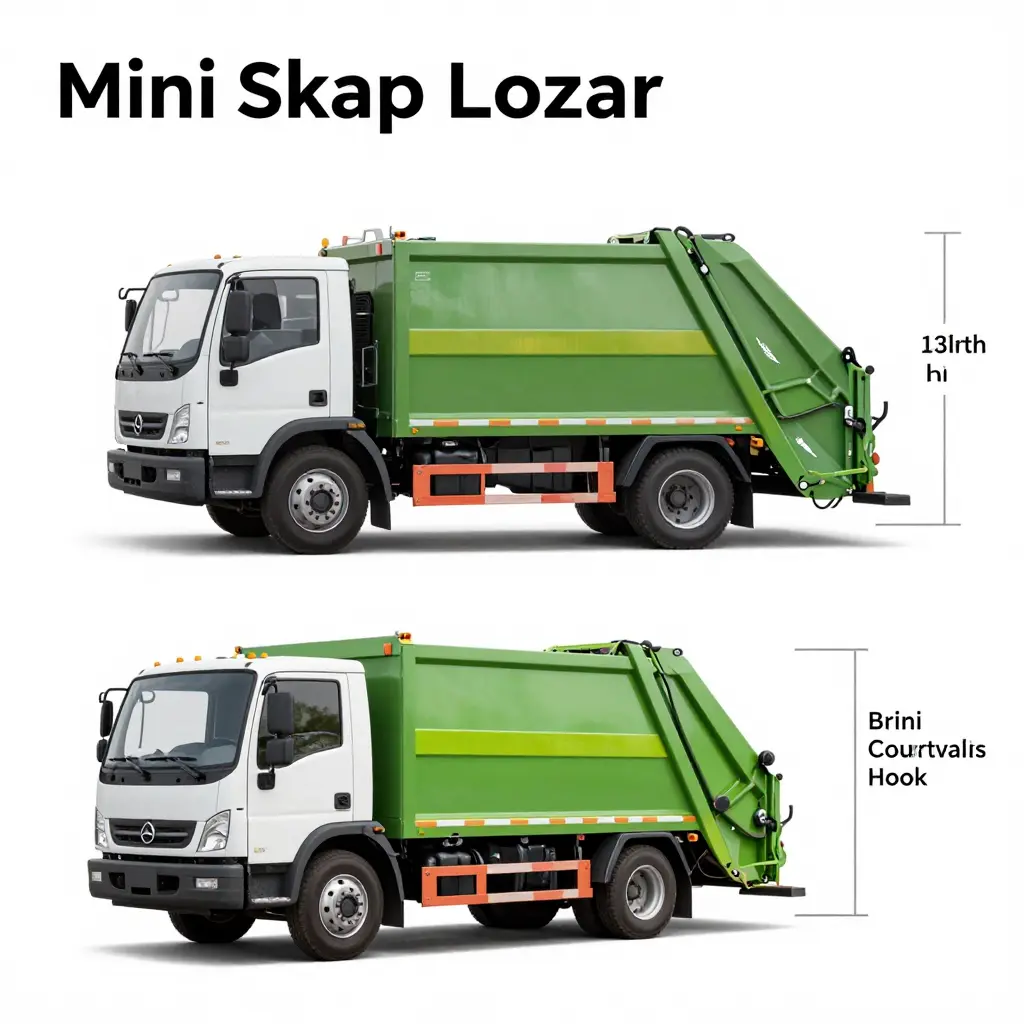
A mini skip loader garbage truck is a compact hook lift built to carry, set down and tip small skips where a full-size unit cannot turn. Two numbers decide whether it works in courtyard collection: bin capacity against the collection cycle, and lift arm clearance measured before the order goes in.
Bin capacity is the usable volume of the skip the unit lifts and tips, so it has to suit how often the site gets collected. Lift arm clearance is the vertical and horizontal room the hook and arm need in order to raise and tip a bin without hitting walls, gate posts or overhead cables. Courtyard collection means servicing bins from an internal yard or shared block, where approach space is short and turning room is minimal.
- Capacity set wrong: sized too large for the cycle, skips overflow between visits; sized too small, the unit makes extra empty trips that burn driver hours. Start with bin size against chassis length, which fixes the chassis-side ceiling.
- Clearance set wrong: the arm fouls a wall on the lift, or cannot reach the bin at all. No payload figure or body specification recovers that.
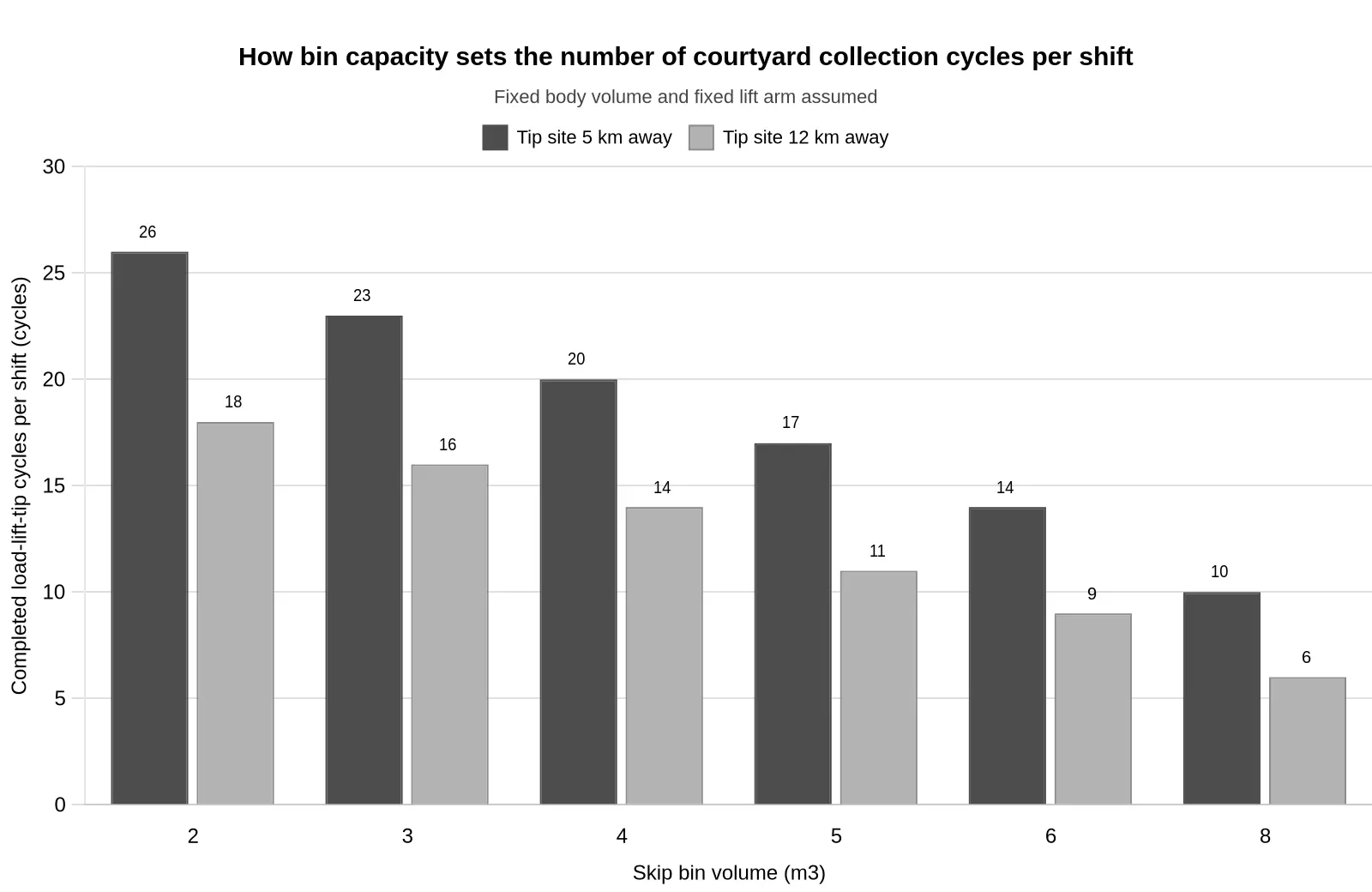
Where the curve flattens is the largest bin that still fits inside a shift: about 5 m³ with a 5 km tip run, about 4 m³ once the tip site sits 12 km away. Past that point a bigger bin adds volume the shift cannot absorb.
Matching bin capacity to courtyard collection
Start with the daily volume at each point
Bin capacity follows the refuse a courtyard produces in a day, not the size of the yard. Count the households or units, apply a per-unit daily figure (roughly 0.010 to 0.015 m³ of loose domestic refuse per apartment), and add headroom for weekends and wet days. A courtyard producing 0.45 m³ a day will overfill a 240 L bin before the second lift, so a 660 L bin emptied daily becomes the practical minimum. Anything smaller moves the overflow onto the ground and onto your supervisor’s phone.
Bins per trip: volume first, weight second
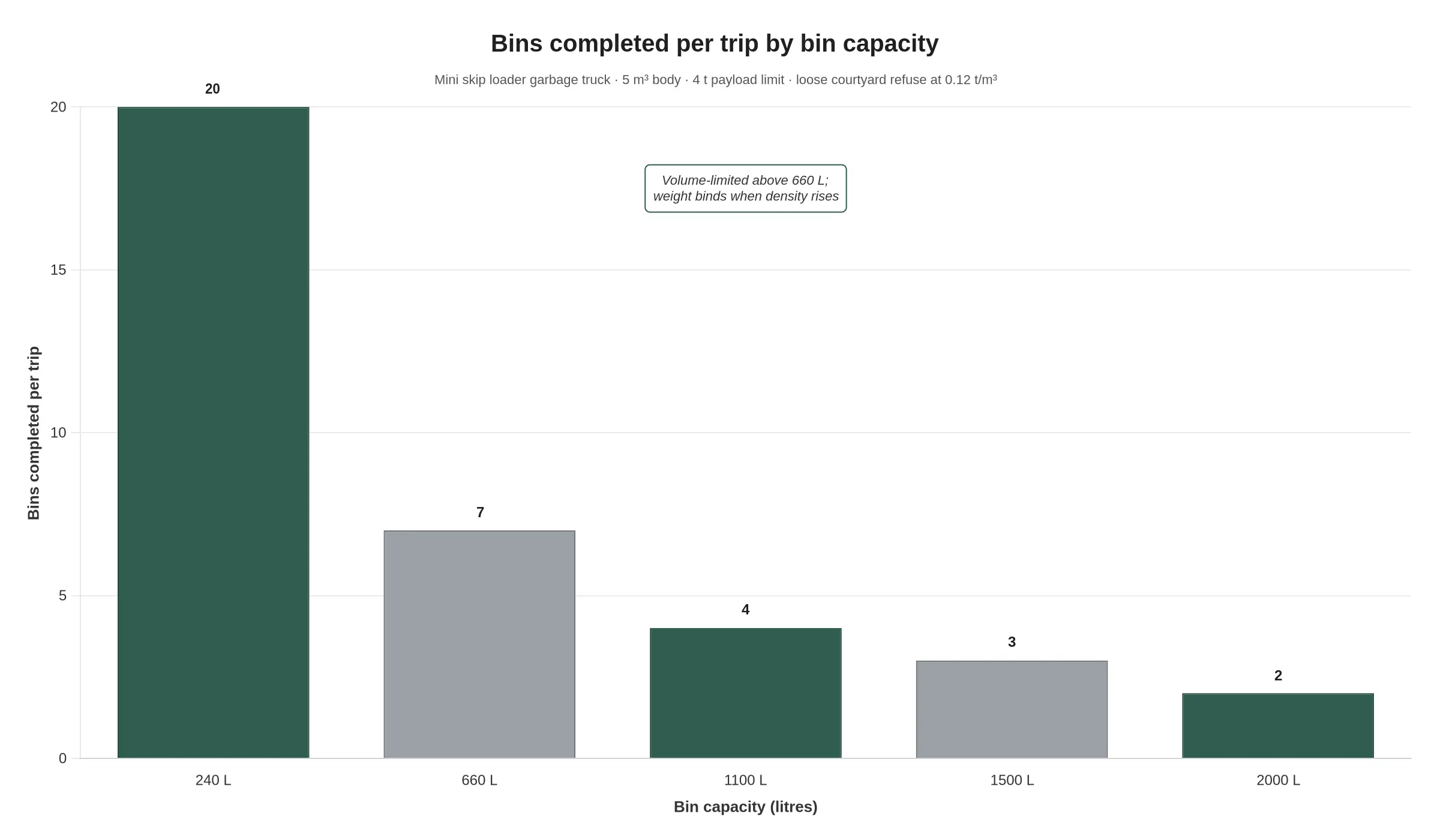
A mini skip loader garbage truck completes a trip when the body fills or the payload runs out, whichever comes first. Take a compact unit with a 5 m³ body and a 4 t payload limit. Loose courtyard refuse at around 0.12 t/m³ is volume-limited, because 5 m³ of it weighs only about 0.6 t. That makes bin capacity against body volume the ratio that matters: divide body volume by bin capacity and round down. Compaction does not close that gap, because a skip loader does not pack a load the way a rear-loader does.
Heavier material sits between the two limits. The payload starts to bind once density passes payload divided by body volume, which is 0.8 t/m³ for this 5 m³, 4 t unit. Commercial kitchen waste at 0.35 to 0.45 t/m³ stays below that, so the body still fills first; what often goes wrong there is granularity. Once the leftover space is smaller than the next bin, that bin waits for the next trip instead of being squeezed in.
The same body takes roughly twenty 240 L lifts but only two at 2,000 L. Every lift spends body volume the truck cannot get back.
Three sizing rules worth handing to any supplier:
- Size each bin to peak daily volume at that collection point, not to the weekly average.
- Keep bin capacity at or below one-fifth of body volume if you need five or more drops per trip.
- Check loaded weight (bin tare plus refuse) against the narrow chassis rating before you order.
Footprint and loaded weight on a narrow chassis
Courtyard collection lives or dies on access. A 1,100 L bin on castors takes up roughly 1.4 m by 1.1 m and still needs swing room for the lift arms; a 2,000 L bin needs noticeably more, and a chassis only 2.0 to 2.2 m wide may not get its arm centres over that bin on a tight turn. Loaded weight adds to the problem: a 1,100 L bin holds about 440 kg of wet refuse plus 90 kg of steel, and that mass arrives on the rear axle at full arm extension. Legality is about axle load, not body capacity, so weigh the realistic worst bin and compare it with your plated limits. The same discipline applies in matching bin size to chassis length.
Why oversizing cuts cycles instead of raising throughput
A 2,000 L bin where 660 L would do takes the truck from seven drops per trip down to two. The operator still drives the same courtyards, still lifts with the same arm, and still burns the same hours, but finishes far fewer cycles before the shift ends. Oversized bin capacity lowers the number of collections the fleet completes, and it usually forces a second vehicle or an extra run at overtime rates. Buy the smallest bin that clears peak daily volume, and put the savings into another unit or a tighter route.
Mini skip loader garbage truck: bin capacity against loaded mass and chassis class
Volume alone says very little about whether a mini skip loader will pick a bin up. Loaded bin mass and chassis GVW class move together, and the lift arm has to clear the bin’s pocket before any of it matters. Compare your courtyard bins against this reference before you talk to a body builder, and read more on matching bin size to chassis length if your sites vary in width.
| Skip bin nominal volume (m³) | Typical loaded bin mass (kg) | Recommended body volume (m³) | Chassis GVW class (t) | Minimum lift arm clearance to confirm (mm) |
|---|---|---|---|---|
| 2 | 800 | 2–3 | 3.5–5 | 1,100 |
| 3 | 1,300 | 3–4 | 5–7.5 | 1,200 |
| 4 | 1,800 | 4–5 | 7.5–10 | 1,300 |
| 6 | 2,900 | 6–7 | 10–12 | 1,450 |
| 8 | 4,000 | 8–9 | 12–15 | 1,600 |
How to use the row you land on: the loaded mass figure is what the lift arm has to survive, and wet green waste, food waste and construction offcuts will push a nominally light bin well past its dry weight, so leave headroom on the arm and on the rear axle instead of sizing to the brochure maximum. The body volumes above are the smallest that suit each bin. Where you want several lifts per trip, size the body from the bin count and the one-fifth rule in the previous section.
The figures are representative; confirm every value against the supplier’s load chart for your exact body and arm.
Measure the lift arm clearance before you sign the order
Before bin capacity or body length, measure the air around the bin. Lift arm clearance is the three-dimensional envelope the arm and bin sweep through: the vertical rise as the hook takes up the load, the lateral swing as the bin tilts back over the chassis, and the arc the bin lid traces as it opens. A courtyard gives you walls, gates, kerbs, drain covers, and sometimes a low cable run overhead. Anything inside that envelope turns a routine lift into a damaged bin, a bent arm or a claim.
The five measurements to record on site
- Approach gap: the clear distance between the bin face and the nearest wall or gate post. Short by a few centimetres and the arm cannot close on the hook squarely, so the bin drags in at an angle and the hook lands off centre.
- Lateral swing clearance: free space either side of the bin as it rotates up. Too tight and the bin corner rakes the wall or clips the gate hinge every few lifts, which is why that damage tends to go unnoticed until it is serious.
- Overhead height at the pick-up point: measured with the bin fully raised at its worst angle. A few centimetres short means the lid arc fouls a cable tray or canopy, and the operator stops the lift halfway out of habit, loading the cylinder.
- Ground slope at the bin stand: fall across the footprint, not along it. Even a small off-level base throws the bin sideways as it lifts, and the clearance you measured on paper no longer exists.
- Distance from bin lip to arm hook: the reach you actually need. Short here and the bin sits too far back for the hook to engage fully, so the lift starts with a jolt.
Write these down against your worst-case bin position, then repeat against the second-best one. Courtyard sites rarely let you choose the stand.
Then match bin size to the chassis
Clearance numbers only mean something once you know which body length you are buying. The gap needed between bin and cab grows with the bin, so read matching bin size to chassis length before you fix the spec. Then confirm what the arm will actually lift. Loaded weight is what stresses the hook, and the tare figure is how you get there, so check the numbers in this guide to understanding tare weight.
Lift arm clearance points at a glance
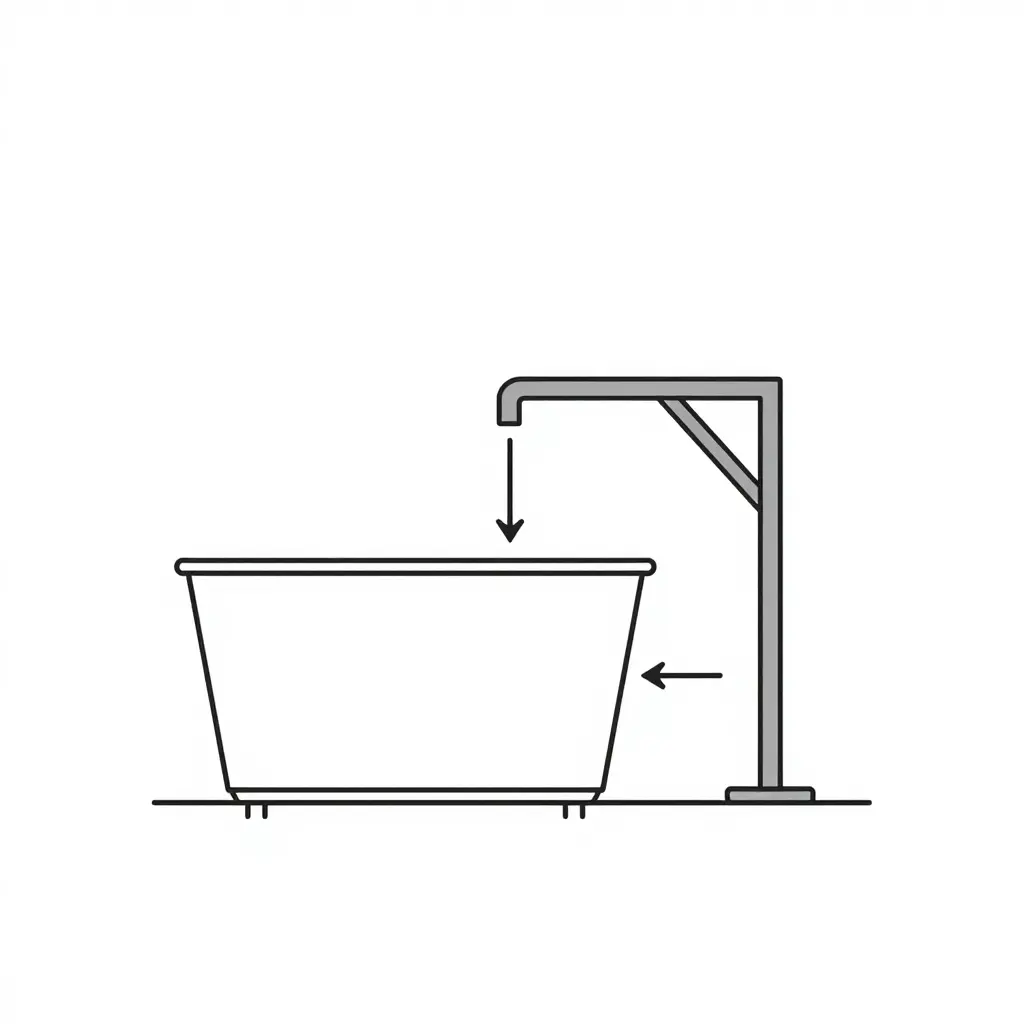
The sketch shows relationships, not hardware: the lateral gap between arm and bin, the overhead height the arm sweeps through, and the ground line everything is measured from. Take those three readings on site before you commit to a body and arm combination, and pair them with the bin-to-chassis arithmetic in our guide to matching bin size to chassis length.
Lift arm clearance and bin capacity checks to complete before confirming an order
Hand this sheet to your site supervisor and ask for a written figure beside every line. If a number is missing, the order is not ready to confirm. Our guide to matching bin size to chassis length explains why each figure below decides whether the truck fits the courtyard.
- Record the narrowest approach gap along the whole bin route in millimetres, measured between the two tightest fixed obstructions, and mark that pinch point on a simple site sketch.
- Measure the overhead obstruction height at the pick-up point in millimetres, from ground level up to the lowest cable, branch, canopy edge or doorway header.
- Note the ground slope and surface at the bin stand, giving the gradient in percent plus the surface type (concrete, asphalt, gravel, block paving) and any soft patch that appears after rain.
- Log the bin lip height and hook position in millimetres, from ground to the underside of the lip and to the centre of the hook, so the lift arm geometry can be matched to that exact bin.
- Confirm the bin’s loaded mass in kilograms by weighing one typical full bin on a portable scale, not from the nominal capacity plate.
- Verify the bin volume against daily refuse volume per point, in cubic metres per day, so no single point fills before the next scheduled collection.
- Check the body volume against the number of daily cycles, dividing total daily refuse volume by planned trips to confirm each load lands inside the body rating.
- File all eight figures alongside the chassis and lift arm specification on one sheet, so the supplier signs off clearance, hook height and payload together before an order number is raised.
A checklist filled in this way turns a vague courtyard problem into a specification the factory can build against, and it leaves a written record if a bin later fouls a wall or a lift stalls short of the hook.
Locking the specification with the manufacturer
Measured figures become a purchasing document once they are written as numbers the factory is obliged to meet. Most of the risk sits between the courtyard survey and the purchase order, because a loose annex leaves the builder free to supply whatever is closest to its standard product.
State capacity and clearance as numbers in the technical annex
Keep the descriptive text brief and move every critical figure into the technical annex as one value, one unit, and one stated measurement condition. Prose such as “sufficient lift height” cannot be verified at pre-shipment inspection. “2,150 mm from ground level to the underside of the hook at full lift, on level ground, at rated load” can be checked with a tape measure and signed off.
| Annex field | What to write | Why it matters |
|---|---|---|
| Bin capacity | Nominal capacity in m³ to one decimal, with struck or level basis named | Container suppliers quote capacity on different bases |
| Lift arm clearance | Lowest point of the arm above ground at full lift, in mm | Sets gate, kerb and overhead clearance in service |
| Cylinder rating | Bore, rod, stroke and rated working pressure | Determines real lifting capability, not catalogue tonnage |
| Pump flow | L/min at the PTO speed the truck will actually run, plus relief setting | Controls cycle time and cold-start behaviour |
Add the tolerances you will accept, and require written agreement before the body is mated to the chassis if any value changes. Cross-check the finished annex against the sizing logic in this guide to specifying a garbage tipper truck from a China-based manufacturer.
Confirm cylinder rating and pump flow against the heaviest bin
Work from the heaviest bin in the fleet, not the average. Confirm the hydraulic lift cylinder’s rated capacity at working pressure, with margin for a wet load and a partly jammed container, then confirm pump flow at the speed the PTO will run in daily operation. Those two figures set cycle time, and they explain most cold-morning stalls. The checks in this review of subframe and lift cylinder checks show which details belong in writing.
Specify plate thickness where wet refuse is handled
Where bins carry food waste or leachate, state floor and side plate thickness in millimetres, name the steel grade, and require the floor to be a continuous sheet or a fully welded joint rather than a lap. Add the corrosion protection schedule while the annex is open.
Require the clearance envelope to be confirmed on the actual chassis
Ask the factory to confirm the clearance envelope on the chassis that will carry this body: measured, photographed and signed off, not extrapolated from a generic drawing for the model family. Frame height, cross-member position and suspension options all move the numbers.
Units are built under CRRC’s quality system and delivered to global clients, which makes the annex the document every inspection is measured against.
Frequently asked questions
What is the smallest bin capacity that suits courtyard collection?
For courtyard work the practical floor is a 3 m³ (about 4 cu yd) skip; anything smaller adds a lift cycle without reducing the space the bin occupies. A 4 m³ to 6 m³ bin is the common working size, because it still fits a 2.2 m wide passage while holding enough refuse to justify the trip. Below 3 m³ the truck spends more time on hydraulic cycles than on collecting, so the route cost per tonne climbs. If you are weighing body length against bin size, this guide on matching bin size to chassis length walks through the arithmetic.
How much lift arm clearance should be allowed beyond the bin’s physical size?
Allow a minimum of 300 mm (12 in) of lift arm clearance on each side of the bin’s widest external point, and 500 mm where the yard has a gatepost, kerb or wall corner. The same 300 mm minimum applies vertically above the bin’s top edge, so the arm can arc without striking an archway or branch. Take them with the bin static and level, not from the driver’s seat.
Can a mini skip loader garbage truck lift the same bins as a full-size hook lift unit?
Usually not. A mini skip loader garbage truck is rated by its lift cylinder and boom geometry, and it typically handles bins of 2 m³ to 8 m³, or roughly 0.8 t to 4 t loaded, which is where the chassis classes above sit. A full-size hook lift unit commonly works bins of 12 t to 20 t. The bin’s hook height and rail spacing must also match the truck’s hook profile, so a bin built for a large unit can be physically too tall to seat correctly.
Which figure comes first, bin capacity or lift arm clearance?
Measure lift arm clearance first, because the site fixes it and you cannot change it by choosing a different bin. Bin capacity is the variable you adjust afterwards, within the envelope the passage allows. Reversing that order produces a truck that cannot enter the courtyard at all.
What happens to collection cycles if bin capacity is oversized for the route?
Oversizing cuts the number of lifts per trip, and each lift takes longer. Once the bin exceeds the body volume, the truck also has to tip mid-route, adding a disposal stop the schedule did not include. An oversized bin pushes rear axle load up faster as well, which can take the vehicle over its plated limit before the body is full.
Closing summary: the order that holds up
Measure lift arm clearance first, because that single figure decides which bins the truck can actually reach and set down inside a courtyard. Then match bin capacity to daily refuse volume and body volume, so the route empties once rather than twice. Finally, fix both numbers in the technical annex, where they become the reference point for every future service call and replacement bin order, as outlined in this sizing guide.
Three points to confirm before signing
- Lift arm clearance measured at the tightest courtyard entry, with the bin at full lift, not at rest.
- Daily refuse volume in cubic metres checked against both bin capacity and body volume, with the peak collection day included.
- Both figures written into the technical annex and cross-checked against the chassis plate and body rating.
A specification built on measured figures keeps a mini skip loader garbage truck productive in tight courtyard collection routes.