Match Body Volume to Route Tonnage Before You Lock the Build Spec
When you buy from a garbage tipper truck manufacturer China-based or elsewhere, the first number to settle is not the paint colour or the cab layout. It is the relationship between body volume and route tonnage, because those two figures decide how much waste the vehicle can legally and practically move per shift. Settle them before the build spec is signed. Once the steel is cut and the hoist geometry is fixed, changing capacity means rebuilding the truck.
Every route has a tonnage ceiling: the weight of refuse collected per day, which follows material density and stop count. A garbage tipper truck body quoted in cubic metres with no reference to that weight is a guess, and an expensive one to correct after delivery.
An oversized body carries steel and empty air the route never fills. The truck runs light on every trip, burns fuel hauling space it cannot use, and the extra body weight comes straight out of the payload left for refuse on the axle group.
An undersized body fills before the round is finished. The driver tips, returns and repeats, which adds trips, fuel and driver hours, and puts extra cycles on the hoist, tailgate seal and tipping frame.
A quick sanity check
Start with your own density figures, then check them against the axle ratings on the chassis you intend to buy.
| Route tonnage per shift | Loose refuse density | Body volume to plan for |
|---|---|---|
| 3 – 4 t | 250 – 350 kg/m3 | 12 – 16 m3 |
| 5 – 6 t | 250 – 350 kg/m3 | 16 – 22 m3 |
| 7 – 8 t | 300 – 400 kg/m3 | 20 – 26 m3 |
Volumes are struck capacity for a plain tipping body at the densities shown, before any heap margin. Check each row against local axle limits.
If the volume that fits your tonnage looks too small for the collection round, the answer is usually a denser load or a second unit, not a bigger body. For the material and hydraulic details that follow this decision, see this guide on sourcing body steel grade and hydraulic spec.
Matching Route Tonnage to Garbage Tipper Truck Body Volume
Size the body to the route before you approve drawings, and keep the body steel grade and hydraulic spec checklist open alongside it.
| Route tonnage per shift | Typical refuse bulk density (kg/m3) | Body volume range (m3, packed load) | Matching chassis GVW class | Build spec item to verify first |
|---|---|---|---|---|
| Up to 5 t | 250 – 400 | 8 – 10 | 7.5 – 10 t (4×2 light) | Floor plate thickness |
| 5 – 10 t | 300 – 450 | 10 – 14 | 12 – 16 t (4×2 medium) | Tailgate seal |
| 10 – 18 t | 350 – 500 | 14 – 18 | 16 – 18 t (4×2) or 6×4 | Body lift cylinder |
| 18 – 25 t | 400 – 550 | 18 – 22 | 25 t (6×4 heavy) | Floor plate thickness |
| 25 – 35 t | 450 – 600 | 22 – 26 | 31 – 33 t (8×4 heavy) | Body lift cylinder |
Route tonnage here is tonnage per shift across all trips, not payload per trip, so a 30 t shift on a 33 t GVW chassis means two or three loads. This grid assumes the load is packed to roughly twice its loose density, the way a compactor body packs it; on a plain tipper, roughly double these volumes. That is also why the figures differ from the sanity-check table above, which is sized on loose density for a plain body. Confirm every row against local axle load limits and registered GVW before locking the build spec.
The Tonnage-to-Volume Calculation Chain
Most buyers arrive with a body size already in mind – 12 m³, 16 m³, 20 m³ – and then try to bend the route around it. The calculation runs the other way. Route tonnage is the input; garbage tipper truck body volume is the output. The chain goes in this order:
- Fix route tonnage per shift. Weigh what one truck collects between disposal runs, or estimate it from a round you already service – 7 tonnes across two tip-outs on a wet commercial route, for example. If you can weigh it, weigh it.
- Convert tonnage into trips available. Divide that figure by the payload the chassis can legally and practically carry, then check how many loads the shift can complete before the day ends.
- Apply the bulk density of the collected refuse. Loose mixed household waste as tipped sits around 100-250 kg/m³. Wet, food-heavy commercial bins reach 400-600 kg/m³, and soaked rubble or sludge runs 800-1,200 kg/m³. The grids above quote packed densities, which is why their numbers run higher.
- Calculate required body volume. Volume = mass ÷ density, per trip, plus a heap margin so you are not chasing the load over the sidewall.
- Check chassis payload and axle limits. A tipper truck body that fills to the rail at 8 tonnes on a chassis rated for 5 tonnes on the rear axle is a fine volume with a failed weight certificate.
Struck Volume vs. Usable Heaped Volume
Struck volume is the body filled flat to the top rail. Usable heaped volume is what you can realistically carry with a slight mound that does not spill on the first corner or climb a gradient into the tailgate. Specify struck volume for the legal paperwork and heaped volume for the route plan. The gap between them is usually 10-20%, and it shrinks to nothing once the material is wet and sticky.
Why Wet Refuse Changes the Answer
Water is heavy, and it rearranges the load. A bin that leaves the yard at 90 kg can be far heavier after a wet week once water gets past the lid, and damp material bridges in the corners instead of self-trimming, so usable heaped capacity drops at the moment each cubic metre gets heavier. This is how route tonnage drives body sizing in mixed-waste service, and it is why we ask for a wet-season density as well as a dry one.
Lock the volume before you choose the hydraulics. Cylinder bore and pump flow should be sized to lift and tip the load that volume actually produces. Do it the other way round and you end up buying a body that carries less than the route needs.
Where Body Volume Stops Paying Off
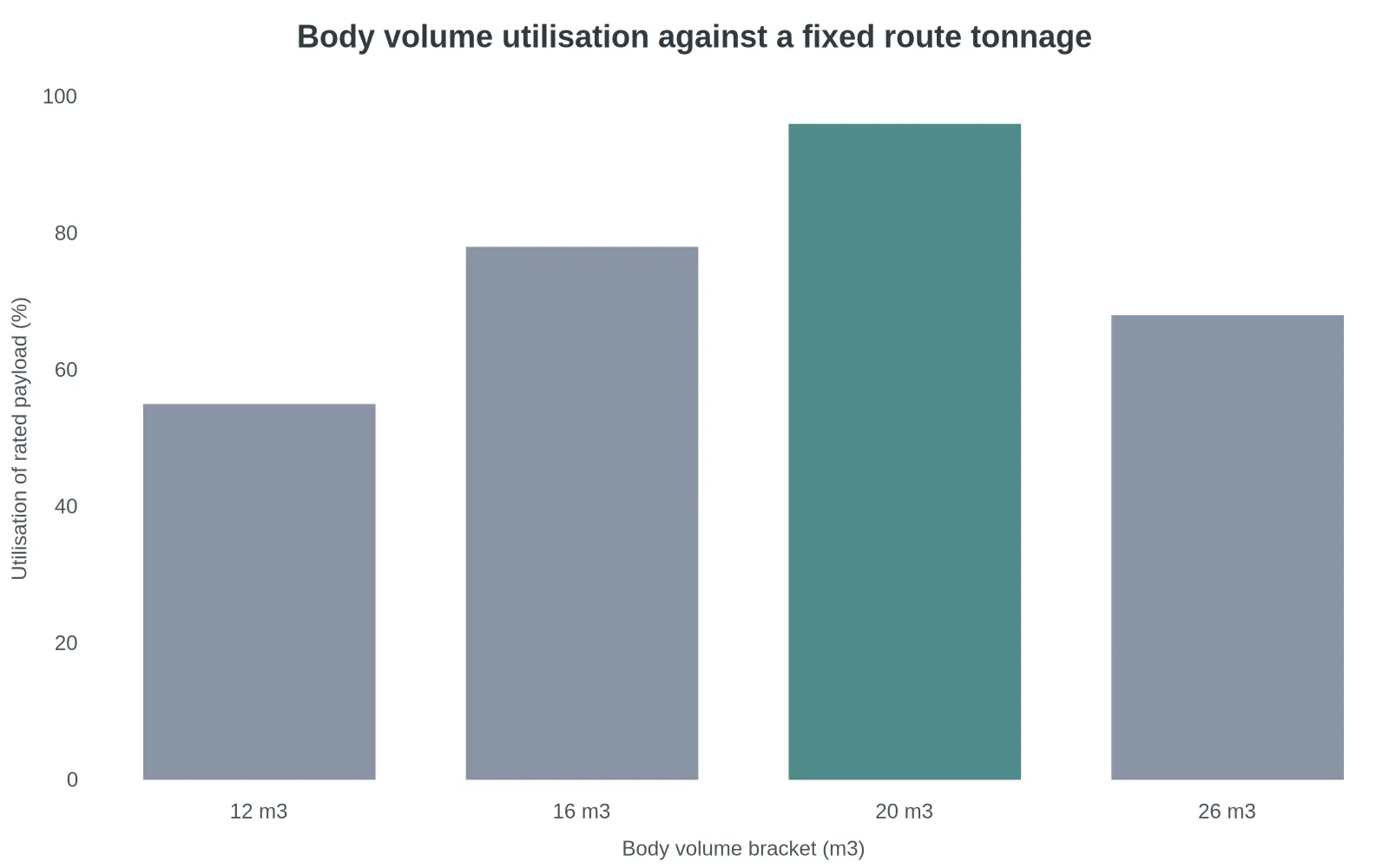
In the model behind this chart, payload utilisation reaches 96% with the 20 m3 body matched to the route, then falls to 68% once the body is oversized.
On a fixed route tonnage, an undersized body adds trips and an oversized one adds tare, so a half-filled box hauls steel that earned nothing. Only the matched bracket turns rated payload into paid work. If you want to see how compaction ratio sets that volume figure in the first place, read our guide to what a residential route really packs.
Data to Collect Before You Lock the Build Spec
Before you lock the build spec for a garbage tipper truck, pull the numbers below off your actual routes and sites. Each one moves the final body volume, steel grade or hydraulic package, and a guessed value turns into a unit that is too tall, too short or overweight.
- Tonnage per shift, including your heaviest day. Payload, not volume, decides whether the body fills legally before it fills physically.
- Collection frequency and stops per shift: more trips and compaction cycles per day point toward a packer body rather than a plain tipper.
- Refuse bulk density in kg/m3, measured per waste stream (loose cardboard and wet food waste sit at opposite ends of the volume-to-weight break point).
- Bin type and cart tipper compatibility, including bin lip width and pocket spacing. A mismatched lift geometry forces a different hopper height and body length.
- Tipping point height clearance at the transfer station or MRF – a low canopy caps body height and rules out high side walls before you ever discuss volume.
- Leachate volume per shift, and whether you need a sealed tailgate that stops leachate drips plus a drain valve (wet routes add weight, corrosion load and a tank detail the spec must include).
- Local axle load rules and permissible gross vehicle weight, which is the number that tells you which limit is hit first, volume or mass.
- Body steel grade and floor plate thickness the builder can actually supply. Thin floors wear through quickly on wet commercial routes and end in premature relining.
- Hydraulic pump flow and PTO spec at the chosen body volume. Undersized flow stretches cycle time, so the body never reaches the tonnage it was rated for.
- Legal overall length and the turning radius of your tightest city block: body length has to fit the route, not the yard where it gets parked.
Bring these as written numbers with units, not ranges. A builder can size around a quantity; it can only guess at an impression.

A two-state cross-section: the lower line is struck capacity, the upper line is usable heaped capacity, and only the band below each level is shaded. Read it together with our notes on body steel grade and hydraulic spec choices before confirming the build sheet.
From Volume to Build Spec: Turning Cubic Metres into Hardware Decisions
Once route tonnage has fixed the body volume, that single number still has to become a build spec that makes sense after three years of wet, gritty refuse. Volume on its own tells you nothing about whether the floor will dish, whether the cylinder will strain, or whether the tailgate will weep into the street.
Floor and side plate thickness
The floor takes the drop impact and the drag of every load, so it should run a step heavier than the sides, with an added wear strip in the discharge zone where scrapers and bins scrape hardest. Sides can be lighter for weight savings, but only after you have confirmed the refuse is not coming in mixed with rubble or wet construction debris. For the trade-offs between steel grade, plate thickness and hydraulic spec, see this guide to body steel grade and hydraulic spec sourcing.
Lift cylinder sizing and mounting
Size the cylinder for rated payload plus body and tailgate mass, then add margin for sticking loads and cold, thick oil. Mounting matters as much as bore: a properly braced subframe, a stable base position, and hard-piped lines routed clear of the tipping arc are what prevent the twisted rams and cracked mounts that show up on overloaded units. Ask your manufacturer in China to state the cylinder rating against your actual body mass, not a generic chassis figure.
Tailgate seal and leachate control
A tipper truck body that drips generates complaints. Specify a continuous replaceable seal, a drip rail that carries liquid back into the body instead of down the rear panel, and a drain point you can actually reach. If your current units leave trails on the road, this piece on tailgate seal gaps and leachate drips explains where the leaks start.
Tipping stability on uneven ground
Stability is a geometry decision: a wide subframe footprint, the cylinder base mounted as far forward as the design allows, and enough stroke to reach full discharge angle without a violent final lift. Train drivers to check cross-slope and ground bearing before raising, because no cylinder spec rescues a truck parked with one rear wheel in a soft verge.
Good builders wrap these choices into a documented quality system and a staged build: steel verification, weld inspection, pressure testing, and a load trial before dispatch. Ask to see that sequence, not just a spec sheet.
Plate thickness, cylinder bore, seal type and subframe layout all get settled by the tonnage figure. Move the tonnage and every one of them moves with it.
FAQ: Sizing Body Volume to Route Tonnage
Q: How do I estimate the required body volume from my daily route tonnage?
A: Convert daily route tonnage into loose cubic metres by dividing it by the bulk density of the refuse you actually collect, then divide by the compaction ratio of the body you are considering – 1.0 for a plain tipper. Add 10 to 20 percent for partial loads, end-of-shift carry-over and heap. The result is a working body volume figure to check against axle limits, not a final number.
Q: Does a larger garbage tipper truck body always reduce trips?
A: No. Trip count drops only while the payload stays inside the legal axle limit, so a body that fills before the axles reach their limit is carrying air and hauling its own extra steel. Extra volume also raises kerb weight, which cancels out part of the payload you thought you were gaining. Match route tonnage and density first, then choose size.
Q: What refuse bulk density range should I use when sizing?
A: Use roughly 0.10 to 0.30 t/m3 for loose, uncompacted household refuse as tipped, and around 0.40 to 0.60 t/m3 for wet commercial or mixed loads with food waste. The grids above quote packed densities, which is why they read higher. If route tonnage swings by season, size on the densest month rather than the annual average. State the assumption in writing so the quoted volume and your own figures agree.
Q: Which build spec items should I confirm with a garbage tipper truck manufacturer China supplier before ordering?
A: Confirm body steel grade and floor and side plate thickness, tipping or compaction geometry, hydraulic cylinder and pump specification, PTO type, tailgate or slide gate seal design, and the rated payload the chassis can legally carry. Ask the manufacturer to state the refuse density assumed behind their quoted body volume, and read up on how compaction ratio sets body volume before you sign the build sheet.
The Order of Decisions: Tonnage First, Volume Second
The sequence matters more than any single number on the spec sheet. In this order the truck fits your route; backwards, you end up with a body that looks impressive on paper and disappoints every day.
- Measure route tonnage. Weigh real loads over a full week, including the heavy days, not the average you remember.
- Fix body volume to that tonnage, using the compaction ratio your waste stream actually achieves.
- Confirm payload and axle limits so the legal ceiling still holds with a full body, a full crew and a wet load.
- Lock the build spec with the manufacturer only after those three figures agree.
A large body does not create tonnage you were never collecting, and it will not make a light route heavier. It adds tare weight, fuel cost and a box that stays half empty. If your stream is wet and clings to the floor, read why wet refuse sticks and packs short of nameplate volume before you settle on a size.
A garbage tipper truck manufacturer China can build almost any body you ask for, so arrive with measured numbers rather than a wishlist. Bring the figures, and the build conversation becomes short and precise.