Why Year-Two Downtime Is Decided Long Before Delivery
Reliability is settled before the purchase order, not when it is signed. If you are comparing quotations for a garbage tipper truck, the best predictor of maintenance downtime in the second year of service is the factory audit you carry out before placing that order. Warranty wording and delivery schedules say what a supplier intends. The production floor shows what the supplier can do.
The reason is timing. Most first-year failures come from assembly: an under-torqued body mount, a hydraulic hose routed against a sharp edge, a stiffener weld that was skipped. A structured pre-delivery check catches all three. A truck that clears its first twelve months has already passed the point where assembly faults announce themselves.
Year two is a different problem. By then the unit has completed thousands of body lifts, taken leachate and road salt, and carried loads well past the brochure payload. What fails is not workmanship but the decisions fixed at the factory: material grade, weld procedure, hydraulic component specification, corrosion protection. Once the plates are cut and the welds laid, changing the body steel grade or hydraulic specification means rebuilding the truck rather than repairing it. No buyer can turn a 4 mm floor into the 6 mm the duty called for.
So the audit, not the invoice, sets the second-year maintenance curve. And an audit is worth only the paperwork it produces: plate certificates, weld procedure specifications, component nameplates, coating test records. Verbal assurance is not evidence.
Factory Audit Verification: Eight Checkpoints Tied to Year-Two Failures
Take this sheet into the plant and work down it. Each row pairs something you can see with a document you can carry out. Each also targets a failure that hides at handover and surfaces only after the first year on route. Ask the garbage tipper truck manufacturer to run all eight in sequence, with the body on the stands and the hydraulics live.
| Audit Checkpoint | What to Verify | Typical Year-Two Failure If Skipped | Evidence to Demand |
|---|---|---|---|
| Body steel grade and plate thickness | Mill certificates confirming body steel grade, plus ultrasonic readings of floor and side plate thickness against order. | Substituted or under-thickness plate bulges, then cracks at the hopper corner within 18 months. | Mill test certificates, ultrasonic thickness log per panel, physical offcut sample for your own check. |
| Weld quality on body floor and hopper area | Continuous welds on floor and hopper seams, no skips or surface porosity, dye-penetrant tested on suspect runs. | Wet refuse weeps through seam cracks, and floor plate tears along the hopper transition. | Weld procedure spec, welder qualification certificates, penetrant test report, dated close-up photos. |
| Hydraulic cylinder and pump bench test records | Bench test sheets for each hydraulic cylinder and pump: pressure hold, leak-down rate, flow at rated rpm. | Cylinder drift appears, first lift slows noticeably, and the pump whines under full load. | Signed bench sheets matched to serial numbers, pressure-hold durations, leak-down figures in writing. |
| PTO and pump hours/specification match | PTO ratio, pump displacement, and hour-meter reading matched line by line to the build sheet. | Undersized pump overheats the oil, tipping slows, and seals harden well before warranty ends. | Pump nameplate photo, PTO ratio tag, hour-meter photo, signed copy of the garbage tipper truck manufacturer build sheet. |
| Body-to-chassis mounting and subframe fasteners | Subframe bolt grade, torque values, and isolation pads checked at every single mounting point. | Loose fasteners fret the frame rails, ovalise holes, and crack subframe crossmembers under load. | Torque log signed per fastener, grade markings photographed, frame rail images from both sides. |
| Tailgate seal and leachate containment | Seal compression around the full tailgate perimeter, plus a documented drain route or collection tank. | Leachate drips along the seal line, corrodes the hinge, and triggers route complaints and fines. | Seal material and hardness spec, water-pour leak test video, measured hinge gap and tailgate alignment. |
| Surface preparation and coating system | Shot-blast grade plus primer and topcoat thickness readings on the floor and hopper interior. | Coating blisters over mill scale, and rust-through begins inside the hopper by year two. | Thickness gauge readings per panel, blast grade report, inclusive paint data sheets for each coat. |
| Tipper body lift and tipping-angle test under load | Full loaded lift cycle to rated tipping angle, timed, with hydraulic pressure logged at the relief valve. | Body stalls short of tipping angle at rated payload, and oil overheats on repeated cycles. | Loaded test video, pressure gauge log, inclinometer angle reading, cycle time sheet per lift. |
Two rules keep the sheet honest. Nothing verbal counts: if a checkpoint has no paper or photo, it has not passed. And cross-check the numbers between documents, because a cylinder that bench-tests well behind an undersized pump still fails on the route.
If you are planning the visit, read our guide to body steel grade and hydraulic spec checks first, so the specification discussion and the audit cover the same ground.
Three Audit Checkpoints That Most Reliably Predict Year-Two Downtime
An audit earns its cost by measuring what fails after the warranty conversation is over. On a garbage tipper truck, three checkpoints carry most of the predictive weight, ranked here by how closely each tracks second-year downtime: body plate specification, hydraulic documentation, and the corrosion and sealing work that fresh paint covers.
1. Material and Thickness Verification
The body steel grade and the gauge of the floor plate decide when the body wears through and needs relining. Almost nothing else on the truck moves that date as far.
Abrasive refuse and repeated compaction load attack the floor and lower sidewalls first. A floor in a softer grade, or at a nominal thickness that is under gauge at the centre, loses section faster and reaches the reline threshold years earlier than the specification sheet suggests. Grade and gauge are also the two claims easiest to shade, because paint and undercoat hide them completely. Measure with ultrasonic readings on a grid across the floor, not at a single spot near the tail.
Ask for mill certificates matching the quoted body steel grade, and for a thickness map covering floor centre, wheel-arch zone and front bulkhead. Ask as well for a written reline trigger: the minimum remaining plate thickness at which the floor must be replaced. Unmarked plate, quoted and measured gauges that disagree, or a supplier who will only confirm thickness “by eye” should be scored as a fail.
For a closer look at how grade and hydraulic spec are quoted, see body steel grade and hydraulic spec sourcing.
2. Hydraulic System Documentation
Pump displacement, cylinder rating and PTO hours recorded at test predict cycle-speed decay and seal failure better than any inspection of a clean, painted hydraulic bay.
Cycle time is set by flow against cylinder volume. A pump with optimistic displacement numbers, or a cylinder with a thin rod and a marginal pressure rating, runs hot under continuous bin work, and heat is what degrades seals and stretches cycle times until drivers are waiting on the body. PTO hours at test are the honest proxy for how much duty the system has already absorbed before delivery. A system with no flow, pressure or hour record is a system nobody has measured.
Put three things on the request list: a test sheet stating pump displacement, relief pressure setting, cylinder bore and rod rating, and the PTO hour-meter reading at the time of test; cycle-time figures for full raise, hold and lower under load, recorded rather than quoted; and the serial numbers that tie the sheet to the components on the truck. Undocumented pump rebuilds, mismatched cylinder and pump combinations, and hour meters that were reset, disconnected or “not fitted” count as fails.
3. Corrosion Protection and Sealing
Surface preparation before coating, plus gate and floor sealing, decide whether the body rusts through and whether the gate binds after wet pickups.
Leachate pools in the same low points every shift. Coated over mill scale, rust or moisture, the paint fails from underneath and the floor rusts through from the inside out. A gate seal with generous gaps lets liquid and fines into the track, and that mixture sets hard, turning a two-minute tip into a twenty-minute delay. Dry film thickness readings and measured seal gaps are checkable numbers; “good paint” and “fits well” are not.
Before coating, the steel should be blasted to a stated grade, and dry film thickness readings should come from the floor, the sides and the gate. Seal gaps at gate and floor need measuring against the specified track clearance for the slide or hinge arrangement. Fresh paint over visible scale or rust, a coating applied with no documented prep step, or seals fitted with no gap measurement all count against the supplier.
On where leachate escapes first, read tailgate leachate drips and seal gaps.
Audit Priority at a Glance
| Rank | Checkpoint | Key measurement | Reject trigger |
|---|---|---|---|
| 1 | Material and thickness | Plate grade certificate plus thickness map | Unmarked plate or under-gauge floor |
| 2 | Hydraulic documentation | Pump displacement, cylinder rating, PTO hours at test | No test sheet or reset hour meter |
| 3 | Corrosion and sealing | Dry film thickness and seal gap values | Paint over scale, unmeasured seals |
Audit them in this order and you end up holding three documents you can put to the supplier in year two, when downtime stops being an inconvenience and starts costing money.

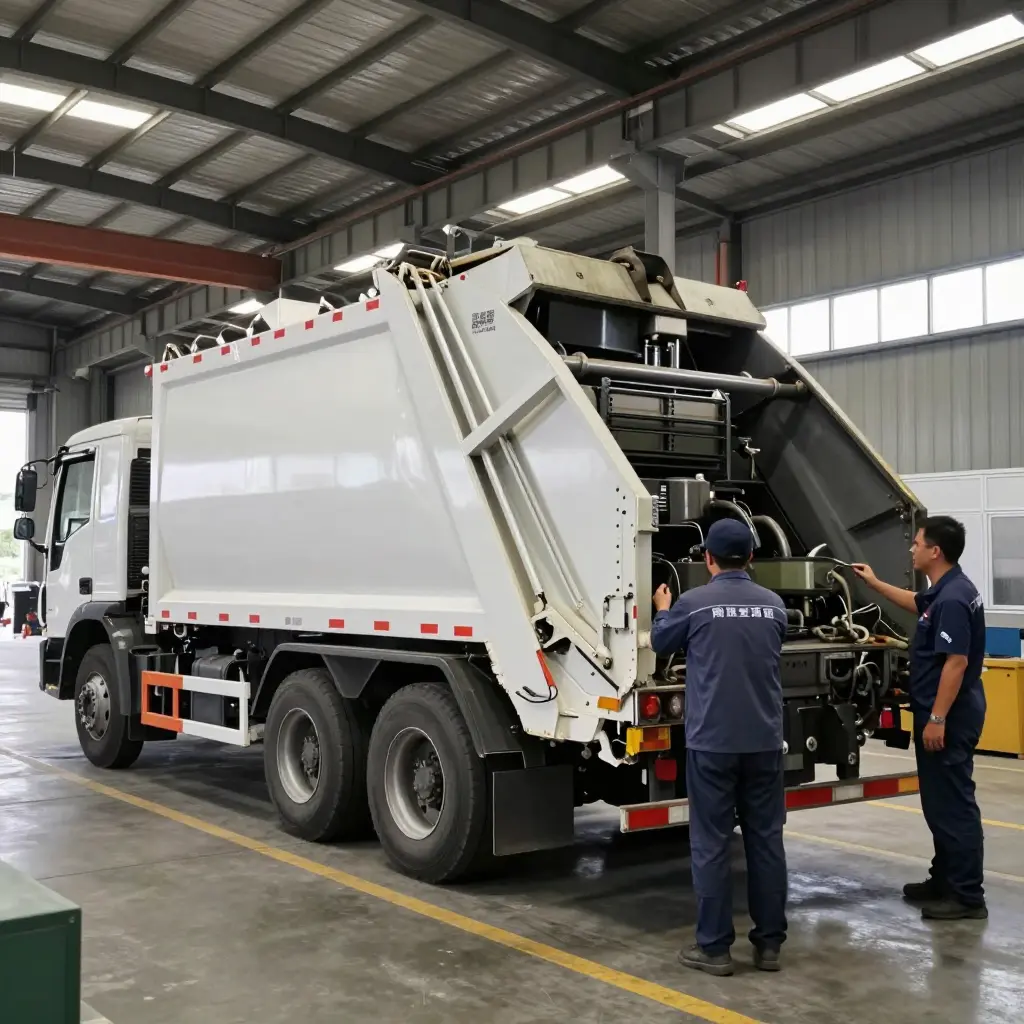
Visual anchor for the five-stage audit walk: document and certification review, steel grade and thickness measurement, weld and structural inspection, hydraulic bench test and PTO verification, then loaded tipping and pre-delivery inspection.
Eight Red Flags and the Paperwork That Should Answer Them
Every item below is a document request, not grounds for walking out. A supplier who finds the record in minutes is usually a supplier who keeps records at all.
- Hydraulic bench test records withheld. Ask for the bench log showing relief valve setting, holding pressure and flow at rated load for each cylinder.
- Body steel grade given only as “high strength steel”. Ask for the mill certificate (EN 10204 3.1) naming the grade and the ordered plate specification, consistent with the body steel grade and hydraulic spec you intend to contract.
- Welding with no documented procedure. Ask for the WPS, the supporting PQR and welder qualification certificates covering the body seams and subframe joints.
- No PTO hours recorded at the moment of test. Ask for the PTO hour-meter reading taken at pre-delivery testing, together with the test duration, so pump wear can be benchmarked later.
- Coating thickness never measured. Ask for a dry film thickness gauge record with readings logged at defined points on the floor, side panels, subframe and internal corners.
- Fastener torque accepted without verification. Ask for the torque log with the wrench calibration certificate and the recorded check values per fastener group.
- No loaded tipping demonstration. Ask for a witnessed test report at rated payload stating lift time, maximum tip angle and controlled descent behaviour.
- Plate thickness not stated by zone. Ask for the body fabrication drawing that lists thickness separately for floor, sides, headboard, tailgate and wear strips.
Where a supplier answers three or more of these with verbal reassurance instead of paper, the risk that shows up in year two is structural rather than cosmetic, and the price difference rarely covers the repair.
Two supplier quotes rarely look different in year one. They separate in year two, when the hydraulic system, body steel and mounting points that were never inspected start charging rent. The chart below shows the pattern: audited and non-audited suppliers start reasonably close together, then pull apart as wear accumulates.
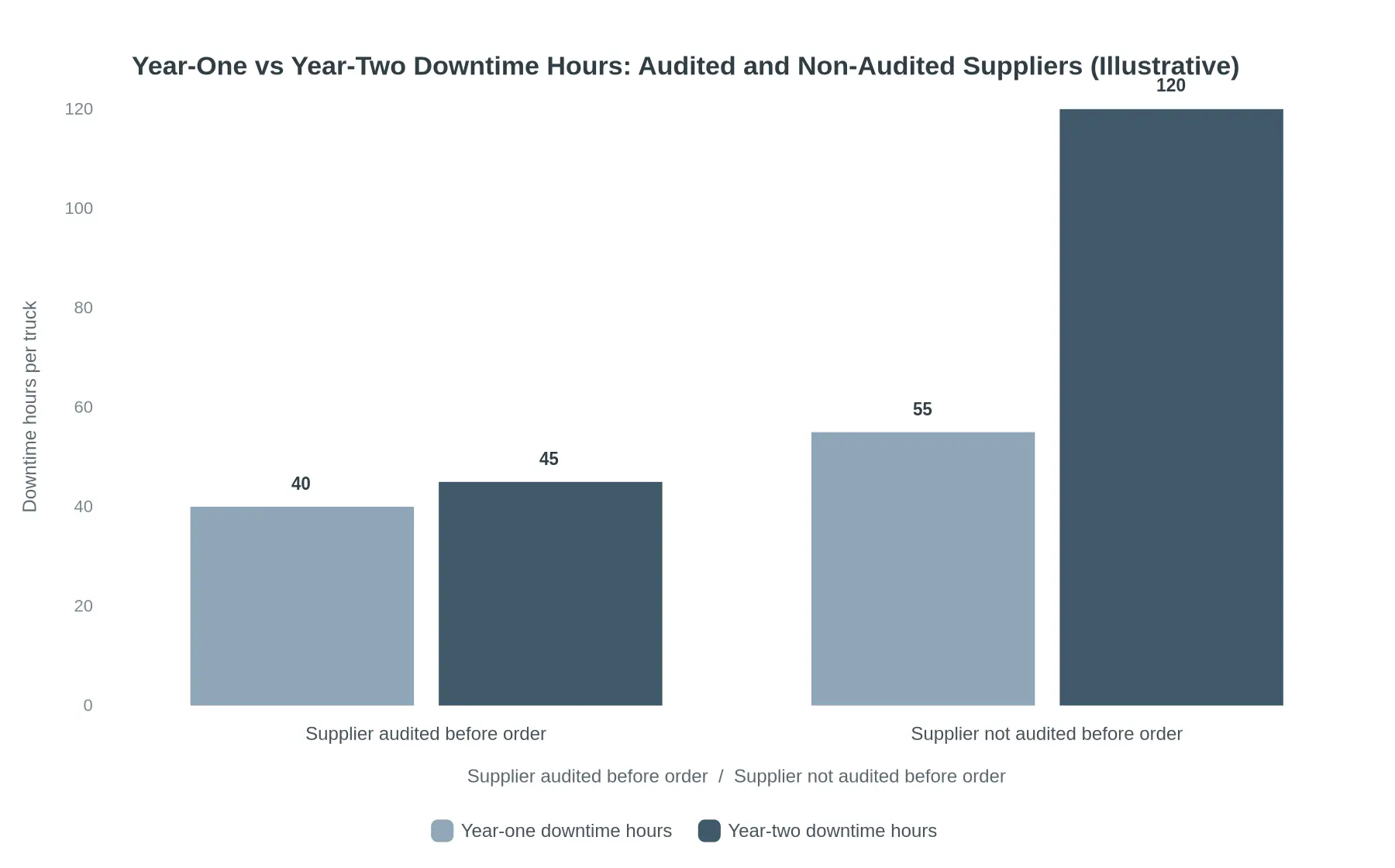
Illustrative figures only. This chart illustrates the pattern discussed in the text, not the measured performance of any specific supplier.
Read the two gaps separately. The year-one gap is small enough to dismiss as noise or a lucky batch. The year-two gap is the cost of the checks nobody made, arriving as unplanned downtime, urgent parts and a truck that misses collection rounds. Which is why the questions worth asking are physical ones, about plate thickness, weld quality and the hydraulic spec behind the lift. All of them are covered in this guide to body steel grade and hydraulic spec when sourcing from China.
Score the Audit, Do Not Just Collect Impressions
An audit should leave you with a result you can defend six months later. The simplest method that holds up is to score every checkpoint Pass, Conditional or Fail, and then treat two of them as gates rather than points.
| Result | Definition | Action |
|---|---|---|
| Pass | Meets the written specification, verified by measurement, certificate, or witnessed test | Record it and move on |
| Conditional | Meets specification only after a defined correction, spare-part change, or monitoring step | Price the fix into the contract |
| Fail | Does not meet specification, or cannot be verified on the day | Reject the checkpoint |
A Fail on material grade or on hydraulic records is disqualifying, however strong the rest of the score looks. If the steel certificate, plate thickness reading, cylinder specification, or pressure and flow test cannot be produced, the buyer is underwriting an unknown. That is why the plate and hydraulic details in this guide to body steel grade and hydraulic specification deserve gate status: they determine how the body behaves under wet, heavy refuse and repeated lifts.
For the material gate, ask for the mill certificate and measure plate thickness at the floor, side and headboard. For the hydraulic gate, record cylinder bore and stroke, pump displacement, relief setting, and a witnessed pressure test.
A Simple Scoring Sheet
Score the remaining checkpoints at 2 (Pass), 1 (Conditional), or 0 (Fail):
- Body-to-chassis mounting: fastener torque, shim condition, frame rail contact, and cracking at the gussets. Use these body-to-chassis mounting checks to standardize what you photograph.
- Body lift: full-cycle time, drift after hold, cylinder rod condition, and hinge or pivot wear. Review common tipper body lift issues before the visit so you know which symptoms matter.
- Welding and seam quality: continuous welds at high-stress corners, no undercut, and no pinholes in the floor.
- Coating: blast grade achieved, dry film thickness readings by panel, and paint data sheets for each coat.
- Tailgate and leachate control: seal gaps, hinge play, and drip path.
- PTO and pump condition: hour meter reading, oil condition, and visible leaks.
- Dimensional fit to route duty: body volume, tare weight, and axle load against the routes the truck will actually run. A manufacturer sizing guide is more use here than a brochure payload claim.
- Documentation: QC sign-off, test records, and traceable serial numbers.
Eight scored checkpoints, so 16 is perfect. Set a minimum of 12 out of 16, with both gates passed. A Conditional is not a fail, but it must carry a price and a deadline.
The Evidence File to Leave With
Do not leave the plant with a phone full of photos and a verbal promise. Ask for a bound or shared folder containing:
- A signed and dated score sheet with the auditor’s name
- Steel mill certificates and plate thickness readings by location
- Hydraulic component nameplates, relief valve setting, and witnessed pressure and flow results
- Timestamped photos of body-to-chassis mounts, welds, hinge pins, and tailgate seals
- A lift-cycle video showing time, drift, and abnormal noise
- PTO hour meter and pump serial number
- General arrangement drawing with tare weight and body volume
- A corrective action list for every Conditional, with owner and date
- Warranty terms and a spare-parts list
A garbage tipper truck manufacturer working under a formal quality system, such as ISO 9001, can usually produce this pack in hours because the records already exist. A supplier without one often asks you to wait while documents are recreated, and the wait is itself a data point: records missing today tend to become support missing in year two.
Compare Suppliers on Gates First, Price Last
Put both quotes on the same sheet, with identical checkpoints and identical route assumptions. Compare gate results first, then the number and cost of Conditionals, then evidence completeness, and only then commercial terms. Price and delivery time matter, but they are outcomes of the build, not criteria for judging it.
| Comparison layer | Question to ask | How it changes the decision |
|---|---|---|
| Gates | Did either supplier fail material grade or hydraulic records? | A fail ends the comparison |
| Conditionals | What exactly must be corrected, and at whose cost? | Add correction cost to the quoted price |
| Evidence | Is the file complete and traceable? | Incomplete evidence raises year-two risk |
| Commercials | Price, lead time, warranty, parts | Compare only after the first three layers |
Two garbage tipper truck suppliers can quote the same price and carry very different year-two risk. The evidence file is what separates them.
Conclusion
Treat the evidence file as the baseline for your year-two maintenance forecast, not as paperwork for its own sake. A supplier who passes the gates, prices the Conditionals and hands over a complete file has given you something a quotation cannot: a downtime number you can plan around.
Frequently Asked Questions
How long does a factory audit for a garbage tipper truck take?
One to two working days on site, depending on truck configuration and how many hydraulic tests you witness. A focused audit of body mounting, tipping cycle and leak checks can fit into one day.
Can the audit be done remotely if travel is not possible?
Part of it can, but not all. Documents, photos and video of the tipping cycle can be reviewed remotely. Hydraulic pressure tests and structural checks need someone on site. Treat remote evidence as a screen, not as a full factory audit.
Which single record best predicts year-two hydraulic downtime?
A pressure-and-flow test at operating temperature, recorded during the factory audit. Low flow or slow pressure build-up shows pump wear before failure, which makes year-two hydraulic downtime more likely. Pair it with the leak history.
Does a pre-order factory audit replace the pre-delivery inspection?
No. The audit checks capability and build quality before you commit. The pre-delivery inspection checks the finished garbage tipper truck before shipment. Keep both: the audit reduces risk, the inspection confirms the actual unit meets the agreed specification.
Turning the Audit File into a Decision
Findings only matter if they change the order. Choose the garbage tipper truck supplier whose audit file answers every checkpoint with a document or a measurement: a steel certificate showing the actual grade, a hydraulic test record with pressure and cycle figures, a weld inspection sign-off, a torque record for the body-to-chassis mounts. A checkpoint answered with “we will confirm later” is an unanswered checkpoint, however good the quotation looks.
Missing hydraulic records or an unverified body steel grade are not paperwork gaps. They are year-two cost: a pump that fails at low hours, a floor that thins faster than the wear allowance you assumed, a warranty argument nobody has the data to win. Price them as future repair and downtime, and the cheaper quote usually stops being cheaper. Confirm the steel grade and hydraulic specification in writing before you sign.
Three takeaways
- Audit before the order. Visit, measure, photograph. A brochure spec is a claim, not evidence.
- Keep the evidence file. Certificates, test sheets and measurements belong in the truck’s service history, not a drawer at the factory.
- Re-audit or re-verify before a repeat order. Builds drift between batches, and a good first unit does not guarantee the fifth.
The measure is total cost of ownership over a multi-year service life, not the size of the purchase invoice.