Garbage Tipper Truck China Sourcing: Body Steel Grade and Hydraulic Spec for Municipal Fleets
Before a municipal buyer accepts a quotation in a garbage tipper truck China sourcing package, two items have to be written down: the body steel grade together with a full plate thickness map for floor, side walls, front wall, tailgate and loading hopper, and the hydraulic system specification covering pump type, working pressure, cylinder type and relief valve setting. Those numbers decide structural fatigue life and cycle time on a collection route. Cab trim does not, and neither does paint. An offer that says “high-strength steel body” or “imported hydraulic pump” cannot be evaluated, and what cannot be evaluated cannot be enforced.
This is a specification and due-diligence guide for the technical annex of a municipal fleet supply contract: what to write, how to verify each line at factory inspection, and which discrepancies justify holding a shipment. Comparing competing Chinese body builders on equal terms depends on that discipline, because body volume in cubic metres and nominal lifting capacity say almost nothing about wall thickness or pump displacement.
Over a 7-10 year municipal service life, the two largest cost drivers are body steel grade and hydraulic component sizing. Under-thickness plate and an undersized pump rarely fail in year one. They fail after four or five years of wet loads, compaction shock and daily lift cycles, and then the repair bill lands on the maintenance budget instead of the capital one. Both therefore belong in the technical annex as pass/fail acceptance criteria – grade designation, mill certificate, plate thickness at each panel, pump displacement, relief setting, cylinder bore – rather than as supplier discretion. Thin gauge in a loader hopper turns into a structural failure point faster than most buyers expect, which is what plate thickness specified for loader hopper floors looks like on paper.
Body Steel Grade and Plate Thickness: Specifying Steel by Function, Not by Habit
A garbage tipper truck body is four wear environments bolted to one chassis, not a single steel structure. Grit, glass and demolition debris grind the floor; the side walls flex on every tip; the subframe passes the whole load into the chassis rails; the discharge end takes the concentrated impact of a dumped load. Picking one body steel grade for all of it is the most common specification shortcut in municipal fleet procurement, and the most expensive. Match grade, hardness class and thickness to the duty each zone actually sees instead.
Structural carbon steel (Q235B / S235JR) belongs in the skeleton, not the wear zone. At a nominal yield of around 235 MPa it is cheap, weldable and forgiving, which suits the subframe, cross-members, bolsters, mounting brackets and non-contact reinforcement. It does not suit a floor that takes abrasive municipal waste: mild steel work-hardens slowly and simply thins out.
High-strength low-alloy steel (Q355B / S355JR, still written Q345B on drawings older than 2018) earns its premium in the rails and side walls. At roughly 355 MPa yield it lets the designer thin the section while holding the same load capacity, so a Q355B longitudinal rail can be lighter than a Q235B rail of equal strength. On a tipper body that saving goes straight into payload, and on the side walls it also drops dead weight from above the tipping pivot. Insist on mill test certificates confirming yield and chemistry, not the grade stencil on the delivery note.
Wear-resistant plate (NM400 / NM450, or the HB400 / HB450 hardness class) is mandatory for the floor and the discharge end. Quenched-and-tempered abrasion-resistant plate resists sliding grit and impact far better than mild steel at the same thickness, which is what a tipping cycle produces. The discharge end and the last 1.5 to 2 m of floor take the highest impact energy, so those areas should go one class harder or one step thicker than the rest of the floor.
Plate thickness as a map, not a number
Treat thickness as a zone-by-zone map. The table below is a practical starting point for a typical 8 to 15 m3 municipal rear-tipping body; confirm it against the OEM structural calculation and the payload you need on the axle group.
| Body zone | Typical steel grade | Typical plate thickness | Reason |
|---|---|---|---|
| Floor (main) | NM400 wear-resistant | 6 – 8 mm | Sliding abrasion from tipped waste |
| Floor (discharge end) | NM450 wear-resistant | 8 – 10 mm | Highest impact and scrape energy |
| Side walls | Q355B / S355JR | 3 – 4 mm | Bending stiffness at low weight |
| Front wall (headboard) | Q355B / S355JR | 4 – 5 mm | Load surge during braking and tipping |
| Tailgate | Q355B with wear liner | 4 – 6 mm | Hinge loads plus abrasion at the lip |
| Subframe and bolsters | Q235B / S235JR | 8 – 10 mm | Weldability and cost, not wear resistance |
| Main longitudinal rails | Q355B / S355JR | 8 – 10 mm | Bending moment with reduced mass |
Corrosion and abrasion pull in opposite directions, and wet municipal waste settles the argument zone by zone. Weathering steel looks good on paper until you remember that it needs alternating wet and dry cycles to build a stable patina; a floor sitting in leachate and washed down weekly often stays wet long enough that corrosion keeps going instead of passivating. Epoxy protects side walls and the headboard well, but it wears through on a floor within weeks, and once breached it hides corrosion behind intact paint. The workable compromise is uncoated or primed wear plate on the floor with a generous thickness allowance, epoxy or zinc-rich primer on side walls, front wall and tailgate, full seam sealing, and drainage at the low point so leachate does not pond. If your route profile suggests the floor will rust through before it wears through, read why compactor body floors fail from the inside out before fixing the grade.
Grade, thickness and certification belong on the purchase contract as separate line items. A body described only as “wear-resistant floor” is not a specification. Each zone should list the steel grade, the nominal thickness with its tolerance, the hardness range for wear plate, and an EN 10204 3.1 mill certificate traceable to the heat number, with the right to check thickness by ultrasonic gauge on arrival. That closes the most common downgrade route: mild steel floor plate supplied under a wear-resistant description.
Downgrading a floor from wear plate to mild steel saves money once. Mild steel at the same thickness wears several times faster under abrasive municipal waste, so the first floor replacement usually arrives in the first half of the body’s service life, with cutting, welding, repainting and lost collection days attached to it. Add the cost of a truck off route and the extra 0.5 to 1 t of steel needed to recover the strength, and the original saving is gone well before year two.
Body Steel Grade Quick-Reference Table
The grades discussed above, condensed for pasting into a tender annex or a technical clarification request:
| Steel Grade | Typical Standard/Designation | Min. Yield Strength (MPa) | Typical Hardness | Recommended Application in the Tipper Body | Procurement Notes |
|---|---|---|---|---|---|
| Q235B / S235JR | GB/T 700 (Q235B); EN 10025-2 (S235JR) | 235 | 120-140 HB | Side panels, mudguards, non-wear structural members, light-duty municipal routes | Request mill certificate with heat number; EN 10204 3.1 not normally justified |
| Q355B / S355JR (Q345B on older drawings) | GB/T 1591 (Q355B); EN 10025-2 (S355JR) | 355 | 150-180 HB | Main body framing, cross members, longitudinal rails, general fabrication | Request EN 10204 3.1 certificate with heat analysis and mechanical results |
| Q460 / S460N | GB/T 1591 (Q460); EN 10025-3 (S460N) | 460 | 180-210 HB | High-GVW body frames, hoist subframe, floors on dense-waste routes | Request EN 10204 3.1 certificate plus impact test values at stated temperature |
| NM400 / HB400 | GB/T 24186 (NM400); abrasion-resistant plate, 400 HBW class | 800 – 1000 (mill-dependent) | 360-430 HBW | Floor plate, lower side panels, tailgate liner, high-scuff zones | Request mill certificate plus hardness test report (HBW, delivery condition) |
| NM450 / HB450 | GB/T 24186 (NM450); abrasion-resistant plate, 450 HBW class | 1000 – 1100 (mill-dependent) | 420-480 HBW | Hopper floor, discharge and impact zones, wet or abrasive commercial waste | Request mill certificate, hardness test report and CEV/chemical composition for weldability |
HB = Brinell hardness, HBW = Brinell hardness measured with a tungsten carbide ball. Wear plate is sold on guaranteed hardness, so the mill test report matters more than the grade name on the drawing: yield strength varies by mill and heat, and hardness is the property to accept or reject on. Note that GB/T 1591-2018 renamed Q345B as Q355B, with a minimum yield of 355 MPa for plate up to 16 mm; quotations and drawings written before 2018 still carry the old designation.
Hydraulic System Specification for Garbage Tipper Trucks
A hydraulic system specification for a garbage tipper truck is a list of numbers a supplier can be held to at factory acceptance, not a paragraph of adjectives. Draft the following into the purchase order, and test each line before shipment.
PTO type and engagement method
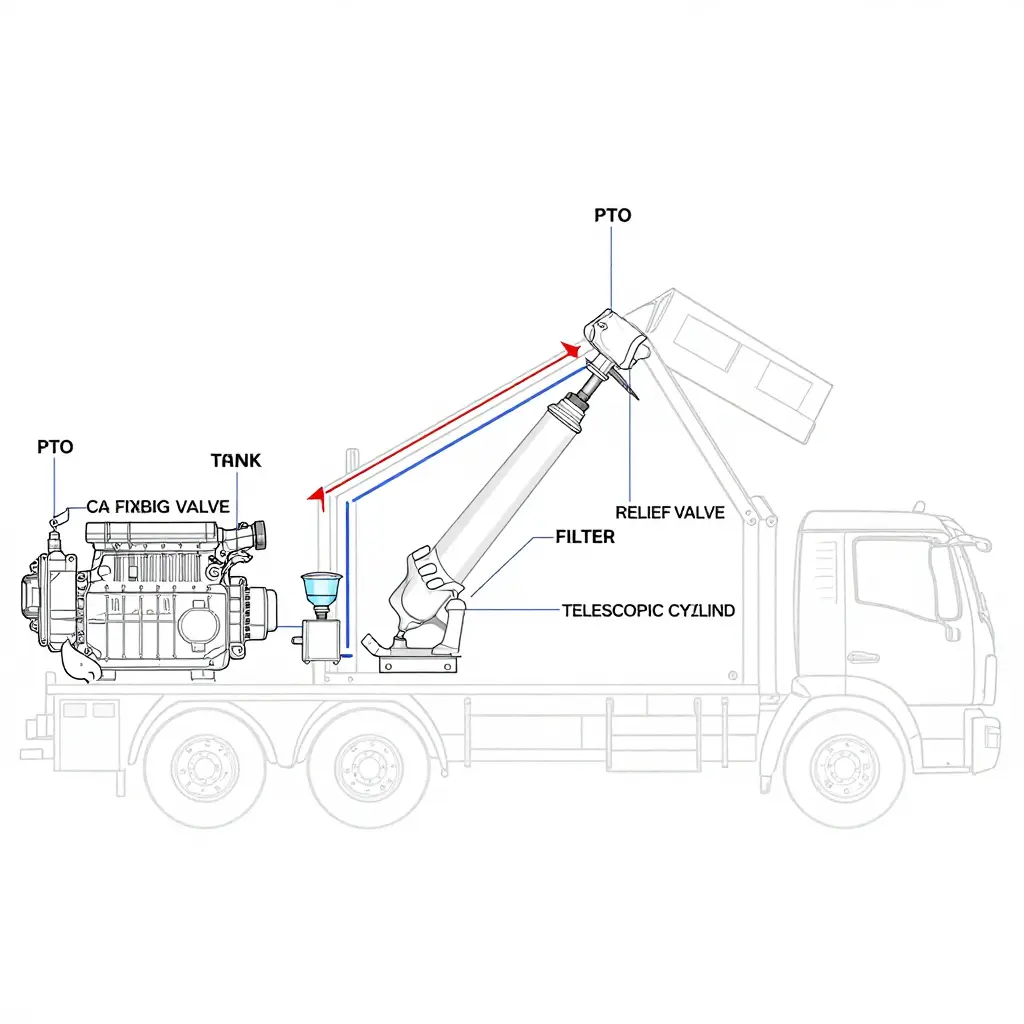
State whether the pump is driven from the crankshaft (engine-driven) through a driveshaft, or by a transmission side-mount or sandwich PTO. Engine-driven PTOs are simpler to cool and route but eat engine-bay space; transmission PTOs keep the pump close to the tank and give a cleaner driveshaft line. Engagement should be pneumatic, actuated from a dash switch, and interlocked with the park brake and neutral gear so the pump cannot be live while the vehicle is able to move. Quote PTO output speed at rated engine rpm, because that ratio fixes pump flow.
Hydraulic pump sizing from cylinder volume and lift time
Work the displacement out from the cylinder volume and the lift time you want; never accept a pump size because it is what the supplier stocks. Required flow equals effective cylinder swept volume divided by target lift time. A 45 L telescopic cylinder raised in 22 s needs 2.05 L/s, or 123 L/min. Divide by PTO speed and volumetric efficiency (about 0.92): 123,000 / (1500 x 0.92) = 89 cm3/rev. Specify a cast-iron gear pump whose continuous pressure rating sits above the relief setting.
Telescopic cylinder versus underbody multi-stage mounting
A front-end telescopic cylinder lifts through a long angle ahead of the bulkhead, which keeps the loading deck low – a real advantage on hand-loaded municipal routes. Underbody-mounted multi-stage cylinders need a subframe and typically add 100-200 mm of floor height, but they spread load across two mounting points, which is more stable with partial loads and on uneven yard surfaces. Low deck or lateral stability: the route decides which one you need.
Working pressure, relief valve and cold-start protection
Tipper systems normally run at 16-20 MPa. Set the relief valve at no more than 90% of the cylinder’s rated continuous pressure, so a 20 MPa cylinder gets a 17.5 MPa relief. That margin earns its keep on cold mornings, when viscous oil makes the relief chatter and pressure spikes hammer the seals. Lip seals fail by extrusion rather than gradual wear, and a handful of cold-start deadheads against a marginal relief will destroy them – the same mechanism behind cold-morning lifts that stall before the pump is blamed.
Tank, filtration, hose and fitting class
The tank has to absorb the oil the cylinder pushes back. An 89 cm3/rev pump delivering about 120 L/min therefore needs roughly 150 L of tank capacity with a 100 L working fill, baffled, with breather, level and temperature gauge. Specify a 10 micron absolute return filter (beta 200 >= 200), a 100 micron suction strainer and a cleanliness target of ISO 4406 18/16/13. Two-wire braid EN 853 2SN covers 200 bar service; go to four-spiral EN 856 4SP above that, with fittings rated at a 4:1 burst ratio and whip restraints at every hose run.
| Parameter | Value to write into the PO | Verification |
|---|---|---|
| PTO | Transmission side-mount, pneumatic, dash switch, park-brake and neutral interlock | 20 engage/disengage cycles |
| Hydraulic pump | Gear pump, 89 cm3/rev, 1500 rpm PTO, continuous rating >= 200 bar | Flow and pressure test |
| Lift cylinder | Telescopic front-end, 45 L swept volume, 20 MPa rated continuous | Stroke and lift-time test |
| Relief valve | 17.5 MPa, not exceeding 90% of cylinder rating | Gauge check at deadhead |
| Oil tank | 150 L, baffled, 100 L working fill, breather, level and temperature gauge | Visual and dipstick check |
| Filtration | 10 micron absolute return filter, 100 micron suction strainer | Filter part numbers on invoice |
| Hoses and fittings | EN 853 2SN or EN 856 4SP, 4:1 burst ratio | Batch certificates |
| Lift / lower time | Lift <= 22 s, controlled lower 18-20 s at 1500 rpm, 40 C oil | Stopwatch at factory acceptance |
Why lift and lowering times must be numbers
“Fast” cannot be tested, priced or compared across suppliers, and it hides the two variables that actually control cycle time: engine speed and oil temperature. Give lift and lowering times in seconds at a stated rpm and temperature. Lowering matters as much as lifting, because a loaded body that drops in 8 s instead of 18 s shock-loads the rear hinge, crossmember and chassis rails, and can spill material behind the truck. Put both numbers in the contract, then witness them on the test stand.
Hydraulic Specification Verification Checklist for Garbage Tipper Sign-Off
Hydraulic faults seldom announce themselves at the factory gate. They turn up eighteen months later, mid-route, with the body stuck up and the depot supervisor on the phone. The defence is desk discipline: an engineer signs each line, in order, before purchasing releases the order. The order matters, because pump and relief data feed the cycle-time check, and hose class cannot be judged until relief pressure is fixed.
Pre-Purchase Order Checklist
- PTO engagement and control location: Confirm PTO type (engine-driven or gearbox-mounted) and that the control is reachable from the driver’s seat; accept only written chassis-builder approval.
- Pump displacement and make: Photograph the nameplate and cross-check cc/rev displacement plus brand/model against the quoted datasheet; reject any mismatch.
- Cylinder stages, stroke, rated pressure: Record all three values from the cylinder nameplate; accept only the stage count and stroke length in the quotation.
- Relief valve versus cylinder rating: Verify the relief valve setting sits at least 10 percent below cylinder rated pressure, confirmed on a witnessed gauge.
- Lift and lower time at rated load: Time a full raise and controlled lower at rated payload; accept quoted seconds within plus or minus 10 percent.
- Tank capacity and filtration: Confirm tank litres suit pump flow and cylinder return volume, and the return filter is 10 micron absolute; accept both on the signed specification sheet.
- Hose pressure class and routing: Check hoses are rated above relief pressure and are sleeved at every frame crossing; accept a certificate per hose.
- Cold-start oil viscosity: Require ISO VG 32 or 46 matched to local winter minimums; accept the ambient-temperature recommendation chart in writing.
- Pressure test record: Witness hydrostatic testing at 1.5 times working pressure; accept a certificate carrying date, serial numbers and inspector signature.
This checklist is attached to the technical annex of the supply contract and moves with the purchase order.
Documents to Request for Each Item
- Items 1-2: Chassis builder PTO approval letter, pump datasheet with performance curve, nameplate photographs.
- Items 3-4: Cylinder manufacturer datasheet and nameplate photo, relief valve setting and test certificate.
- Items 5-6: Witnessed cycle-time test report at rated load, tank and filter specification sheets with micron rating.
- Items 7-9: Hose burst certificates with routing drawings, hydrostatic test certificate, cold-climate oil grade recommendation chart.
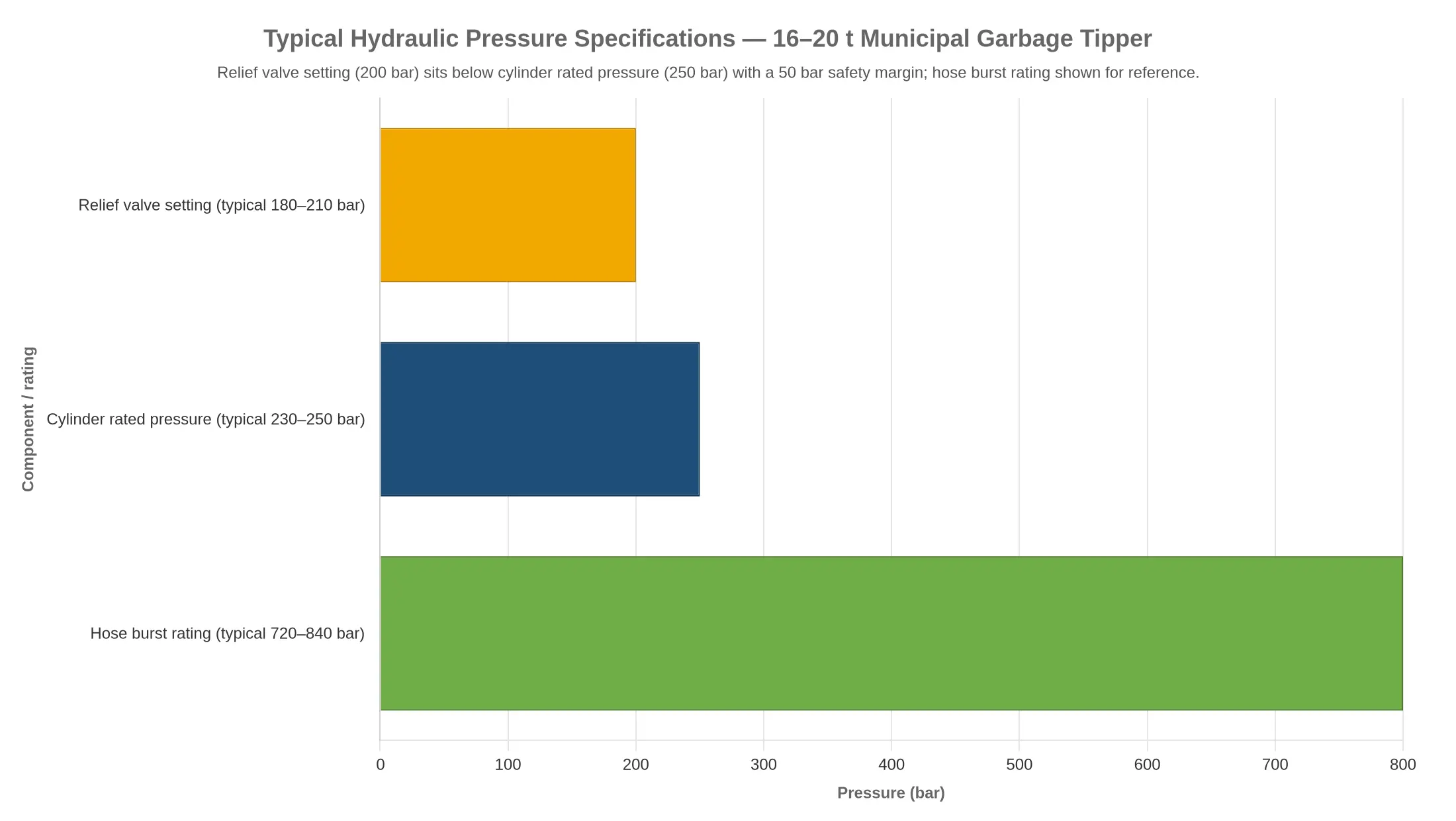
The line most often fudged in a Chinese supplier’s quotation is the relief valve margin, because raising it hides a small pump. If the numbers only work with a 250 bar relief on a 250 bar cylinder, you have found a system that will crack a barrel. For the diagnostic side of that, why cold-morning lifts stall explains how an oil grade that looks fine on paper turns into a slow first lift at 5 a.m.
With the hydraulic checklist signed off, it helps to read the body as a set of plates rather than a welded box. The schematic below shows the cross-section of a tipper body and the structural members beneath and behind it, so every thickness and grade callout in a Chinese supplier’s quotation can be matched to a specific location on the truck.
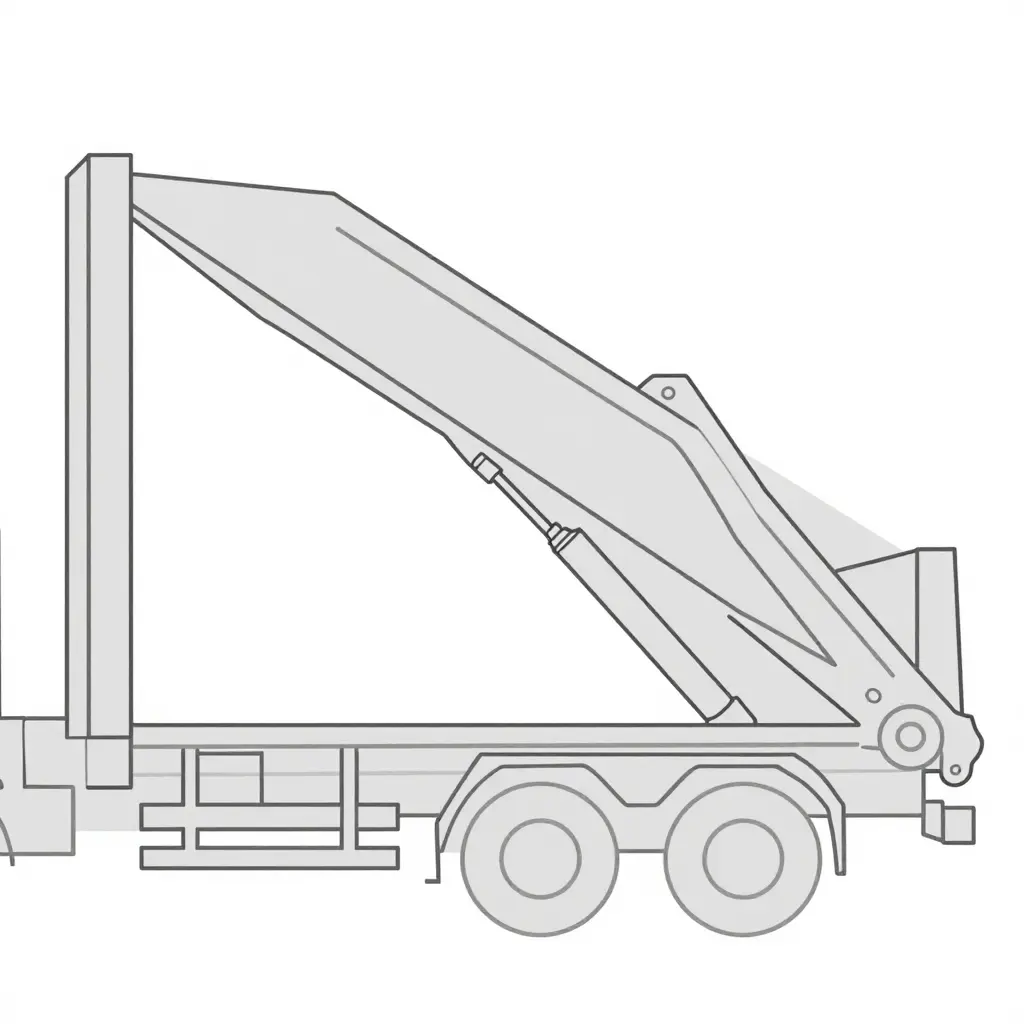
Cross-section schematic of the tipper body, subframe and lift cylinder, corresponding to the plate thickness map set out in the body steel grade section above.
The floor takes abrasion, the side walls take the bulging load, the front wall takes the push from the load, and the subframe rails take the bending moment when the body is raised – four duty cycles, four plate specifications. When a supplier’s drawing pack arrives, compare each zone against the thickness map instead of accepting one headline figure, and treat the rails and cylinder as the parts you will still be inspecting years later. Our notes on subframe and lift cylinder checks translate directly to tipper bodies on the same chassis architecture.
Sourcing Due Diligence and Supplier Verification for Garbage Tipper Trucks
A tipper body is only as strong as the paperwork and the measurements behind it, and in China sourcing that means verifying rather than trusting. Every factory will quote Q355B, Q345B or NM400 plate; the real question is whether the unit that arrives on the dock matches the quotation you signed. Apply due diligence to the steel, the welds and the hydraulics the way you would to any capital asset: state the requirement in the purchase order, demand the evidence at the mill and at the joint, then tie payment release to that evidence.
Steel verification: heat numbers and mill certificates
Grade claims cannot be verified without mill paperwork. A mill issues an EN 10204 3.1 mill certificate covering the actual cast, not a generic datasheet: heat number, chemical composition, yield and tensile strength. Require one 3.1 certificate per heat number plus a plate-to-heat map, and insist that heat numbers are stencilled or photographed before shot blasting, because the marking is usually lost once the body goes through surface preparation. On arrival, match every delivered plate back to its certificate before the unit leaves the yard.
Thickness verification: caliper and ultrasonic measurement
Nominal thickness on a drawing is not delivered thickness. Plate is rolled to a negative tolerance, so a 5 mm floor panel can land at 4.5 mm, and a floor that is already thin when new wears out several seasons early – which is exactly why rear-loader body floors rust through first. Measure with an ultrasonic thickness gauge on a roughly 1 m grid, at least ten readings per panel, or with a caliper at accessible edges, and compare each figure against the contract thickness map. Agree the acceptance limit in advance, including the hopper floor plate thickness to specify, so it is written down rather than argued over later.
Weld quality at high-stress joints
Structural failures almost never begin in the plate; they begin at the weld toe. Three joints deserve documented attention: the body floor to side wall seam, which carries hoop stress plus abrasion; the subframe cross-member connections, which absorb torsional load on uneven ground; and the cylinder mounting brackets, where full hydraulic thrust concentrates on a small footprint. Ask for weld leg length and throat measurements, dye penetrant or magnetic particle testing at bracket-to-subframe welds, no undercut beyond 0.5 mm, no porosity, and continuous rather than stitched welds where the drawing calls for them. The same checks appear in subframe and lift cylinder checks for any hydraulic lifting body you evaluate.
Hydraulic component traceability
Nameplates are the only proof of which pump and cylinder were actually fitted. A lower-displacement pump or a thinner rod is a cheap substitution, and it rarely shows up until cycle times stretch or a cylinder weeps. Record the nameplate model number, displacement and serial for every pump, valve block and cylinder, and check them line by line against the purchase specification. Knowing how PTO hours and hydraulic pump wear correlate tells you what to expect from a given pump model under municipal duty cycles.
Pre-shipment functional testing and third-party inspection
Hydraulics and geometry have to be proven before the truck boards the vessel, not after it clears customs. Require at least three full lift and lower cycles at rated load, with recorded cycle times, a hold test to measure cylinder drift, tailgate and ejector operation, PTO engagement and relief valve setting. Then book an independent pre-shipment inspection with a photographic protocol: heat numbers on plate, pump and cylinder nameplates, weld close-ups at the three critical joints, thickness gauge readings with the instrument display in frame, and the load test itself. That report is what you argue with if something has to be corrected.
| Verification Item | Evidence Required | Procurement Action |
|---|---|---|
| Body and floor plate grade | EN 10204 3.1 mill certificate matched to heat number | Withhold final payment until certificates reconcile with the plate-to-heat map |
| Plate thickness | Ultrasonic readings on 1 m grid against contract thickness map | Reject or credit any panel below the agreed minimum |
| Critical welds | Dimensional check plus PT/MPI at cylinder brackets | Require rework and re-test before dispatch |
| Hydraulic components | Nameplate model, displacement and serial | Compare to purchase spec clause by clause |
| Function | Three loaded lift and lower cycles with drift measurement | Accept only witnessed test data |
| Final release | Third-party report with time-stamped photos | Release balance against a clean inspection report |
The Yield Strength Step Change: What It Actually Buys You
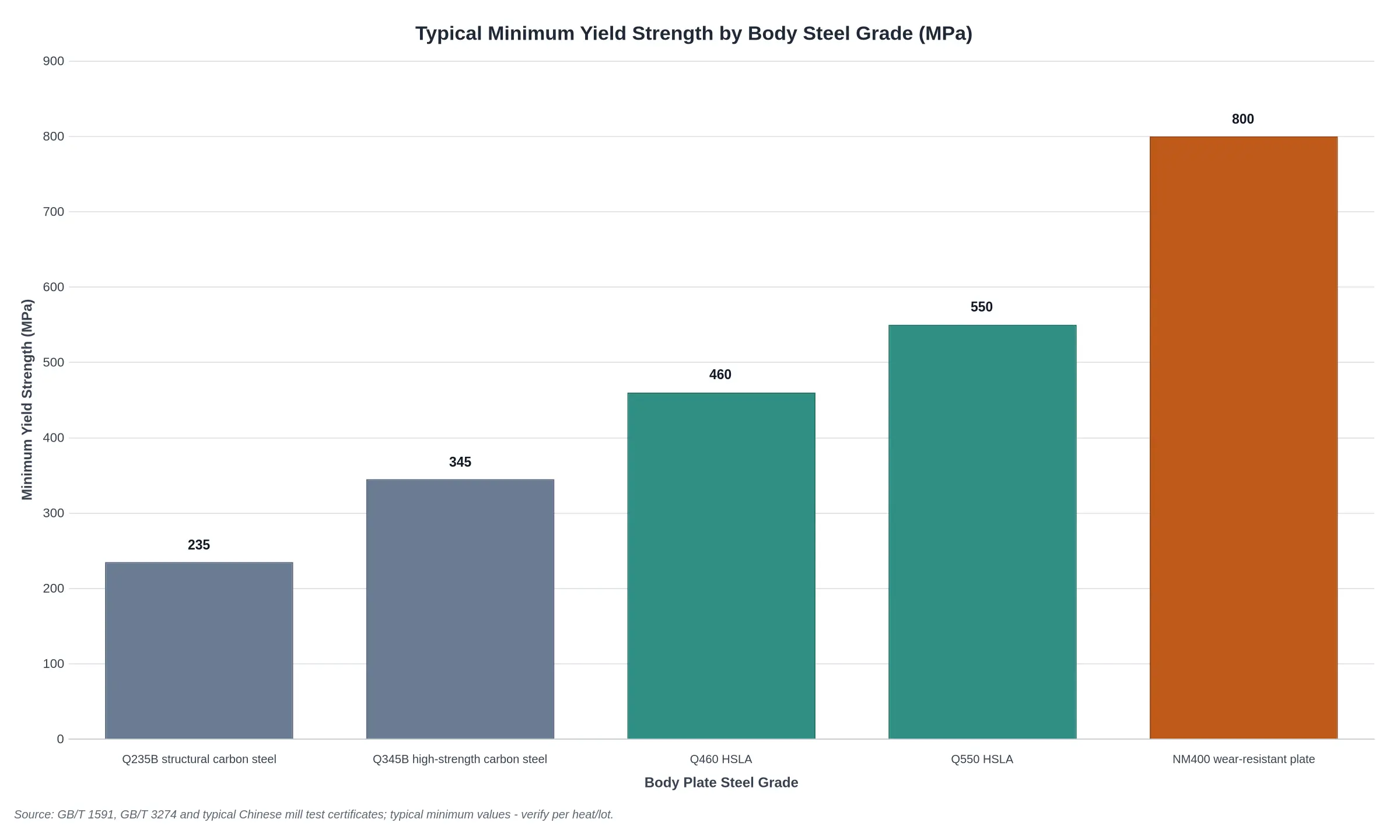
Figure: Typical minimum yield strength by body plate grade at the same nominal thickness. Source: GB/T 1591, GB/T 3274 and typical Chinese mill test certificates; values are typical minimums – verify against the certificate for each heat and lot. Q345B appears here under its pre-2018 name; the current GB/T 1591 designation is Q355B.
Read the chart as a thickness decision, not a steel catalogue. Bending capacity rises with the square of plate thickness but only linearly with yield strength, so moving a body from Q235B to Q550 HSLA or NM400 class plate lets the builder thin the side walls and floor while holding comparable resistance to denting and local buckling. Stiffness is a different matter – it rises with the cube of thickness, which is why longitudinal rails are usually governed by deflection and gain less from a yield upgrade than the chart suggests. On a municipal garbage tipper, saved plate mass comes off the tare figure, and under a fixed gross vehicle weight that margin goes back into payload per trip. Before you accept a weight claim in a quotation, ask for the calculated tare build-up rather than the brochure number; the discipline used to audit the tare weight of a hook lift dumpster truck applies to a rear-loader or tipper body just as directly.
Tare Weight, Payload and Chassis Matching
Body steel grade and plate thickness are the two variables that quietly decide how much refuse a municipal garbage tipper can legally carry. A thicker floor and heavier wear plate buy durability – resistance to gouging from wet commercial bins, compaction shock and shovel contact – but every kilogram of that steel comes out of the payload allowance. On a typical 6 m body, each additional millimetre of floor plate adds roughly 110 kg, and 10 mm wear plate across a 2 m discharge zone adds 350-400 kg. Upgrading from a 4 mm Q235 floor to a 6 mm Q355 floor with hardened wear strips pushes tare weight up by 350-450 kg, which comes straight out of the payload margin on a 25 t GVWR 6×4 chassis. Because that mass sits low and rearward, it also shifts load onto the rear bogie and off the front axle – worth knowing when per-axle limits, not just gross weight, are audited at the weighbridge.
That is why body steel grade must never be optimised in isolation. Set the chassis gross vehicle weight rating first, then per-axle limits, then the payload your route actually needs, and only then the plate specification that fits inside that budget. The exchange rate between durability and payload is fixed by steel density, not by negotiation. A practical procurement fix is to specify a body weight target in the purchase order with a tolerance – for example, “bare body mass not to exceed 4,200 kg measured on a certified scale, tolerance +/-3%” – so suppliers cannot quietly answer a durability requirement with extra millimetres. For how bodies fill up before they reach rated weight, see this analysis of rear-load compactor payload versus axle weight.
Every extra millimetre of floor or wear plate is durability bought with payload, so specify it against a stated tare weight target and per-axle limits.
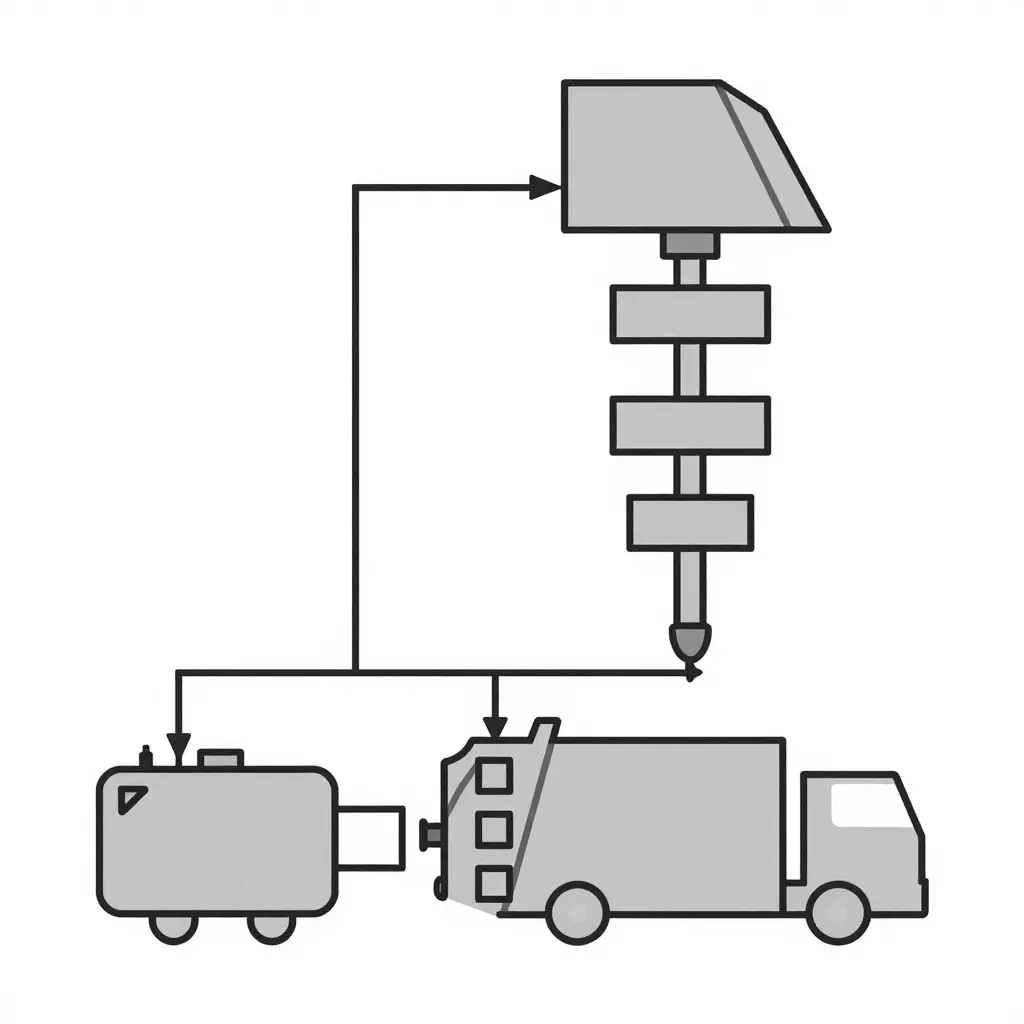
Schematic of the tipper hydraulic circuit: tank, PTO and pump block, control valve, relief valve, and multi-stage telescopic lift cylinder, with arrows showing flow direction and the point where pressure is regulated.
Where Municipal Tippers and Hydraulic Systems Fail First
Before locking a build sheet, it pays to know which components break early in the field, whatever the drawing says about how substantial they look. The chart below splits premature failures across the body and hydraulic package of a municipal garbage tipper.
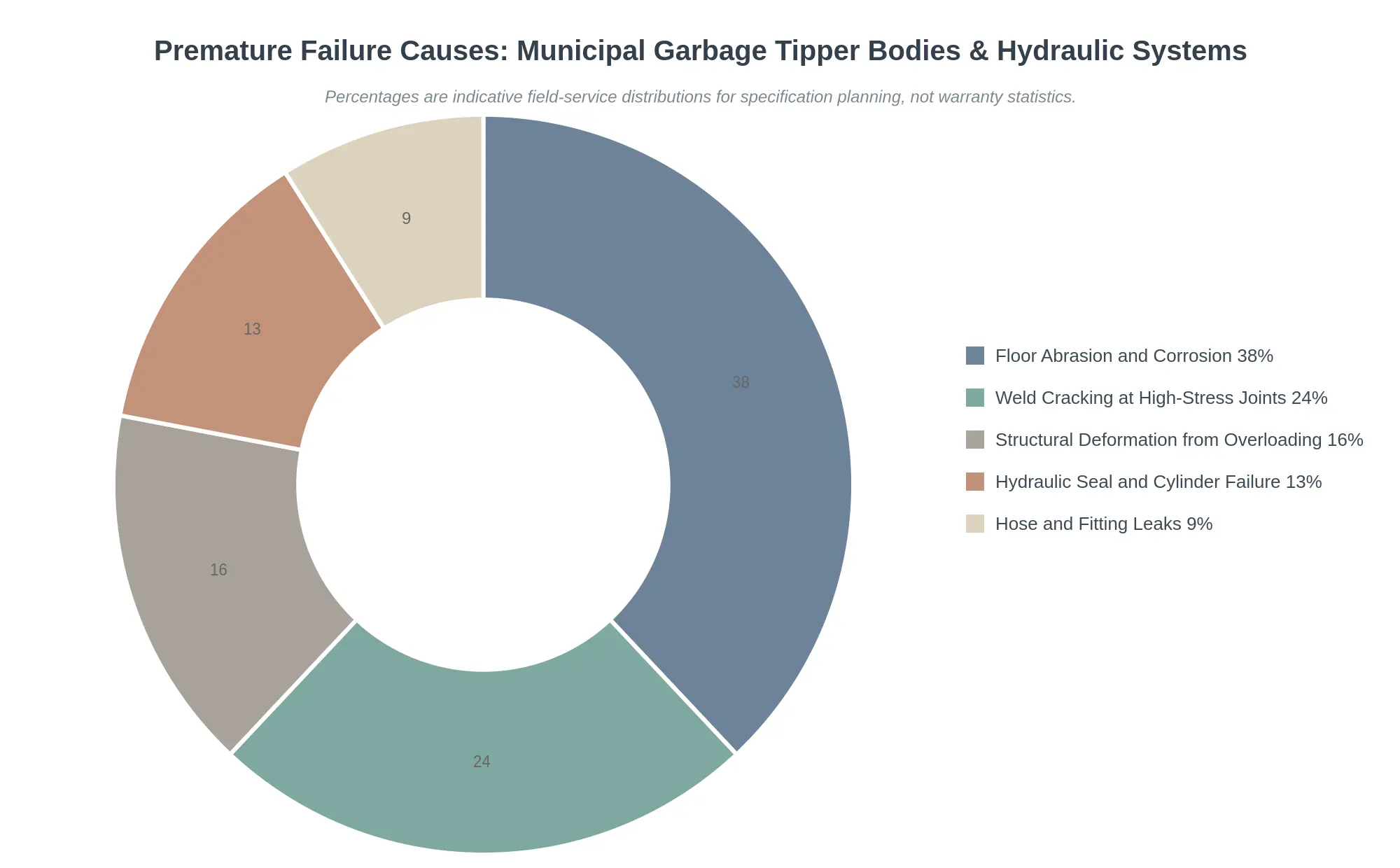
Figure 1 – Relative share of premature failure causes on municipal garbage tipper bodies and hydraulic systems. Note: percentages are indicative field-service distributions for specification planning rather than warranty statistics.
Legend
- Floor abrasion and corrosion – 38%
- Weld cracking at high-stress joints – 24%
- Structural deformation from overloading – 16%
- Hydraulic seal and cylinder failure – 13%
- Hose and fitting leaks – 9%
Floor abrasion and corrosion plus weld cracking at high-stress joints account for roughly six in ten premature failures, which is the argument for specifying a wear-resistant floor to a defined hardness and thickness instead of accepting mild steel as standard – the same logic behind why compactor body floors rust through first. The 13% seal and cylinder share is instructive in a different way: correctly rated relief settings and a matched pump-cylinder combination keep working pressure inside the design envelope, so cylinders are lost to normal wear rather than to pressure spikes that no warranty claim will ever recover.
Frequently Asked Questions: Garbage Tipper Truck China Sourcing
Five questions come up in almost every technical clarification round with a Chinese tipper body builder: plate selection, hydraulic ratings, verification testing, warranty risk and cylinder layout.
What steel grade should be specified for the tipper body floor and why?
Specify NM400 or NM450 abrasion-resistant plate for the tipper body floor, 6 mm minimum, with Q355B for side walls. On China sourcing orders, state hardness at 360 HBW or above to resist gouging from compacted wet refuse and shovel impact. Why compactor body floors rust through first explains the corrosion side of that plate choice.
What hydraulic working pressure and cylinder type suit a municipal garbage tipper truck?
Specify 16-20 MPa working pressure on a single-acting multi-stage telescopic cylinder with a chrome-plated rod and a load-holding valve for controlled lowering. Municipal routes need repeatable lift cycles, and they need the body to come down at a controlled rate. With the relief at 17.5 MPa and hoses rated at 200 bar working or better, cold-start pressure spikes stay inside the hose rating.
How can a buyer verify that the delivered plate matches the specified steel grade and thickness?
Require mill test certificates matched to heat numbers stamped on each plate, then verify with ultrasonic thickness gauging on a 1 m grid, at least ten readings per panel, plus portable hardness testing. Third-party inspection before shipment closes the gap between the paperwork and the delivered body.
Which hydraulic specification values cause the most warranty disputes with Chinese suppliers?
Disputes concentrate on working pressure ratings, cylinder bore and stroke tolerances, and relief valve settings. Suppliers quote system pressure while buyers test peak pressure. Mismatched relief settings, undeclared bore sizes and unlisted cycle times account for most hydraulic system specification claims after delivery.
Is a front-end telescopic cylinder always preferable to an underbody cylinder for municipal fleets?
No. A front-end telescopic cylinder suits long bodies and high dump angles, but it takes space ahead of the bulkhead and needs a reinforced front crossmember. An underbody cylinder spreads load across two mounting points and stays cleaner in narrow city blocks, at the cost of 100-200 mm of floor height. Chassis layout and route geometry decide, not preference.
Closing the Specification: A Decision Framework for Municipal Buyers
The technical ground covered above comes down to one procurement point. For a garbage tipper truck sourced through China sourcing channels, comparability comes from documentation, not from the headline price. These line items therefore belong in every purchase order, and each value should be a number, a range or a named standard rather than a descriptive adjective.
- Floor and side wall steel grade with a thickness map. State the grade by designation (for example Q355B or a documented equivalent) and map thickness by zone: floor plate, side wall lower panel, side wall upper panel, headboard and tailgate. Wear-driven thinning belongs on paper, not in a service report three years later.
- Hydraulic pump and cylinder model designations. Model number for the pump and each lift cylinder, with rated pressure, displacement and relief valve setting, plus reservoir capacity and filtration rating.
- Lift and lower time at rated load. Seconds for both directions, with the test load used to establish those figures stated alongside.
- Tare weight target with tolerance. Reference the chassis and body combination actually ordered, and pair it with solid tare weight calculations so payload and axle loading assumptions stay valid.
- Required certificates and pre-shipment test reports. Material certificates covering the body steel grade, weld inspection records, hydraulic pressure test results and a signed factory load test report.
Each item is measurable, quotable and comparable line by line across bidders. A specification written at this level is what makes price comparison between Chinese suppliers mean anything: where a quotation cannot be matched to the same body steel grade, the same hydraulic system specification and the same test evidence, a lower figure reflects a reduced scope rather than better value.