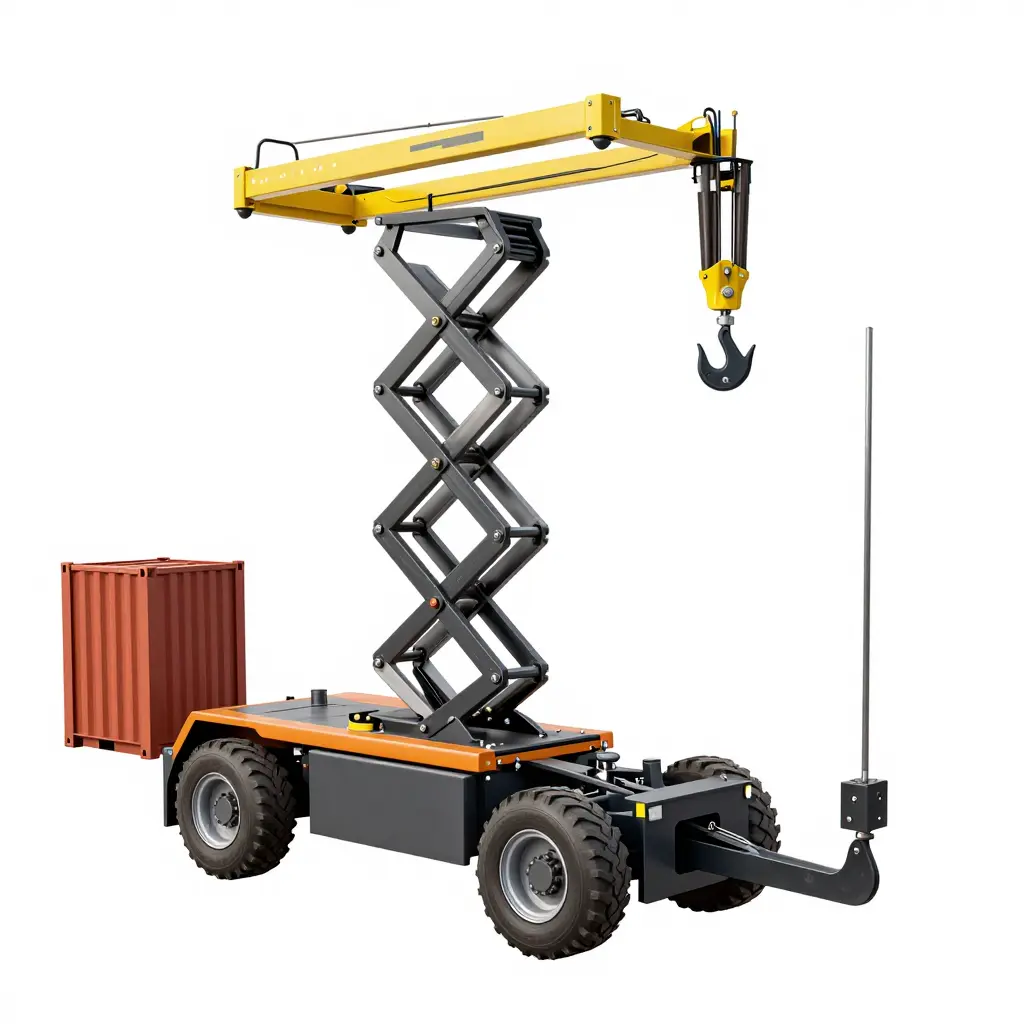
Why Floor Plate Thickness Decides Skip Loader Lifespan on Debris Routes
Skip loader bodies on construction debris work rarely fail at the sides. The floor goes first. Dropped blocks punch dents into it, grit and cut rebar ends grind the surface, and moisture trapped between plate and crossmember rusts it from underneath until the section left is thin enough to flex by hand. By the time it gets that far, the side panels have not been asked to carry much at all.
Floor plate thickness separates a body that lasts from one that is relined twice inside the same service life. A thin floor saves a few hundred kilograms at the weighbridge, then gives them back as welding hours, downtime and a second replacement floor before the truck is paid off.
The options below are set against debris type, weight penalty and payload, so the decision rests on numbers rather than on a spec sheet that lists only body volume. If you also run lift equipment, the same weight decisions ripple through the rest of the body; this guide to tare weight on a hook lift dumpster truck follows them through.
Skip Loader Floor Plate Thickness vs Debris Type
| Plate Thickness (mm) | Typical Use on Construction Debris Routes | Section Loss Tolerated Before Relining (3 mm minimum) | Approximate Floor Weight Penalty | Comment |
|---|---|---|---|---|
| 4 mm | Light rubble, clean skips, short urban runs | 1 mm | Baseline; roughly 390 kg floor | Cheapest upfront; fails early on rebar and concrete |
| 5 mm | Mixed C&D debris, brick, occasional tile | 2 mm | +100 kg versus 4 mm | Adequate for light mixed loads; most debris routes step up to 6 mm |
| 6 mm | Heavy rubble, concrete chunks, rebar offcuts | 3 mm | +200 kg versus 4 mm | Starting point for most heavy construction debris routes |
| 8 mm | Plant debris, abrasive slag, daily heavy bucket drops | 5 mm | +400 kg versus 4 mm | Overkill unless relining downtime costs more than payload |
| Wear plate + base plate | Extreme abrasion, hot slag, tracked machine loading | 7-12 mm on the wear plate | +500-600 kg versus 4 mm | Payback only on 24/7 abrasive demolition routes |
Thickness is never chosen on its own. Plate grade goes with it, and hardness and thickness are settled as one decision (see how hopper floor plate thickness is specified).
How a Skip Loader Floor Wears Through
A skip loader floor does not fail in one event. It goes through thousands of small ones every shift, and most of the damage comes from three sources: impact, sliding abrasion and corrosion. How the plate is specified decides how many shifts it lasts.
Debris tipped from height lands as a point load. A concrete lump, a tile or a length of bent rebar hits one spot and dents the plate, and those dents shallow out into depressions that hold grit and water the floor would otherwise shed at the tail.
The bins do the sliding damage. Each one is dragged across the floor on the way in and on the way out, and its steel edges grind the plate under the weight of a full container. Corrosion works more slowly. Fines and moisture collect in the gap where plate meets crossmember and stay damp for hours, so rust takes plate from underneath while the bins take it from above.
That is why the centreline goes first: the bins travel along it and the debris lands on it. The bin-entry zone is next, because bin edges strike there at an angle rather than sliding flat. On a thin plate the loss from below and the loss from above meet sooner than most owners expect. Specify for both faces, and put wear-resistant steel where the bins run. Matching bin size to chassis length also changes how much of that load lands on the centre strip.
What to Write Into the Purchase Order
Most of a floor’s life is fixed at quotation, not on the route. Get these lines into the written specification so the supplier has nothing left to interpret.
- Nominal floor plate thickness in mm, with the tolerance range you will accept on delivery.
- Steel grade and surface hardness in HB, with mill test certificates supplied for every body.
- Crossmember spacing in mm and section size, fully welded to the longitudinal rails.
- A written weld procedure for the floor-to-side seam, full penetration, with inspection records supplied.
- Replaceable wear strips or a bolt-in liner fitted across the loading zone.
- Underfloor anti-corrosion treatment: shot blast, primer and topcoat, each measured in microns.
- Floor flatness checked with a straight edge, and a stated drainage fall to the tail.
- The floor as one continuous plate, with any longitudinal joint positioned and welded as drawn.
Cross-check these clauses against the wider body steel grade and hydraulic spec before you sign, so plate grade, body build and tipping system are agreed as one package.
Estimated Floor Plate Section Loss Over Service Life
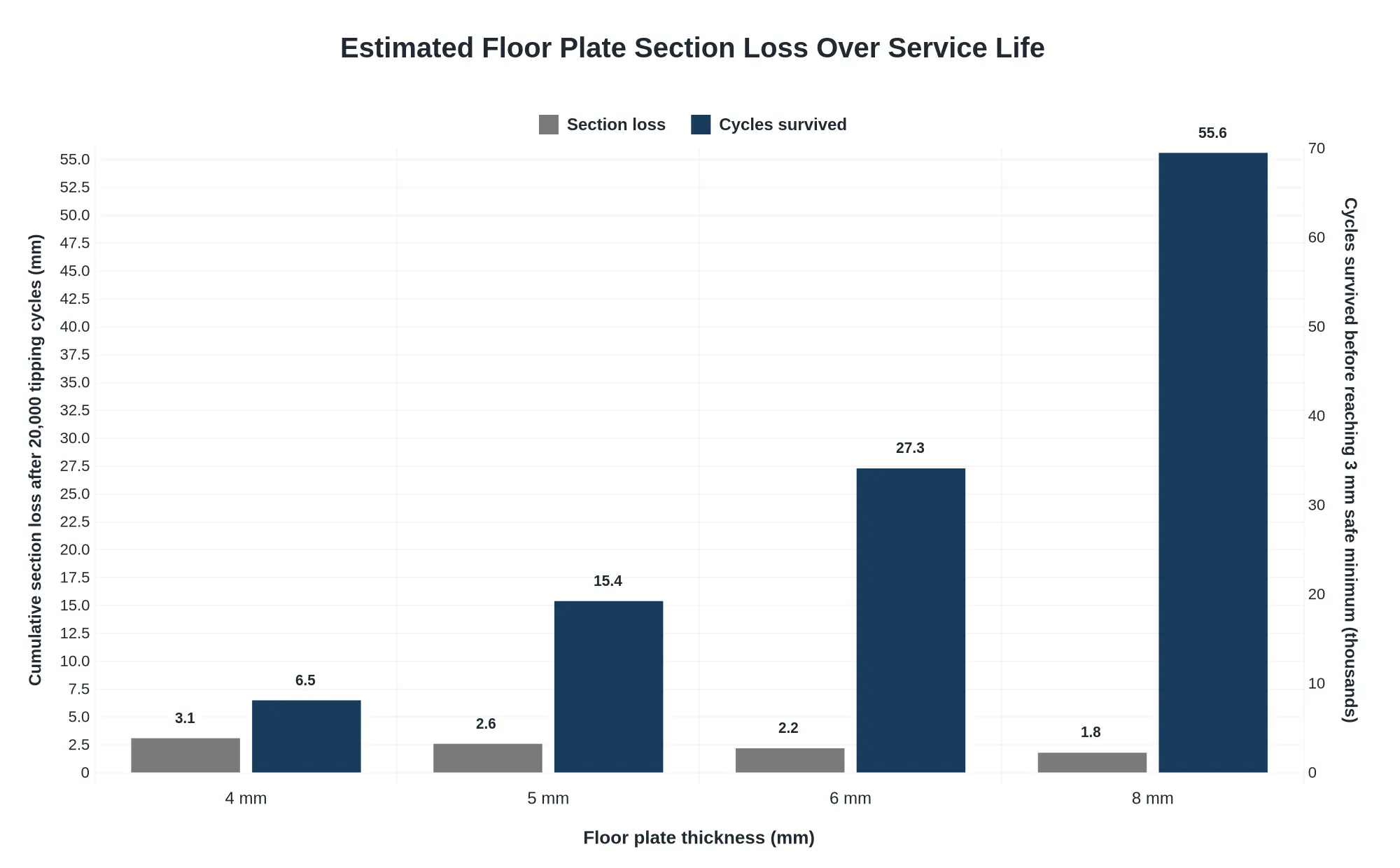
A 4 mm floor loses roughly 3.1 mm over 20,000 cycles and is out of service at about 6,500. The same duty gives 5 mm about 15,400 cycles, 6 mm about 27,300, and 8 mm more than 55,000 before the section drops under the 3 mm minimum. The relationship is not linear: a stiffer plate deflects less between crossmembers, so it wears more slowly as well as having more material to lose.
This chart shows the general trend only; actual section loss depends on the debris mix, steel grade and maintenance regime on your route.
For the cracking pattern that usually forces a reline before the plate wears through, read about why hopper floors fail on wet commercial bins.
Steel Grade, Hardness and Thickness Trade-Offs
Buyers sizing a floor for a China skip loader garbage truck tend to compare millimetres. Grade matters at least as much. A 5 mm wear-resistant plate at roughly 400 to 450 HB will often outlast an 8 mm mild steel plate on abrasive sliding loads, because it is hardness that resists scratching and gouging, not bulk. The thinner hard plate also trims tare weight, which counts on a route where every kilogram of body steel is a kilogram of debris you cannot legally carry. On grit, broken tile, plaster dust and sand, the thinner hard floor is often the better engineering choice, not merely the cheaper one.
Hardness is not toughness. A 400 HB plate resists abrasion. It does not resist a concrete kerb section or a half-buried rubble chunk dropped from bin height. Under that impact, hard plate cracks, spalls or dishes at the impact point, while a softer mild steel floor dents and keeps working. Hardness also raises the bar for field welding: preheat is usually required, low-hydrogen consumables are non-negotiable, and a careless stitch sequence invites cracks along the seam. Repair welds run slower on hard plate, and a patch that cools too fast becomes the next failure site.
The loading method should set the specification. If debris slides in and is tipped out, or is shovel-loaded rather than dropped, go thinner and harder. If bins are tipped from height, or you handle demolition rubble, concrete or scrap steel, or your drivers routinely drop loads, a thicker mild steel floor survives better and forgives more. Both sides carry repair consequences: a hard floor gives long abrasion life but needs a fabricator who understands preheat and crack control, while a thick mild steel floor welds easily in the field and can be patched with a doubler plate in an afternoon. Matching grade to duty, then confirming the body steel grade and hydraulic spec at the quoting stage, is what keeps a floor out of the workshop.
Where the Load Goes
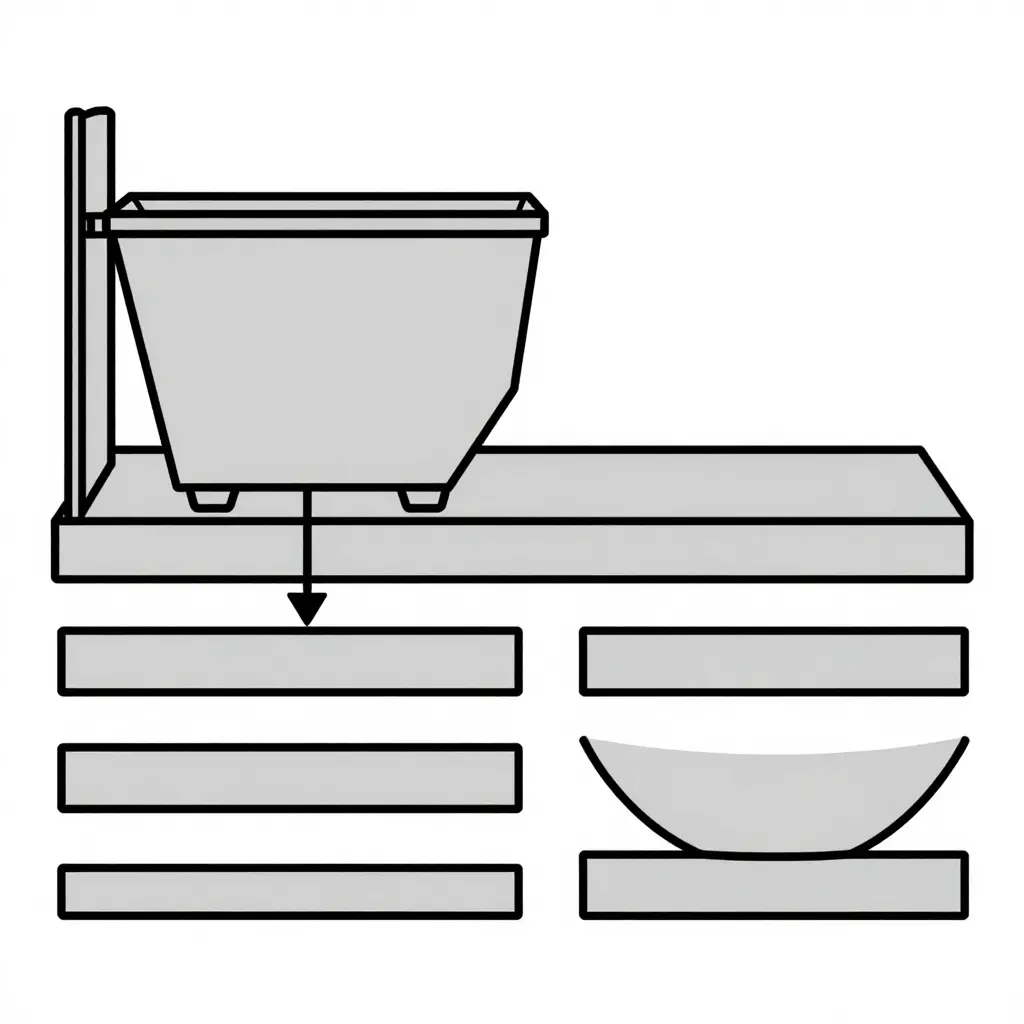
A skip bin never lands evenly across the whole floor plate. It comes down on a small footprint, and that footprint becomes the entry point for everything the bin carries. From there the load spreads through the plate, drops into the crossmembers, travels along them to the chassis rail, and reaches the axles and tyres.
The number that decides whether a plate survives a construction debris route is not thickness alone but the unsupported span between two crossmembers. Wide spacing stretches the plate over a longer gap, so the same bin weight produces a deeper sag and much higher bending stress along the seams and welds, which is usually where the first hairline crack appears.
If a supplier widens crossmember spacing to save weight or cost, plate thickness has to climb to compensate. A thick plate on a wide-spaced frame is money spent twice.
If you want the material side of this decision in more detail, read about body steel grade and hydraulic spec when sourcing a tipper body in China.
Thickness vs Payload and Axle Load
At roughly 7.85 kg per square metre per millimetre, a skip loader floor of about 12-13 m² gains close to 100 kg for every extra millimetre you specify. Going from 6 mm to 10 mm “for safety” adds around 400 kg to the truck’s own weight before a single bin or brick is loaded. On a chassis already carrying a lift frame, hydraulic tank and hoist cylinder, that is capacity paid for and never used. Weigh the empty vehicle first, because tare weight is the number your payload is measured against.
Where the mass sits matters as much as how much of it there is. The floor plate sits high on the chassis, and on most builds its forward section is well ahead of the rear bogie, so kilos added there load the steer axle harder than kilos added at the tail. A floor a few millimetres over-spec can push the front axle toward its rating, and with a full bin raised the combination can put load distribution out of legal balance even while gross weight still looks fine on paper.
The answer is the thinnest plate that reaches your intended reline interval on the routes you actually run, not the thickest plate in the catalogue. Broken concrete and rebar offcuts behave very differently from light commercial waste, so work backwards from the reline target for construction debris routes and let that set the floor plate thickness – the same logic used when deciding the plate thickness to specify for impact-damaged hopper floors.
FAQ: Skip Loader Floor Plate Thickness
What minimum floor plate thickness suits construction debris routes?
For a skip loader garbage truck hauling mixed construction debris, the floor plate starts at 6 mm in Q345B. Routes that carry concrete lumps, broken tile and rebar offcuts go to 8 mm, and the last 1.5 m behind the skip rails stays at 8 mm even on a 6 mm floor. Anything under 6 mm deflects between crossmembers and cracks at the weld toes within the first two years.
Does a wear liner beat a thicker plate?
A bolt-on liner wins in the impact zone. An 8 mm floor plate with a 4-6 mm replaceable liner over the tip and drop area delivers the same impact resistance as a 12 mm solid floor at lower rebuild cost, because the liner is swapped without cutting the body. A thicker solid plate still makes sense on the side walls and the front headboard, where a liner does not fit.
How to inspect floor plate wear without removing the body?
Use an ultrasonic thickness gauge through the top hatch and the rear door opening, taking readings on a 300 mm grid across the floor. Record the thinnest reading per zone and compare it with the original spec; below 70 percent of nominal thickness, plan the reline. Visual checks still earn their place: dish-shaped depressions between crossmembers and rust staining along the seams mark the failure points before a hole appears.
What to specify in a Chinese supply order to get consistent thickness and grade?
Write the steel grade (Q345B or Q235B), the nominal floor plate thickness with the tolerance band you accept (plus or minus 0.5 mm), and the mill certificate number on the purchase order. Ask for the liner thickness, bolt pattern and grade as separate line items, and require the weld procedure for the floor-to-crossmember joints. A China skip loader garbage truck manufacturer that quotes thickness without a tolerance or a heat number is quoting a number, not a plate. Full guidance on the plate thickness to specify sits in our hopper floor and plate thickness notes.
The Buying Decision
Match the floor plate thickness to the debris mix on your routes and to the reline interval you are willing to accept. Concrete rubble and rebar offcuts will chew through a 4 mm floor in a few seasons, while clean timber and packaging waste rarely justifies the payload penalty of an 8 mm plate. Once the number is chosen, confirm the body steel grade and its sourcing specification and the crossmember spacing in writing on the order: grade governs abrasion resistance, spacing governs how much unsupported span the plate must carry. A skip loader garbage truck specified this way stays working instead of standing in the workshop waiting for a floor.
Treat the thickness figure printed on the quotation as unverified until the mill certificate has been matched to the heat number and the plate itself measured at receiving inspection. Caliper or ultrasonic readings taken at several points along the floor and side wall will expose rolling tolerance and any substitution faster than paperwork alone. A factory-backed build with a documented steel specification, produced under CRRC’s quality system, is the reliable way to hold that thickness across a fleet order.