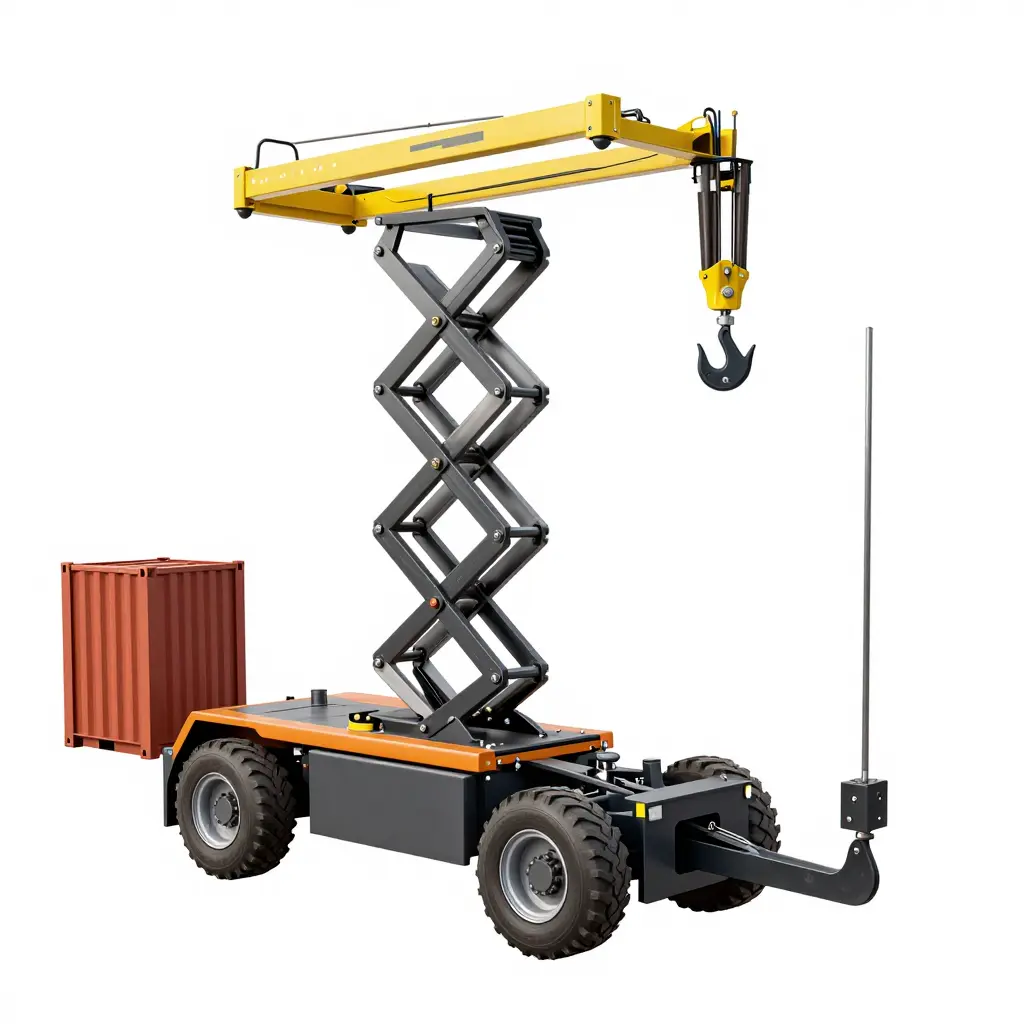
Introduction: Defining Gate Creep on a Slope
The slide rear loading gate is a hydraulic panel at the back of a compactor garbage truck. It rides up and down on guide tracks and closes off the hopper during the compaction cycle. Held correctly, it stays wherever the operator puts it. Gate creep on a slope is what happens when it stops holding: the gate drifts down under its own weight while the truck is parked or working on a grade. The movement is slow and easy to ignore until it starts interfering with cycle timing, packer blade sequencing, or the safety interlocks.
Faced with this complaint, most technicians rebuild the lift cylinder or swap the directional control valve first. The hydraulic sequence valve rarely gets checked, even though it sets the order in which the gate, packer blade, and tailgate circuits receive flow. When it leaks internally or is set wrong, gravity can overcome the hold circuit.
The steps below show how to confirm whether the valve is the culprit and how to correct it.
Slide Rear Loading Gate: Actuation, Hold, and the Slope Load Path
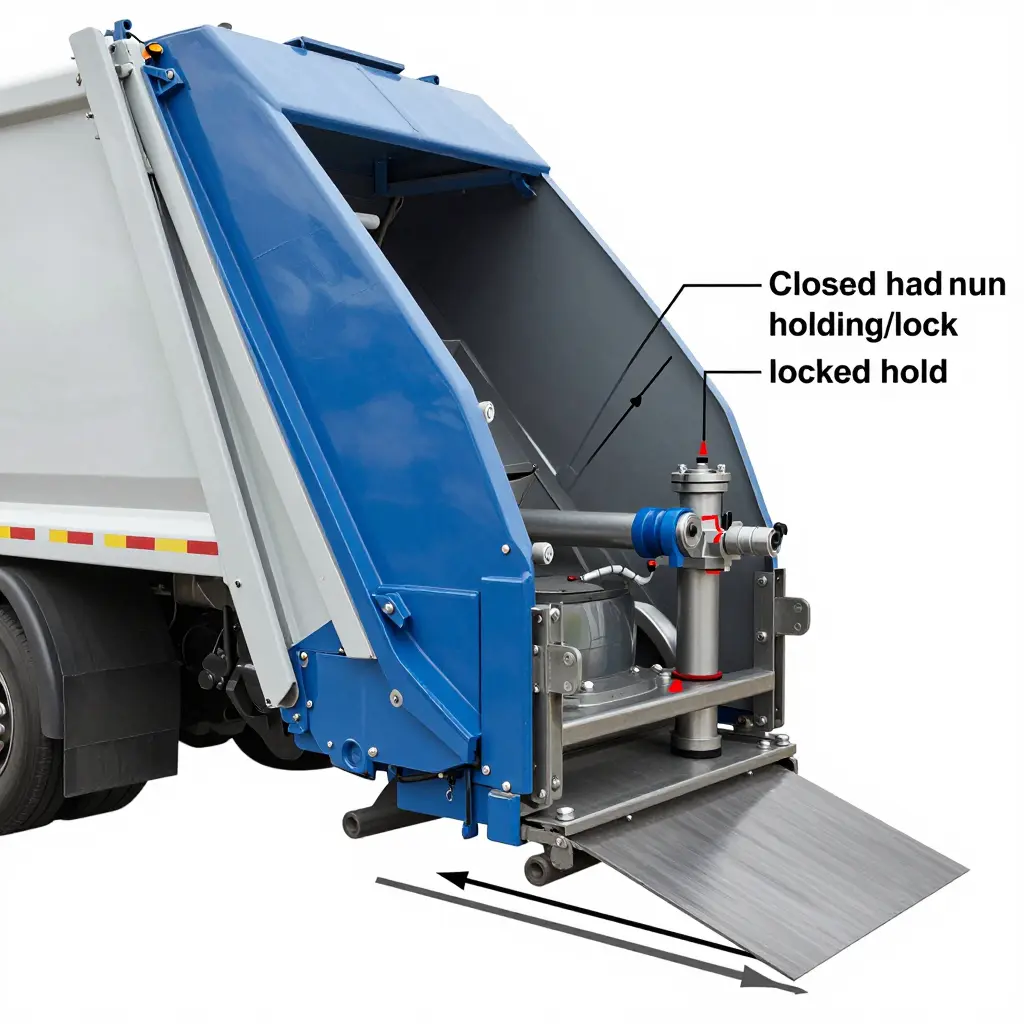
The gate runs on hardened guide rails fixed to the rear body frame and is driven by one hydraulic cylinder or a matched pair. In the loading position, a closed circuit holds it still: fluid is trapped on both sides of the piston, and a locked hold (a pilot-operated check or holding valve) keeps it from drifting while the truck is stationary.
On a grade, part of the gate’s weight pulls along its travel axis. That added axial load means the trapped fluid has to hold more pressure to keep the gate from sliding.
Any small internal leak – worn piston seals, a scored spool, a weeping check – lets that pressurized fluid escape. As pressure decays, the load overcomes the hold and the gate creeps downward.
In practice, this is a pressure-retention problem, not usually a mechanical rail problem. Work through the valve and circuit before condemning hardware, and start with the hydraulic sequence valve. For background on diagnosing rear-load compactor hydraulic faults, review the wider valve and circuit.
Why the Hydraulic Sequence Valve Is the First Component to Check
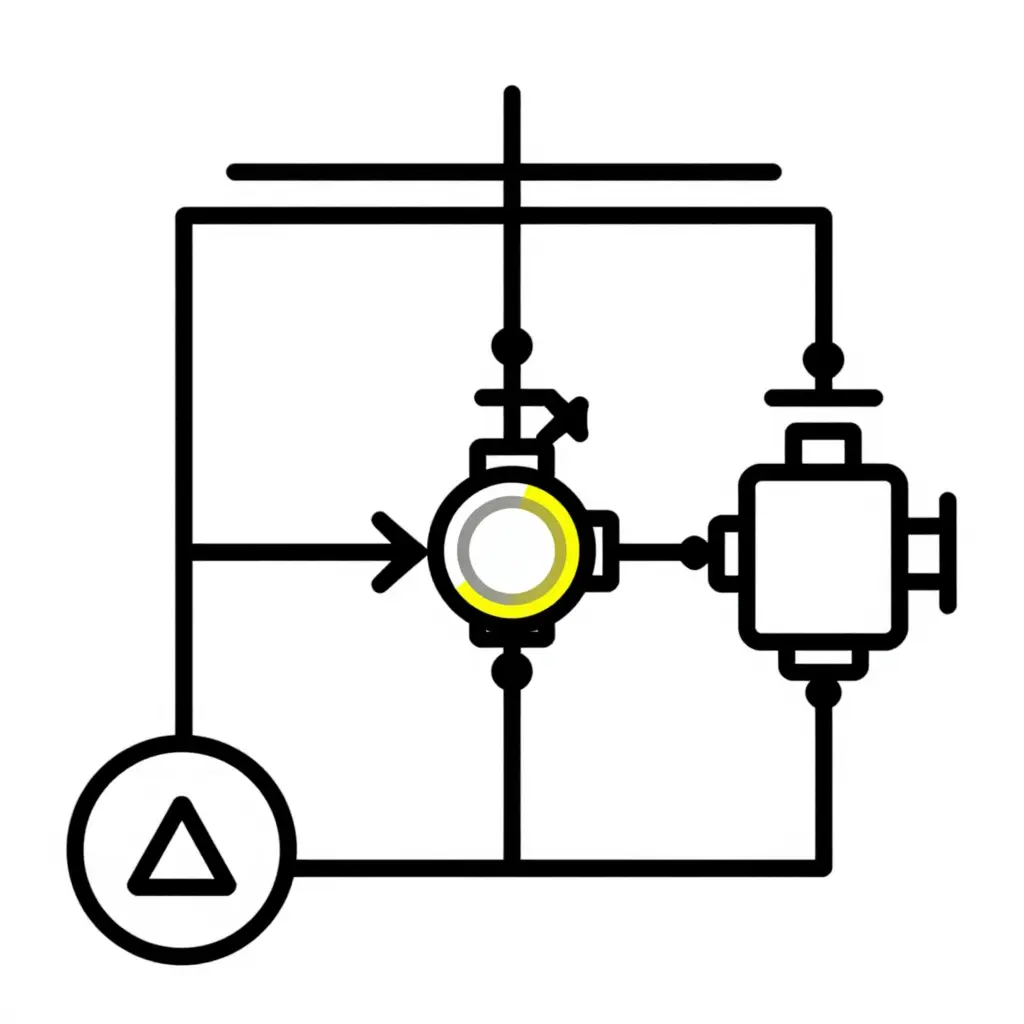
Gate creep on a slope is more often a valve problem than a cylinder problem, and the sequence valve is the part most often missed. It controls the order in which functions are pressurized: it holds the gate circuit until upstream pressure reaches its setting, then passes flow. That pressure-held state is what keeps the gate locked.
A worn or internally leaking spool lets pilot pressure bleed past the lands. A tired spring lowers the cracking pressure, so the valve opens early. A contaminated seat keeps the valve from reseating fully, and fluid leaks through continuously. Either way, pilot pressure bleeds off and the gate drifts downhill.
Check the sequence valve before assuming cylinder seal failure. Cylinder bypass is possible, but it is less common than sequence-valve leakage. A failed cylinder usually shows external weeping or rod scoring; a leaking sequence valve shows neither, yet produces the same creep. Mechanical play such as rear-loader hinge pin wear can look like a creeping gate, but it cannot produce a steady hydraulic drift. Verify the valve setting, inspect the spool and spring, and clean the seat first.
Step-by-Step: Inspecting the Hydraulic Sequence Valve First
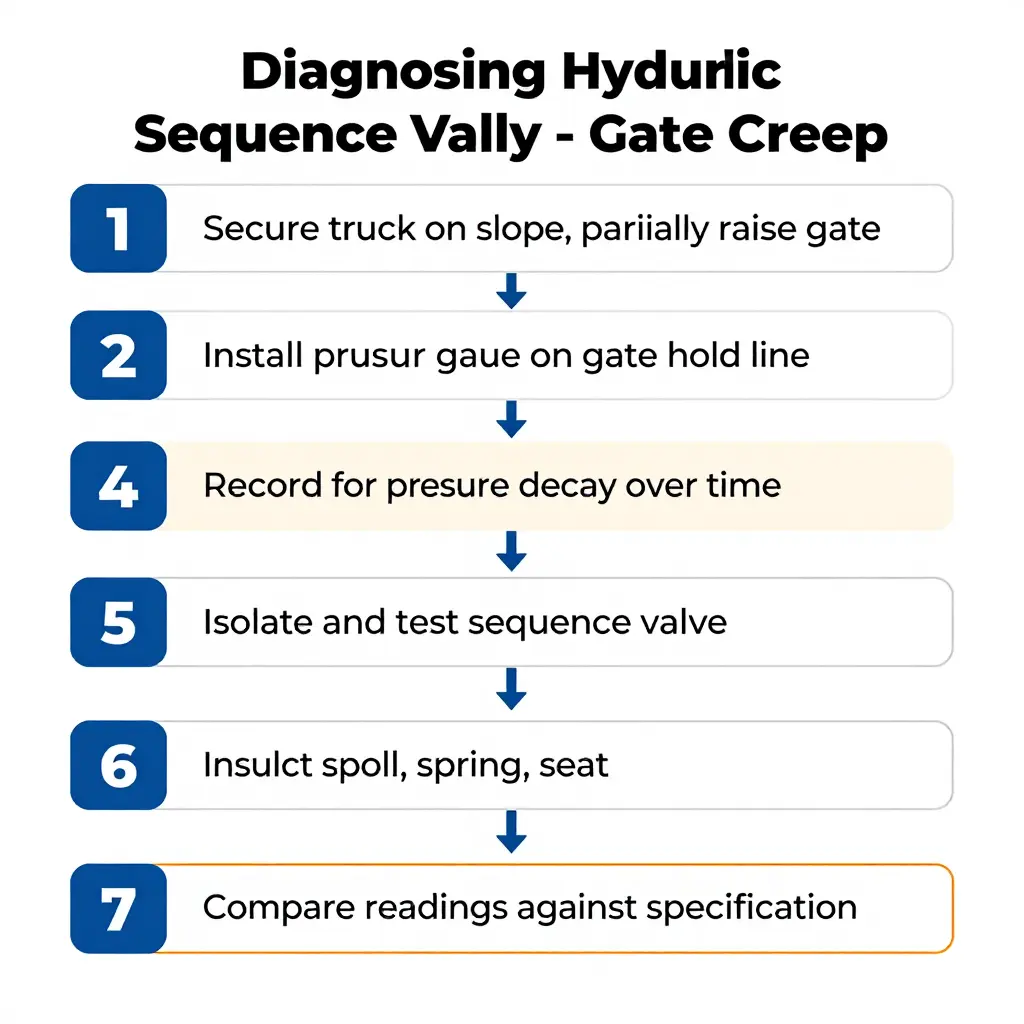
Diagnosing gate creep on a slope starts with the hydraulic sequence valve. Work through this order and change nothing until each reading is logged.
-
Park the truck on the slope, raise the slide rear loading gate partway, then chock the wheels and set the parking brake. Never reach under an unsupported gate or loosen a fitting while the system holds pressure.
-
Fit a calibrated pressure gauge to the gate hold-line test port and record the static pressure once the gate settles.
-
Watch the gauge for several minutes. A steady bleed-down that tracks the gate’s movement points to internal leakage rather than a mechanical bind.
-
Isolate the hydraulic sequence valve and test it on its own. Plug the return line to confirm whether the leakage comes from inside the valve body.
-
Pull the valve and inspect the spool, spring, and seat for scoring, varnish, or trapped debris. Clean and reseal as needed.
-
Check the pilot line for kinks or restrictions, then confirm the sequence pressure setting matches the factory specification.
-
Compare every reading against specification and repair or replace any out-of-tolerance component before returning the truck to service.
For related component diagnosis on these bodies, review this rear-load compactor troubleshooting guide.
When gate creep on a slope is reported, don’t jump straight to the cylinder. Work the symptom backward to the circuit and confirm the diagnosis with a pressure-gauge and flow test before ordering parts. The table below maps the five most common field symptoms on a rear-load compactor gate to their likely root cause and the corrective action.
Gate Creep Symptom vs. Likely Cause vs. Corrective Action
| Symptom | Likely Cause | Corrective Action |
|---|---|---|
| Gate creep on a slope only, under load; drift stops once the sequence circuit is unloaded | Leakage through a worn spool-to-bore clearance in the hydraulic sequence valve | Reseal or replace the hydraulic sequence valve, then recheck its spring and setting |
| Creep with measurable pressure decay on the hold line while the gate is parked | Internal valve leakage (spool lands, check poppet, or seals passing oil internally) | Pressure-test the hold circuit; replace worn seals or spools, or swap the holding/directional valve |
| Creep with external oil weeping at the gate end | Cylinder rod seal failure | Inspect the rod for scoring, install a new rod seal kit, and verify the wiper and gland |
| Creep accompanied by slow gate movement in both directions | Pump wear or relief-valve fault (low volumetric efficiency, mis-set relief) | Flow-test the pump and check the relief valve setting; rebuild or replace as required |
| Creep with intermittent loss of sequence control | Contaminated valve seat preventing a clean seal | Flush the circuit, clean or replace the contaminated valve seat, and service the return filter |
Read the left column first. If creep appears only on a slope and under load, the hydraulic sequence valve is the prime suspect and should be inspected first. If pressure bleeds off on the hold line with no external loss, chase internal leakage rather than the cylinder. Related compactor hydraulic troubleshooting notes describe how these faults present on the packer side of the same circuit.
Sequence Valve Inspection Checklist
Work through these steps in order. Skipping ahead often masks the true fault in a slide rear loading gate that creeps on a slope. For broader compactor valve and blade issues, see this guide to packer blade hydraulic faults.
- Isolate the circuit – Close the body-lift and gate control valves, relieve residual pressure at the sequence valve, and lock out the PTO before cracking any fitting.
- Verify pilot pressure – Tee a calibrated gauge into the pilot port and confirm the signal reaches the valve’s rated value when the gate is commanded to hold.
- Test the spool for freedom of movement – Stroke the spool manually or with a controlled pilot signal; it must shift smoothly without sticking and return fully under spring force.
- Inspect the spring – Remove the cap and check the spring for sag, cracks, fretting, or lost free length against spec; a weak spring lets the gate drift.
- Inspect the seat and sealing edges – Look for brinelling, wire drawing, nicks, or erosion on the poppet or spool land; the sealing margin should be uniform and lapped.
- Check for contamination and varnish – Examine the spool bore and internal passages for silt, metal fines, and dark varnish from overheated oil that can bind the hydraulic sequence valve.
- Verify sequence pressure setting – Bench or in-line test the cracking pressure against OEM spec, and adjust pilot or spring preload only within the allowable range.
- Reinstall and retest the gate hold – Reconnect, purge air, warm the oil, then park on the same slope and time the gate’s drift; drift within spec confirms the repair.
If the gate now holds on the slope and sequence pressure matches spec, clean the valve and return it to service. Persistent creep with a scored seat or sticking spool means reseat or lap the sealing edges. A cracked spring, eroded land, or wear beyond tolerance justifies replacement, not adjustment.
| Result | Action |
|---|---|
| Holds, pressure in spec | Clean and return to service |
| Creep with scored seat | Reseat or lap sealing edges |
| Cracked spring or eroded land | Replace valve |
Hydraulic Sequence Valve Operating Principle
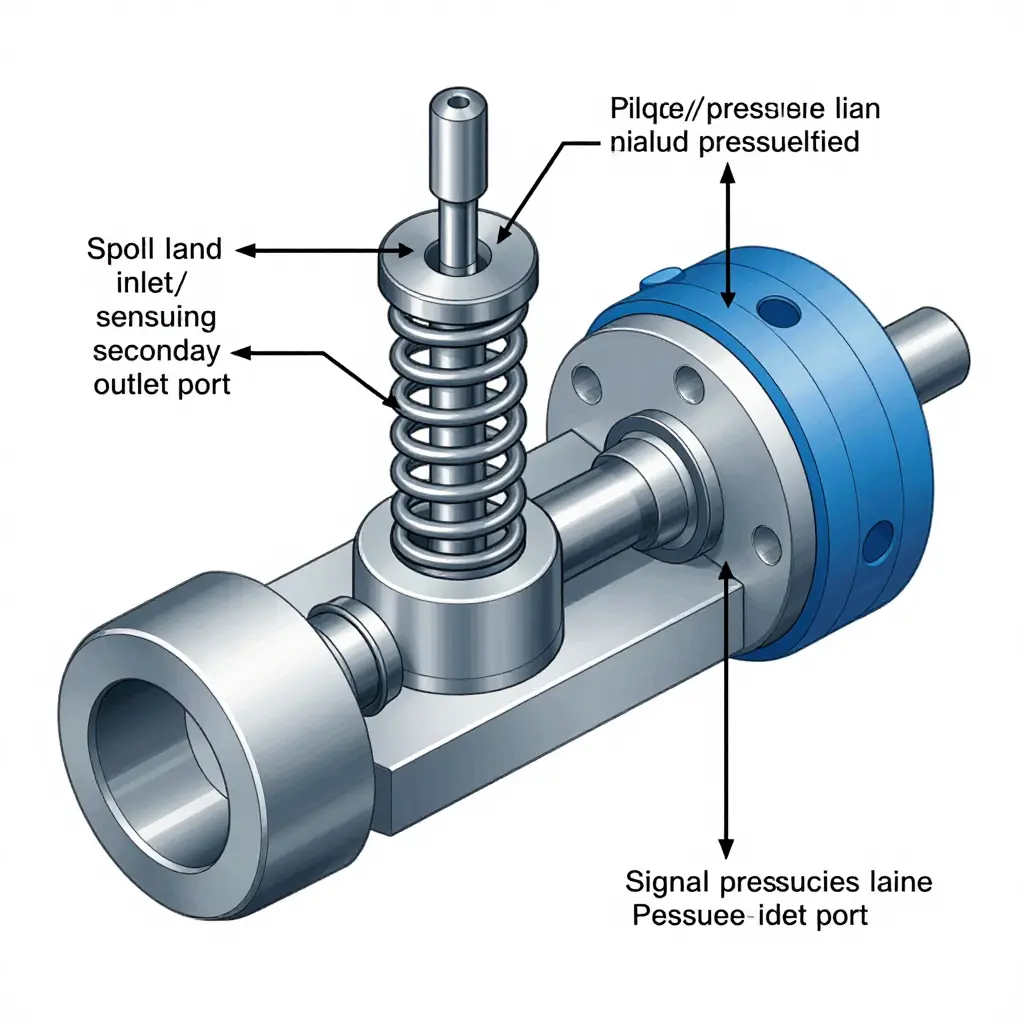
A hydraulic sequence valve is normally closed and pressure-actuated. Spring preload holds a spool seated on one side, while pump supply (pilot) pressure acts on the spool’s sensing face. The valve stays closed until inlet pressure generates force exceeding spring preload – the set threshold, typically 1,500-3,000 psi. Above it, the spool shifts and opens the secondary port to sequence the gate circuit. A signal pressure line from the downstream circuit can hold the spool closed until the primary function completes.
Common Failure Modes and Gate Creep
Four faults produce most sequence-valve gate creep on a slope. Spool scoring from contamination lets fluid bypass the lands and the gate drifts downward; inspect for longitudinal scratches and burnished lands. Spring fatigue lowers the opening threshold; measure free length against specification. Seal degradation from hardened or nicked O-rings permits internal leakage past the spool; look for extruded or swollen seals. Contamination from degraded hydraulic fluid carries varnish and metal fines that accelerate every fault above; check fluid color and sump sludge. For related compactor hydraulics, review rear-load compactor truck packer blade issues.
Reading the Gate Drift Curve
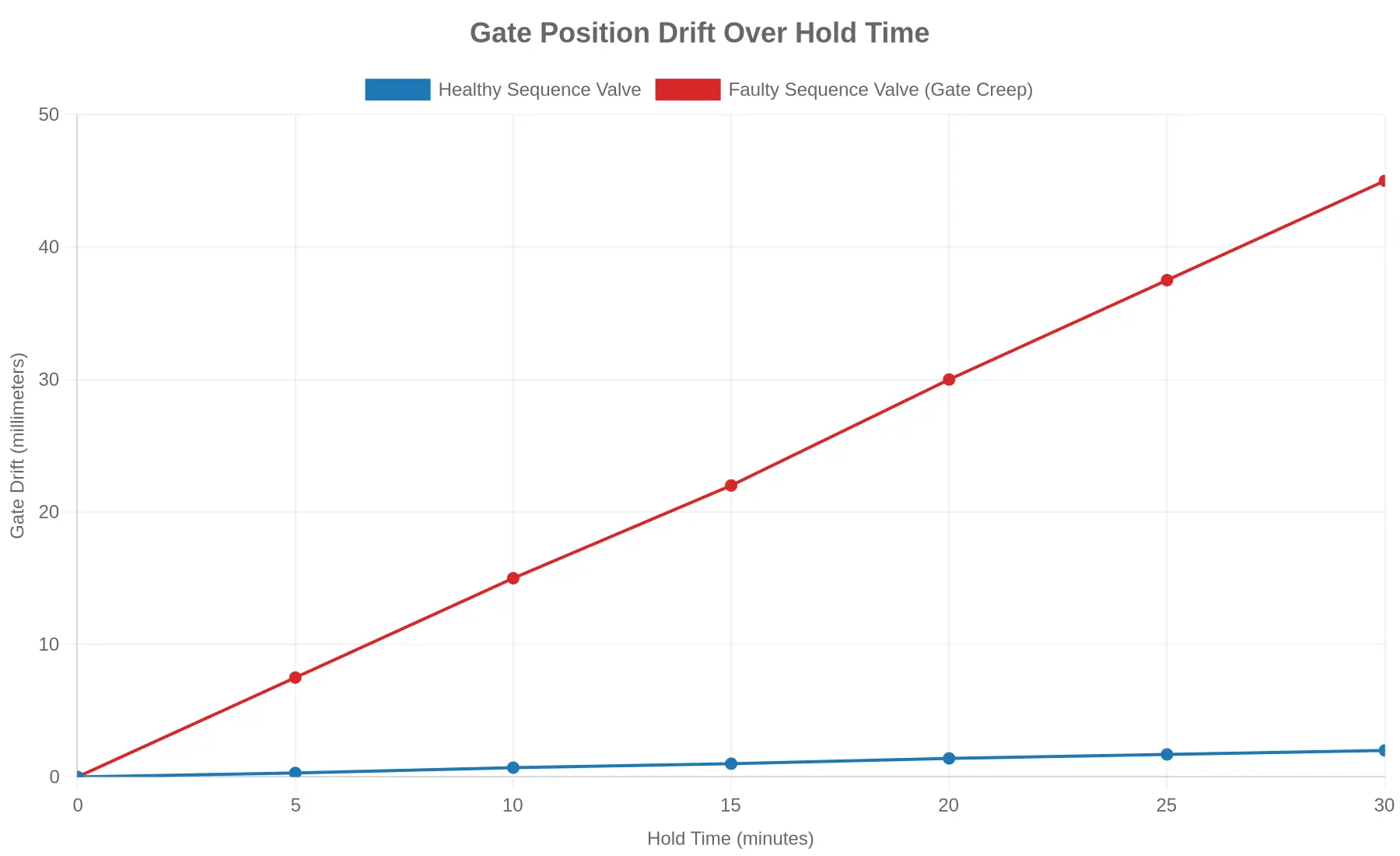
The chart above plots gate position drift against hold time for two hydraulic sequence valves under identical load on a slope. Hold the rear loading gate partway up a grade with no operator input, and a correctly sealing sequence valve should lock the circuit. A worn or leaking valve lets the load side bleed back to tank, and the gate creeps down.
What the Two Lines Tell You
- Healthy sequence valve (blue): Drift stays under 2 mm across the full 30-minute hold. That residual movement is normal spool leakage and thermal contraction, not creep.
- Faulty sequence valve (red): Drift climbs in a near-linear ramp to roughly 45 mm at 30 minutes. A straight, accelerating slope like this points to a valve that is not holding pressure, not a cylinder bypass alone.
| Hold Time (min) | Healthy Drift (mm) | Faulty Drift (mm) |
|---|---|---|
| 0 | 0 | 0 |
| 5 | 0.3 | 7.5 |
| 10 | 0.7 | 15.0 |
| 15 | 1.0 | 22.0 |
| 20 | 1.4 | 30.0 |
| 25 | 1.7 | 37.5 |
| 30 | 2.0 | 45.0 |
Why This Points at the Sequence Valve First
A linear drift curve is the signature to capture before you start pulling cylinders. If the gate only settles on a slope but holds flat on level ground, the sequence valve is the prime suspect, since gravity loads the circuit and exposes the internal leak. The same pressure-holding logic applies to other compactor functions, covered in rear load compactor truck packer blade issues.
Capture the slope and time window, then benchmark against the blue reference line. Anything that tracks the red ramp is a valve problem, not a mystery.
Secondary Components After the Sequence Valve
Once the sequence valve is ruled out or corrected, inspect downstream components in order. Start with the gate lift cylinder, then the control valve, the lock valve, the relief setting, and finally the fluid and filters.
Gate lift cylinder and seals. Worn rod seals leak externally; failed piston seals allow internal bypass. On a slope, bypass lets the cylinder drift under load, producing creep. Check for weeping, scored rods, and pressure-holding with a stall test.
Control valve spool and centering. A sticking or mis-centered spool cannot fully close the gate circuit, so oil bleeds through and the gate drifts downhill. Verify free spool travel and correct return to neutral.
Pilot-operated check valve or lock valve. This valve holds the cylinder against gravity. A leaking pilot check lets the slide rear loading gate creep on an incline. Test its sealing and pilot ratio.
Relief setting. A relief set too low or leaking bypasses oil prematurely, weakening holding force.
Fluid and filters. Contaminated or aerated fluid plus clogged filters cause erratic spool behavior and seal wear. Inspect these last, since debris often traces to an upstream failure.
For broader circuit guidance, see this guide to rear-load compactor hydraulics.
FAQ: Gate Creep on a Compactor Garbage Truck
Can gate creep be caused by anything other than the hydraulic sequence valve?
Yes. Worn slide gate cylinder seals, a scored cylinder bore, a failing pilot-operated check valve, or a leaking directional control valve spool can all let the gate drift. Confirm the hydraulic sequence valve first, but do not rule out cylinder bypass or related rear-load compactor hydraulic faults if creep persists after servicing it.
How often should the sequence valve be serviced?
A common interval is every 500 operating hours or at each scheduled hydraulic service, whichever comes first; confirm the exact figure in the OEM schedule. Replace its seals annually, and check the valve whenever gate creep on a slope appears, since debris and heat degrade settings quickly.
What are the signs of an internal sequence valve leak?
Look for slow gate drift under load, a gate that settles when the engine is off, abnormally hot valve bodies, and hydraulic fluid weeping past the valve cap. Pressure testing the circuit and comparing hold pressure to spec confirms the leak.
Is it safe to operate the truck with a creeping slide rear loading gate?
No. A creeping slide rear loading gate can drop unexpectedly, crush a worker, or spill waste on a slope. Park the unit and repair the valve or cylinder before returning it to route service.
Conclusion: Diagnose the Valve Before the Cylinders
Gate creep on a slope is a pressure-hold problem, not a structural one. When the slide rear loading gate drifts downhill, the circuit is losing holding pressure rather than the cylinders or rails wearing out. Check the hydraulic sequence valve first, because a leaking or mis-set valve lets fluid bypass and the gate migrates under gravity. Condemning cylinders or rails before this step wastes labor and parts.
Verification after repair follows the same logic. Re-test hold pressure on the same slope grade, then confirm the gate stays stationary with the system pressurized and the engine at idle. Recheck the valve setting, watch for internal leakage, and monitor rod position over a timed interval.
Diagnose the circuit in this order and the truck goes back to work with the real fault corrected. More rear-load compactor hydraulic troubleshooting notes cover the rest of the circuit.