Two Limits, One Body Size
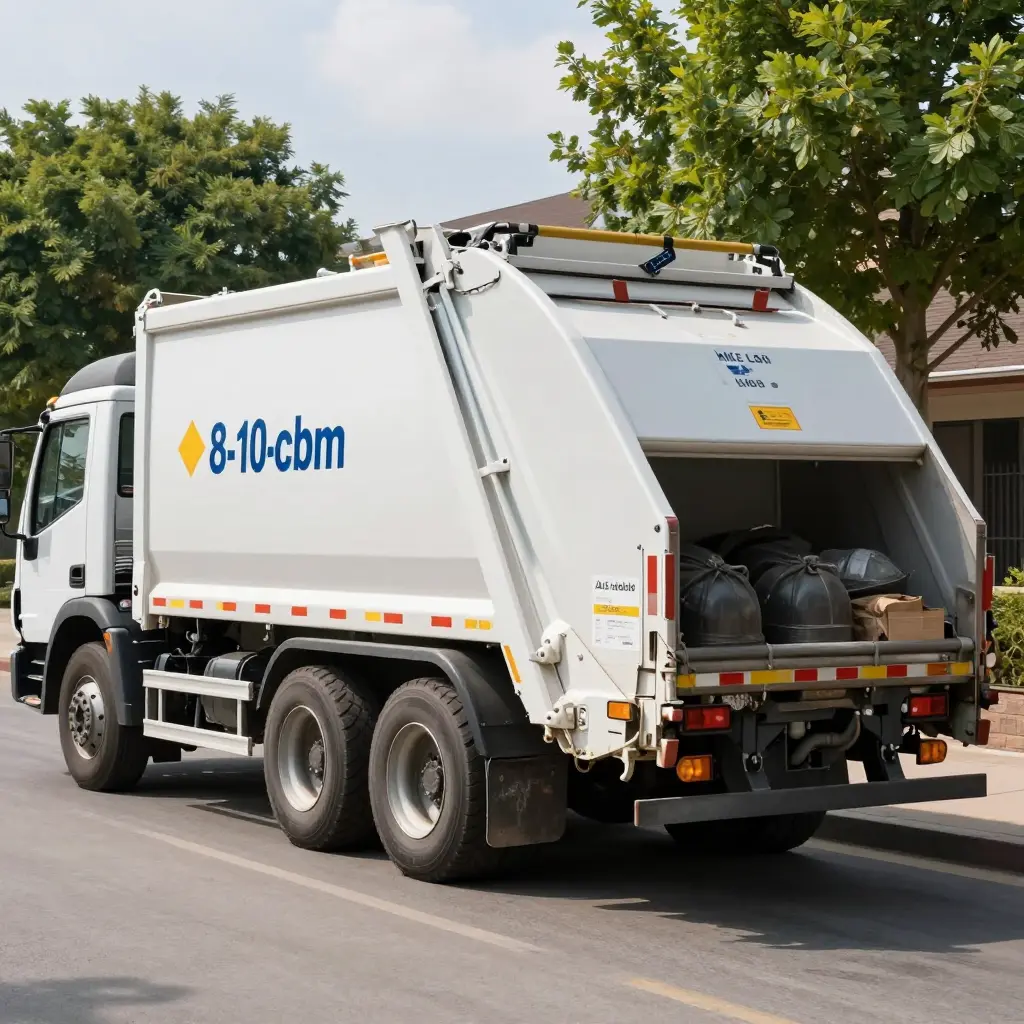
An 8-10 cbm skip loader garbage truck looks simple on a spec sheet: one body, one lift, one driver. Two limits actually decide how much work it does, and they rarely bind at the same moment. Volume is the first – light, bulky refuse fills the body long before the legal weight limit comes close. Axle load is the second, and it sets legal payload, which in turn sets the route count a truck can finish in a shift.
Get the terms straight before you compare quotes.
| Term | What it means |
|---|---|
| Body volume (cbm) | Usable internal space of the skip body, in cubic metres. For this class, 8 to 10 cbm. |
| Tare weight | Kerb weight of the complete truck, body and lift included, with fuel and oil, and with the driver where the local rules count him. |
| GVW | Gross vehicle weight. The maximum loaded weight the chassis is rated to carry. |
| Front axle rating | Maximum load the steer axle is allowed to carry. |
| Rear axle rating | Maximum load the drive axle or axles are allowed to carry. |
| Payload | GVW minus tare weight, then capped by the axle ratings. The legal load you can actually carry. |
| Route count | Bins or stops cleared per shift at legal payload. |
Payload is not a body specification. It is GVW minus tare, capped again at each axle, so a heavier body, a heavier lift frame or a heavier hoist cuts payload directly – which is why tare weight deserves its own check before you sign. A quote that gives a volume figure without a tare figure on the same page is not yet a quote you can compare.
What decides which limit arrives first is the waste stream. Light bulky refuse fills the body while the axle is barely working; dense, wet or mixed loads reach the axle with the box half empty. Route count, bin size and chassis choice all follow from that one fact.
How Different Refuse Streams Fill an 8-10 cbm Skip Loader Body
Body volume and rear axle load are two separate ceilings on the same truck. Which one stops you depends on what goes into the bin.
| Refuse stream | Typical bulk density (kg/m3 range) | Fill behaviour in an 8-10 cbm body | Which limit binds first (volume or axle load) | Practical loading note |
|---|---|---|---|---|
| Cardboard and paper packaging | 30-80 | Fills top-down, bridges at corners | Volume | Flatten boxes, load rearward, skip the compaction pass |
| Loose plastic film and wrap | 20-60 | Domes and voids, never settles flat | Volume | Bag or pierce film so it cannot spring back |
| Polystyrene and foam packaging | 10-30 | Reaches the roof at a few hundred kg | Volume | Net or tarp it before the truck leaves the yard |
| Mixed commercial dry waste | 120-250 | Settles mid-body, uneven side load | Volume first; axle load on dense bag mixes | Shake bags out, keep heavy sacks over the axle |
| Wet food and canteen waste | 500-900 | Sits low, compacts under its own weight | Axle load, at the top of the density range | Keep it forward of the rear axle, watch leachate |
| Construction rubble and soil | 1200-1800 | Half a body can already max the axle | Axle load | Load in partial lifts, never fill the box level |
Table 1: How light bulky refuse and denser streams fill an 8-10 cbm skip loader body, and which ceiling stops the load first.
The first three rows end the same way: airspace runs out while tonnes of payload remain, so a box that looks full can still leave the weighbridge with most of its legal load unused. Wet food and rubble remove that margin. Before you fix a route count or a chassis spec, put a weighed tare into the arithmetic and see how much of your gross vehicle mass is actually available for refuse.
Why Light Bulky Refuse Fills the Body Before It Reaches the Axle Limit
On an 8-10 cbm skip loader the chamber is measured in cubic metres, not tonnes. Loose cardboard, polystyrene, upholstery, pallets and shrink-wrapped film sit somewhere around 40-90 kg per cbm; fill 9 cbm at 60 kg per cbm and you have roughly 540 kg of cargo in a truck plated for several tonnes. The volume budget is gone while the mass budget has barely moved. That is the whole explanation for light bulky refuse filling the body first.
Large rigid items make it worse. Boxes, drums and broken furniture bridge across the chamber walls and lock together instead of settling, so the load hangs on its own structure with air underneath it. The waistline, the roof curve and the floor-to-wall corners are dead space that nothing reaches. The box looks full from the kerb and holds a surprising amount of nothing.
Pressing the load does not rescue this. On dry cardboard and foam the material springs back as soon as the pressure comes off, so the gains fade against a real route mix – the compaction ratio a residential route actually achieves shows how little volume a purpose-built packer recovers from light material.
The effect shows up on the route sheet rather than the spec sheet. The body reads full at half a payload, so trips are limited by volume while the axle still has room, and you drive the same number of runs anyway. The payload versus axle weight relationship that decides what fills first explains why a heavier chassis on its own will not shorten the day.
What recovers usable volume:
- Load dense items – soil bags, wet organics, glass – at the front of the chamber so they anchor the load instead of riding on top of it.
- Break cartons flat before loading rather than tossing them in whole.
- Where the route mix justifies the payload penalty, specify a body with a crushing plate.
Body Volume Filled vs Payload Used
The bin and the scale disagree, and the disagreement is systematic. Light bulky refuse consumes volume while the axles still have capacity; wet waste and rubble do the opposite. The chart plots both against the same rated payload.
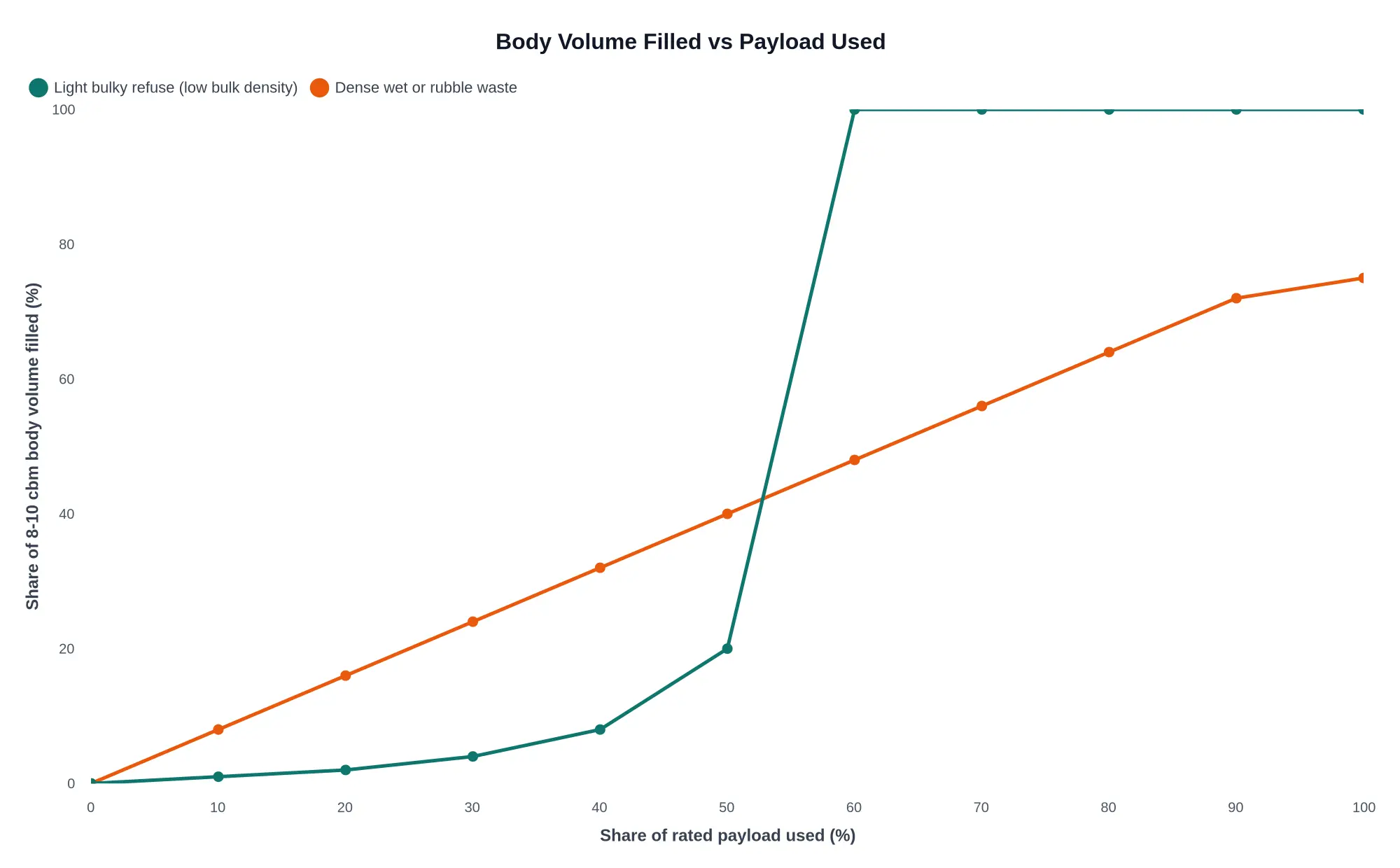
Chart caption: The light-bulky curve climbs steeply and reaches full body volume with much of the payload still unused; the dense-wet curve reaches the payload ceiling with the body still part full. Where they cross sits the volume-limited crossover – the last point at which another cubic metre of body still buys another tonne of capacity. Past that point route count is set by volume, not weight, so a low-density commercial round needs more lifts than its tonnage rating suggests. The exact crossing depends on the rated payload and the density of the stream, so read the chart for the shape of the two curves and calibrate the percentages against your own weighbridge slips.
The Axle Load That Decides Route Count
A route plan starts on the weighbridge. Three steps, in this order.
Subtract tare from GVW. Take the GVW on the plate and subtract the weighed tare weight of the complete unit – chassis, body, lift, fluids. What is left is the payload ceiling: the bin and the refuse, plus the driver where he is not already inside tare. This is where axle load first bites, because a chassis advertised as a “10 tonne” truck rarely hands you ten tonnes of rubbish. Getting tare weight settled before you spec a body saves a lot of arguing later.
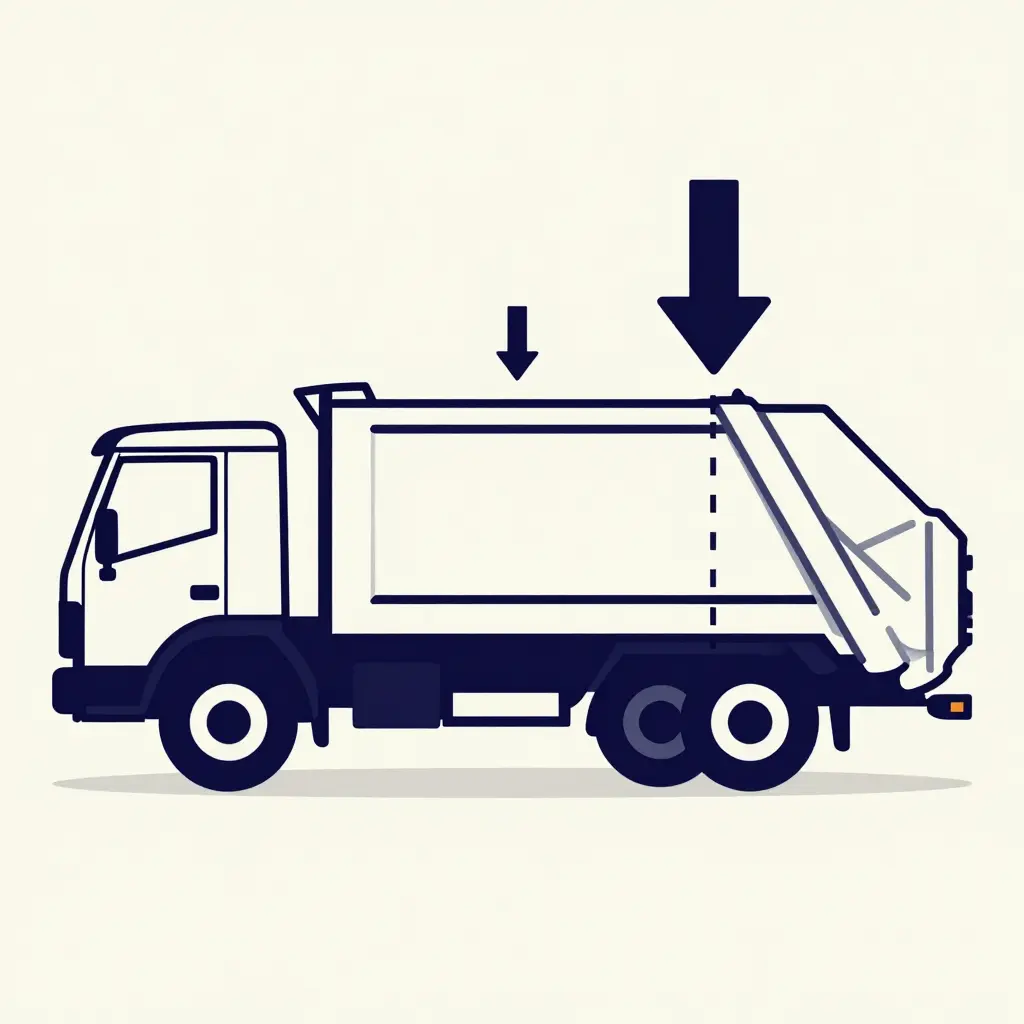
Split the ceiling across the axles. The front axle rating and the rear axle rating divide it. On a rear-loading or hook-lift body the rear axle almost always binds first: the body, the lift arm and the loaded bin all sit behind the cab, so the rear figure runs out of margin while the front axle is still light.
Turn per-axle payload into stops. Divide the per-axle payload on the binding axle by the tonnes you collect per stop. That gives your legal stops per trip; multiply by trips per shift and you have the route count.
The trap is upsizing. A 10 cbm body with a thicker floor plate weighs more on the same chassis, so legal payload falls – and so does route count. A bigger body is not automatically more route capacity for dense waste, which is why matching bin size to chassis length matters as much as the body itself. Check the axle load before you upsize.
Variables That Set Route Count for an 8-10 cbm Skip Loader
Route count is not a volume question on its own. It is a tug-of-war between what the chassis weighs and what the working day allows, and the variables fall into two sets.
Fixed when you order:
- GVW and tare weight of the chassis
- Rear axle rating
- Body and lift assembly weight
Measured on the round:
- Average bulk density of the collected stream
- Average fill level of each skip bin
- Lift cycle time, including hook engagement and tipping
- Travel time between bins
- Unloading turnaround at the disposal site
- Driver shift length
The first set you can write into a purchase order. The second you can only learn by weighing and timing a normal week, which is also the only reliable way to know which of the two ceilings – volume or axle – your route is actually hitting.
What to Specify Before Ordering an 8-10 cbm Skip Loader Garbage Truck
Light bulky refuse fills an 8-10 cbm skip loader body long before it uses the legal payload, so the number that matters is not the volume on the brochure. Put every figure below into the purchase specification, in writing, with units, steel grades and measurement conditions, and make the factory confirm the tare of the complete unit on your chosen chassis. This sizing guide on body volume, axle load and chassis match is a reasonable starting point for the tender wording.
- Rated volume versus usable capacity: ask for the nominal geometric volume and the usable volume after the lift arms, subframe and any floor intrusion, measured with a level load rather than heaped.
- Floor and side plate thickness: for abrasive bulky loads such as rubble, timber offcuts and green waste, fix floor plate, side plate and wear-strip thicknesses in millimetres, plus steel grade and where the wear strips sit.
- Body and lift assembly tare weight: obtain the weighed tare of the body, subframe, lift assembly and bin geometry on the exact wheelbase and cab you are buying, so payload becomes a real figure instead of an estimate.
- Axle ratings and tyre load index: state front and rear axle ratings, the laden load split with a full bin aboard, and the tyre load index and rim rating required – not just ply count.
- Bin sizes matched to lift geometry: name bin capacities, hook height and bin rail dimensions with the lift arm reach and tip angle, so the bins you already own or plan to buy actually cycle.
- Hydraulic pump and PTO: specify pump type and displacement, flow in L/min, working pressure in bar, PTO ratio and engagement type, tank capacity, and the lift cycle duty expected per shift.
With those numbers in hand the order can be placed against a payload target – say 4.5 t of light bulky refuse – rather than a body volume, and the factory’s figures can be checked against the build record instead of accepted verbally. CRRC Trucks publishes sizing and specification material for skip loaders and other sanitation vehicles.
Axle Load Worksheet: From Ratings to Legal Stops per Trip
Two skip loaders can run the same body volume and still earn different route counts, because the pickups a truck can legally finish are capped by the lower of two figures: the GVW ceiling or the rear axle rating. The worksheet below runs both cases end to end with round numbers you can replace with your own. Start with a weighed tare; body steel and lift hardware move every line that follows.
| Line item | Example chassis A (lighter body) | Example chassis B (heavier body) |
|---|---|---|
| GVW (kg) | 16,000 | 18,000 |
| Tare weight including body and lift (kg) | 7,400 | 9,600 |
| Payload ceiling (GVW minus tare, kg) | 8,600 | 8,400 |
| Rear axle rating (kg) | 11,500 | 11,500 |
| Rear axle tare load (kg) | 4,070 | 5,760 |
| Share of payload carried by rear axle | 68% | 70% |
| Payload the rear axle alone would allow (kg) | 10,900 | 8,200 |
| Legal payload, lower of ceiling and axle allowance (kg) | 8,600 | 8,200 |
| Average refuse mass per stop (kg) | 230 | 230 |
| Legal stops per trip | 37 | 35 |
| Which limit binds | GVW | Rear axle |
| Notes | GVW binds. 8,600 x 0.68 = 5,848 kg lands on the rear axle, giving 4,070 + 5,848 = 9,918 kg, about 1,580 kg inside the 11,500 kg rating. Stops: 8,600 / 230 = 37.4, so 37 complete drops. | Rear axle binds. Margin is 11,500 – 5,760 = 5,740 kg, which at a 70% payload share allows 5,740 / 0.70 = 8,200 kg payload. Stops: 8,200 / 230 = 35.6, so 35 complete drops. |
The rear axle tare loads assume 55% of chassis A’s tare and 60% of chassis B’s on the rear axle; put your own axle weights in their place. All figures are illustrative and must be confirmed against the chassis manufacturer’s rating plate, the tyre ratings and your local axle load rules before a route plan is approved.
Read the columns side by side and the trade-off is arithmetic. The heavier body and lift add 2,200 kg of tare against 2,000 kg of extra GVW, so the payload ceiling falls by 200 kg – but the rear axle becomes the binding limit, and legal payload drops 400 kg, which at 230 kg a stop is nearly two pickups per trip.
Frequently Asked Questions
Is 8 cbm or 10 cbm the better body size for light bulky refuse?
Cardboard, foam packaging and bagged plastics fill by volume long before they reach the weight the chassis can carry, so the 10 cbm body usually collects more before the truck has to run to the transfer point. The case for 8 cbm is manoeuvring room and tare weight: on tight city blocks, or where the bins themselves are small, the shorter body keeps rear overhang and axle load inside a range the route can actually use. Measure your average bin fill and the gross weight at the tip before you choose.
Is a compactor body worth it on a skip loader?
A skip loader lifts and tips, and its value comes from swapping bins quickly rather than pressing waste. Adding a packer means more hydraulic capacity and more body weight, and both change the job it does well. On genuinely light bulky refuse the compaction gain is small because the material springs back, while the packer body’s own weight comes straight off your payload. Compaction earns its place where the waste stream is wet or dense and the route is fixed, not where bins are swapped all day.
How do I tell whether a route is volume-limited or weight-limited?
Load a typical day’s collection, weigh the truck at a weighbridge, and note how full the body was at that moment. A full body with the gross weight well under the limit means the route is volume-limited. Reaching the axle or gross limit with the body half full means it is weight-limited, and a bigger body will not add capacity. Two or three weighed days across a normal week are usually enough to settle it.
Do axle load rules differ between markets?
Yes, and by more than the headline number. Gross vehicle weight, front and rear axle limits, tyre ratings, span or bridge rules and the way authorities measure and enforce them all vary by country, and some markets enforce on the rear axle rather than the gross figure. Size the body against the rules of the market where the truck will be registered, not the market where it is built.
What information does a factory need to quote a unit that meets a target payload?
The target payload in tonnes, the body volume you need, the chassis model and wheelbase, and the axle limits that apply in your market. Add the waste type, typical bin size, required lift capacity and any tip or transfer station constraints, because those set body steel, hoist rating and hydraulic specification. With those figures a factory can quote a tare weight and payload that hold up on the weighbridge rather than only on the datasheet.
For how the rear axle behaves when a laden skip loader lifts on soft ground, read about rear axle load behaviour on soft ground.